
Heavy-Duty Self-Tapping Inserts
Self-tapping inserts sized for higher pull-out strength, better torque resistance and stronger wall structure — machine frames, fixture plates, actuator supports; with the collected caveat that the parent material must carry the load.
Last updated: 2026-11
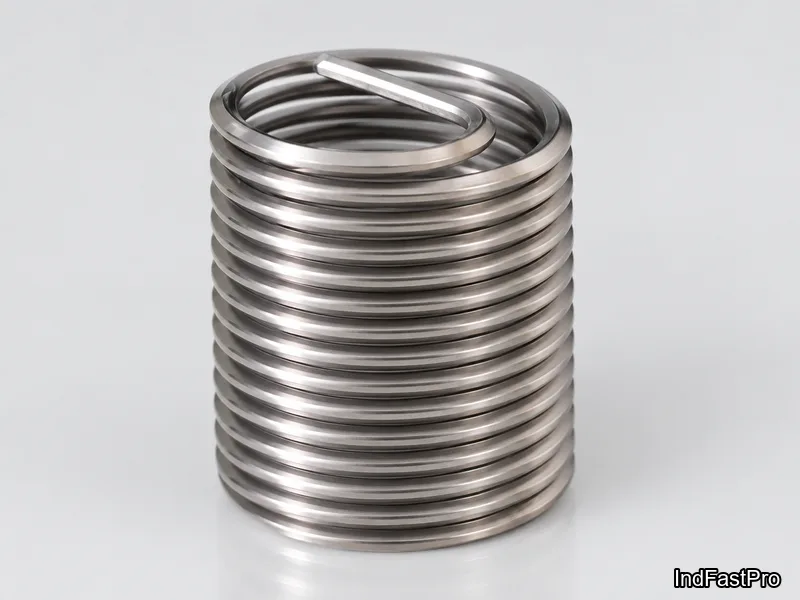
Specifications
Heavy-duty self-tapping inserts are the upsized branch of the self-tapping family, used where the connection requires higher pull-out strength, better torque resistance or a stronger wall structure. The collected sources position them for machine frames, fixture plates, actuator supports, repair points and medium-duty brackets, and describe the design intent as external geometry with a larger engagement area for higher resistance to loads acting on the installed insert. Both sources carry the same engineering caution, and this page keeps it: the insert may be stronger, but the surrounding material must be strong enough to support the load — a heavy-duty insert installed into weak or thin material does not automatically create a heavy-duty joint. Pull-out resistance and torque-out performance are matched by hole diameter and sufficient surrounding material, not by the insert alone.
| Construction | Self-tapping insert branch with external geometry and larger engagement area, for higher resistance to loads on the installed insert |
|---|---|
| Performance intent | Higher pull-out strength, better torque resistance, stronger wall structure than standard self-tapping inserts (collected guide) |
| Typical applications | Machine frames, fixture plates, actuator supports, repair points, medium-duty brackets, assemblies under higher fastening loads or repeated service |
| Parent-material caveat | A heavy-duty insert installed into weak or thin material does not automatically create a heavy-duty joint — parent strength, thickness and condition govern pull-out and torque-out (collected guide, verbatim basis) |
| Selection requirement | Matched hole diameter and sufficient surrounding wall; performance terms should be evaluated under representative conditions, not assumed from the insert designation |
| MOQ / lead time | Not owner-confirmed for this family — confirmed at quotation |
Materials
- Stainless steel
- Carbon steel
- Brass (material per collected guide; confirm required insert material on the RFQ)
Ordering & documentation
Documents
Shipments of Heavy-Duty Self-Tapping Inserts are backed by Mill Test Certificate (MTC), Dimensional Report, Salt Spray Test Report on request, with full batch traceability from raw material to finished product. Quality management for Heavy-Duty Self-Tapping Inserts orders follows the owner-confirmed compliance list: ISO 9001:2015, RoHS, REACH. Exact document sets are confirmed on the order.
Quotation
- The product family (Heavy-Duty Self-Tapping Inserts), product standard/designation and drawing or part number.
- The dimensions that apply to this part — such as size, pitch, length, thickness, fit, grip or groove geometry.
- Material/grade, heat-treatment condition and surface finish, together with the service environment.
- Quantity per size, delivery destination and required test or traceability documents.
Sample & supply
Minimum order quantities and lead times for heavy-duty self-tapping inserts are confirmed at quotation — send insert type, thread size and installation method on the RFQ and the quote will carry a firm schedule; sample availability is confirmed with the quotation.
Storage & shipping
Heavy-Duty Self-Tapping Inserts are packed for export and shipped factory-direct to buyers in Europe, Asia, the Americas and the Middle East. Store heavy-duty self-tapping inserts dry and protected until installation, and keep coated parts in their packaging until use; specific packing and preservation requirements can be stated on the order and confirmed at quotation.
Frequently asked questions
Does a heavy-duty insert make a thin aluminum cover a heavy-duty joint?
No — the collected guide states it directly: the surrounding material must also be strong enough to support the load, and a heavy-duty insert in weak or thin material will not automatically create a heavy-duty joint. Size the boss wall and hole per the insert specification, and validate pull-out/torque-out under representative conditions for load-bearing cases.
When do I step up from standard self-tapping inserts?
When the joint needs higher pull-out strength, better torque resistance or a stronger wall structure than the standard design provides — machine frames, actuator supports and repeated-service brackets are the collected sources' examples. The standard self-tapping page carries the M3–M12 installation reference table.
What should an RFQ for heavy-duty inserts state?
State the insert type, internal thread size, parent material with wall thickness around the hole, expected load direction (pull-out vs torque), and service cycle. Commercial terms are confirmed at quotation.
Request a Quote
Get factory-direct pricing from the manufacturer.
What to include in your Heavy-Duty Self-Tapping Inserts inquiry
- ✓ Identify insert type (helical/tangless, solid, self-tapping, key-locking, heat-set or rivet nut) and internal thread.
- ✓ Give insert length, parent-material type/hardness, available wall thickness and hole dimensions.
- ✓ State installation method and tooling, including tapping or prepared-hole requirements.
- ✓ Describe required pull-out/torque-out resistance, anti-rotation or locking needs and service environment.
- ✓ Factory-direct pricing for your Heavy-Duty Self-Tapping Inserts
- ✓ Standard and custom specifications
- ✓ Factory-direct export to buyers in Europe, Asia, the Americas and the Middle East
- ✓ Full fastener family support