
Threaded Inserts
Mechanical fastening components installed into a prepared hole to provide strong, reusable internal threads in soft, thin, or frequently serviced base materials. Self-tapping variants cut or form their own thread in the receiving hole, reducing or eliminating the need to pre-tap.
Last updated: 2026-11
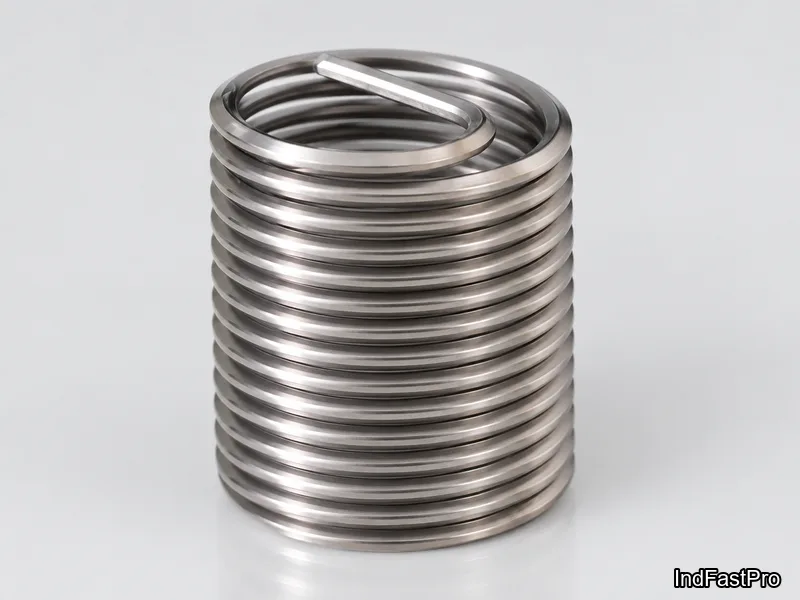
Specifications
Industry-standard reference ranges — availability confirmed per quotation; not a stocked-range claim.
| thread | M3, M4, M5, M6 | M8 or larger |
|---|---|
| installation method | Press-fit, self-tapping, heat-set, ultrasonic, moulded-in or other suitable process |
| base materials | aluminum, soft metals, engineering plastics | cast or low-ductility materials |
Reference notes (collected source statements, not supply-scope values):
- size range:: inserts with the same M6 internal thread may differ in outside diameter, length, cutting features, installation torque limits, and pull-out performance
Materials
- brass heat-set inserts
- stainless steel, carbon steel, brass, and other engineering materials
Selection guidance
Threaded inserts are chosen by the parent material and the installation process first, then by thread size. Each type below carries its own collected-source evidence.
Pick by parent material, then by binding constraint
The collected guide's material rule governs first: the insert must work with the parent material — brass heat-set inserts are the default for plastics and 3D prints, wire and self-tapping inserts reinforce aluminum and soft metals, and stainless earns its premium in humid, outdoor, laboratory or food-related service. Then the joint constraint picks the type: stripped-thread repair with the screw size preserved points to wire (STI-tapped hole) or key-locking inserts; skipping the tapping operation points to self-tapping; anti-rotation under torque and vibration points to key-locking keys driven into the parent; higher pull-out and torque resistance within the self-tapping branch points to the heavy-duty variant.
For sheet metal, expansion rivet nuts install from one side and plastically deform for a tight fit — the collected source scopes them to height-restricted joints and low-torque fastening with moderate connection strength. Their size mapping runs M2.5–M12 by duty (M2.5–M4 compact electronics and covers, M5–M6 general automation brackets, M8–M12 machine bases and heavy fixtures), and the collected installation table carries per-size pilot-hole diameter, depth and torque notes as engineering starting points — the product drawing governs production use.
Keep the bolt as the fuse: engagement and stripping in soft bases
A threaded joint should be sized so the bolt breaks before the threads strip — stripped flanks deform gradually and give little warning, while bolt fracture is sudden and easy to detect. Two family-level rules serve that. Engagement: at least 1.0× nominal diameter for steel nuts, but 1.5× or more when the tapped material is aluminium, cast iron or another softer metal — the 1.0× shortcut only holds for steel-in-steel, and the first one to two engaged threads already carry roughly 35–50% of the axial load. Pairing: the nut (or tapped member) must be stronger than the bolt is the design intent — upgrading the bolt alone, without upgrading the nut or the engagement, moves the failure mode from bolt tension to stripping.
Soft bases also lose clamp after tightening. Embedding — the plastic flattening of surface roughness under the nut face and in the threads — bleeds preload in aluminium and even more in plastics, which creep under sustained stress. Countermeasures scale with the risk: wide hardened washers or flange heads spread the bearing load into aluminium or magnesium; plastic and composite bosses call for a steel compression limiter or, where the base cannot carry the thread at all, the inserts in this family remain the stronger remedy. The full stripping calculations and pairing table are in the soft-base-metal knowledge guide under Related knowledge.
Self-clinching has hard entry limits: parent hardness, sheet thickness, press force
A self-clinching insert works by displacing parent metal into a depleted groove, and that mechanism sets three hard entry limits from the collected data sheet. Parent hardness: the 300-series stainless CFE series is rated for parent materials of Rockwell B-70 or less — harder sheet cannot be displaced, and no amount of press force fixes that. Sheet thickness: every thread size carries a minimum per series, and the values are not negotiable downwards — the collected table lists 1.0 mm minimum for the thin CFEO/CFEOX series at M3–M5 versus 1.5 mm for the CFE/CFEX series, and 1.5 mm at M6. Press force: installation is a press operation with published per-size forces (6.7 kN at M3, 11.1 kN at M4, 12 kN at M5, 15.6 kN at M6 in cold-rolled steel) — a shop without access to that press capacity cannot install the insert at all, which is a real supply-chain constraint, not a catalog footnote.
The same entry limits define the selection boundary against the other types on this page: where the parent is harder than the rating, or the sheet is below the minimum, the press-in mechanism is simply unavailable and the choice collapses to screw-in or wire inserts tapped into the parent — or a redesign of the boss. Specifying by thread size alone skips exactly this gate.
Torque-out and push-out are two different properties — verify the one your joint loads
The collected performance data tabulates them as separate columns because they are separate failure modes: torque-out is the rotation moment that spins the insert out of its clinch (your failure mode when a fastener is over-tightened into the insert), push-out is the axial force that pushes it back out of the sheet (your failure mode under through-bolt load or end pressure). A joint that only sees axial load can run with modest torque-out, and a blind bolt hole that never sees side load does not need high push-out — but a joint loaded in both directions must clear both numbers, and the two are not interchangeable.
The parent material moves the two properties differently, which is why published steel values do not transfer: in the collected table, M4 at 1.5 mm sheet carries 1600 N push-out in cold-rolled steel but 1100 N in 5052-H34 aluminum — a 30% derate — while the torque-out column stays 5.3 N·m across both parents. The lesson is directional: verify push-out against YOUR parent material and thickness, because it derates with softer bases, and treat any quoted performance figure as bound to the material pair it was measured on. The full per-size table is confirmed from the collected sheet before quotation.
What this page cannot verify
Performance figures above come from one manufacturer's published data sheet for one stainless series and two parent materials (cold-rolled steel and 5052-H34 aluminum); they do not transfer to other insert alloys, other parent alloys or tempers, or other thicknesses than those tabulated. This page cannot verify: performance in YOUR parent material and sheet batch, vibration and impact service beyond what the locking-thread note covers, service temperature and galvanic pairing of the insert alloy with the parent, or the punch/press tooling condition your installation would use. Installation-force and performance values are engineering starting points — request the per-size row for your exact size, series and parent material, and first-article the installation before production.
Ordering & documentation
Documents
Shipments of Threaded Inserts are backed by Mill Test Certificate (MTC), Dimensional Report, Salt Spray Test Report on request, with full batch traceability from raw material to finished product. Quality management for this threaded inserts line follows the owner-confirmed compliance list: ISO 9001:2015, RoHS, REACH. Exact document sets are confirmed on the order.
Quotation
- Insert type (helical/tangless, solid, self-tapping, key-locking, heat-set or rivet nut) and internal thread.
- Insert length, parent-material type/hardness, available wall thickness and hole dimensions.
- Installation method and tooling, including tapping or prepared-hole requirements.
- Required pull-out/torque-out resistance, anti-rotation or locking needs and service environment.
Sample & supply
Minimum order quantities and lead times for threaded inserts are confirmed at quotation — send insert type, thread size and installation method on the RFQ and the quote will carry a firm schedule; sample availability is confirmed with the quotation.
Storage & shipping
Threaded Inserts are packed for export and shipped factory-direct to buyers in Europe, Asia, the Americas and the Middle East. Store these threaded inserts dry and protected until installation, and keep coated parts in their packaging until use; specific packing and preservation requirements can be stated on the order and confirmed at quotation.
Insert types
Each insert type uses a different installation method and base-material envelope. Match internal thread, insert length, parent material, prepared hole, installation tool and required pull-out/torque-out performance.
Choosing between insert systems? See the threaded insert type comparison — wire, self-tapping, key-locking and heat-set side by side.
- Wire Thread Inserts
- Tangless Wire Thread Inserts
- Self-Tapping Thread Inserts
- Heavy-Duty Self-Tapping Inserts
- Key-Locking Thread Inserts
- Heat-Set Threaded Inserts
- Stainless Steel Threaded Inserts
- Expansion Rivet Nuts
Engineering references
Dimension charts and technical reference tables for threaded inserts — engineering aids for selection and verification, not a statement of the orderable range. Supply availability is confirmed per quotation.
- ASME B18.29.1 Helicoil (STI) Tapped Hole Chart (Inch Series) — engineering reference
- Heli-Coil Insert Length Selection — by Parent-Material and Screw Strength (AS7245) — engineering reference
- Threaded Insert Drilling Depth (Metric Threads) — engineering reference
- Threaded Insert Drilling Depth (UNC Threads) — engineering reference
- Threaded Insert Drilling Depth (UNF Threads) — engineering reference
- Threaded Insert Fitted Height (Metric Threads) — engineering reference
- Threaded Insert Fitted Height (UNC Threads) — engineering reference
- Threaded Insert Fitted Height (UNF Threads) — engineering reference
- Threaded Insert Nominal Length (Metric Threads) — engineering reference
Frequently asked questions
How do I choose between the threaded-insert types?
Start from the parent material: brass heat-set inserts for thermoplastics and 3D prints; wire, self-tapping or key-locking inserts for aluminum, cast and steel. Then the constraint: preserving the screw size in a repair points to wire inserts (STI tap), skipping pre-tapping points to self-tapping, anti-rotation under vibration points to key-locking, and one-side installation into sheet metal points to expansion rivet nuts.
Do these inserts follow a DIN or ISO standard?
Most of the types in this family are designated by mechanism rather than a single standard number in our collected sources, and we do not print standard attributions we cannot evidence. Where a standard applies to your project, name it on the RFQ and we will confirm the equivalent series at quotation.
What is the MOQ and lead time for threaded inserts?
Commercial terms for this family are confirmed at quotation together with type, thread size, material and parent-material details — state the insert type, internal thread size and pitch, the material being installed into, the installation method available, and quantity per size on the RFQ.
Request a Quote
Get factory-direct pricing from the manufacturer.
What to include in your Threaded Inserts inquiry
- ✓ Identify insert type (helical/tangless, solid, self-tapping, key-locking, heat-set or rivet nut) and internal thread.
- ✓ Give insert length, parent-material type/hardness, available wall thickness and hole dimensions.
- ✓ State installation method and tooling, including tapping or prepared-hole requirements.
- ✓ Describe required pull-out/torque-out resistance, anti-rotation or locking needs and service environment.
- ✓ Factory-direct pricing for your Threaded Inserts
- ✓ Standard and custom specifications
- ✓ Factory-direct export to buyers in Europe, Asia, the Americas and the Middle East
- ✓ Full fastener family support