
Nuts
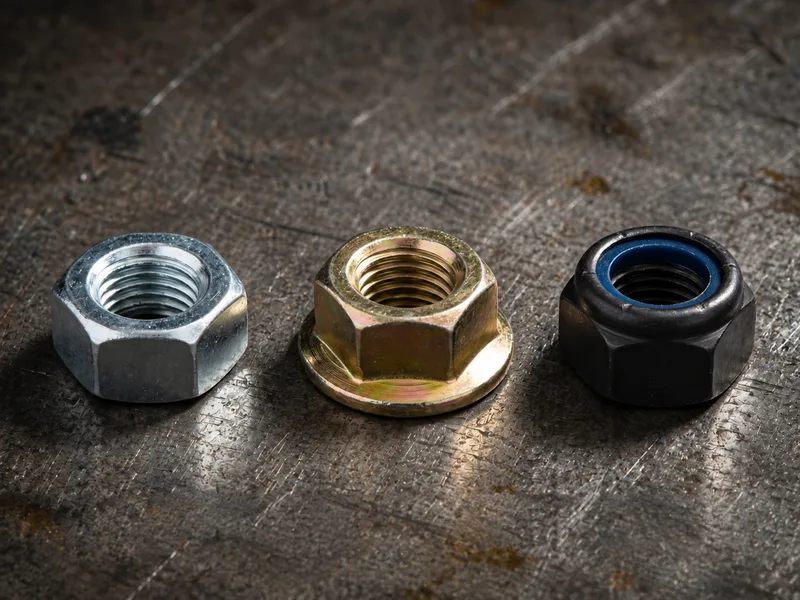
Metric and inch hex nuts, heavy hex nuts, flange nuts, jam nuts and locking nuts for bolted assemblies. Specify the thread, nut pattern, property class, mating-bolt grade, material and finish so the nut can be checked against the joint requirements.
Last updated: 2026-11
Specifications
Current supplyable range — owner-confirmed scope of supply; requirements outside this range are confirmed per quotation.
| diameter | Up to M36 / 1-1/2" (36 mm) |
|---|---|
| thread | Metric (M), UNC/UNF, BSW/BSF |
| strength grade | Grade 8 / 10 / 12 (ISO 898-2); A2 / A4 stainless (ISO 3506-2) |
| coating | Zinc plated (blue/yellow), Geomet, Dacromet, hot-dip galvanized |
| standard | DIN 934 / ISO 4032 (hex nuts); DIN 985 / ISO 10511 (nylon insert lock nuts); ASTM A563 / A194 |
| moq | 10000 pieces |
| lead time | 3-7 days (stock) |
| price from | USD 0.005-0.02/pc |
Engineering guidance
Two decisions decide most nut outcomes: whether the nut class actually develops the bolt it is paired with, and whether the joint keeps its preload in service. Each section below states the family-level rule from the collected sources; the class and pairing fields on the product pages carry the orderable range, and the full mechanisms live in the linked knowledge guides.
Which nut grade matches which bolt?
A nut's property class is a mechanical designation, not a material certificate: under ISO 898-2 the class number states the highest bolt class the nut can be fully loaded with — class 8 nuts for 8.8 bolts, class 10 for 10.9, class 12 for 12.9 — while stainless runs an entirely separate scheme (ISO 3506, steel group A2/A4 with property class 50/70/80). The pairing intent is deliberately asymmetric: the joint is meant to fail in the bolt, whose fracture is sudden and easy to detect, rather than in the nut threads, which deform gradually with little warning. That is why upgrading the bolt without re-checking the nut class is not a like-for-like substitution — it moves the failure mode from visible bolt fracture toward thread stripping, and a nut must never be class-matched by diameter alone.
Verification is where most deliveries are weaker than they look. A readable class marking on the bearing face is only a claim; correct width across flats and acceptable threads do not establish that the nut withstands the required proof load, and a certificate stating only that the part conforms to ISO 4033 does not automatically demonstrate the specified property class. The proof load test is an axial test under standardized conditions — it is not a tightening-torque test, and the proof load is not the recommended service preload. A usable purchase specification names the ISO 4033 edition, thread designation, property class, finish and applicable ISO 898-2 edition; a report listing proof load values for another thread size is a hold-the-lot discrepancy, and the lot must not be accepted on marking alone.
How does vibration loosen a nut, and which design resists it?
A nut that is adequately tight in a static joint can still come loose, because loosening under vibration is a preload problem rather than a strength failure. Under sustained lateral vibration the bolt and nut see side-to-side shear forces that erode the thread friction holding the preload — the Junker effect — and once clamping force drops below a critical threshold, back-off can be almost immediate. Resistance to self-loosening is measured, not assumed: a transverse vibration (Junker) test records the preload decay curve and lets the loosening behaviour of a nut design be assessed before it ships. Without a secondary locking mechanism, a standard hex nut is not appropriate for joints that see constant vibration from engines, hydraulic systems, road shock or rotating machinery; in static, low-vibration joints it performs reliably and stays the economical choice.
Locking designs differ in mechanism, so pick by the joint rather than by habit. A serrated flange nut acts as a one-way ratchet against the bearing surface and holds well in moderate to high vibration, at the cost of marring the seating on repeated disassembly; nylon-insert lock nuts add an independent friction element effective across a broad frequency range; lock nuts with an integrated flange give the strongest resistance to loosening where a fastener coming loose would create a safety hazard. Preload margin helps across every design: a higher-grade nut carries a higher proof load, which supports higher preload and better resistance to joint loosening — though none of these mechanisms recover preload that vibration has already removed.
Ordering & documentation
Documents
Shipments of Nuts are backed by Mill Test Certificate (MTC), Dimensional Report, Salt Spray Test Report on request, with full batch traceability from raw material to finished product. Quality management for this nuts line follows the owner-confirmed compliance list: ISO 9001:2015, RoHS, REACH. Exact document sets are confirmed on the order.
Quotation
- Nut standard, style and nominal thread size/pitch, including metric or inch thread series.
- Nut property class/material and the bolt class/material it must be paired with.
- Locking or prevailing-torque feature, coating and corrosion environment.
- Quantity per size, destination and any lot or mechanical-test documentation.
Sample & supply
Supply source for Nuts: own manufacturing plus qualified outsourcing (per the owner-confirmed scope of supply (own production plus outsourcing)).
Minimum order quantity for nuts is 10,000 pieces (applies to the standard sizes and finishes for nuts; mixed, special or custom variants are quoted — final commercial terms per quotation) Stock items for this family run 3–7 days. Quantities or variants outside the standard range are confirmed at quotation.
Storage & shipping
Nuts are packed for export and shipped factory-direct to buyers in Europe, Asia, the Americas and the Middle East. Store these nuts dry and protected until installation, and keep coated parts in their packaging until use; specific packing and preservation requirements can be stated on the order and confirmed at quotation.
Nut grades & types
Each nut standard or pattern has its own dimensions and proof-load/property-class requirements. Check compatibility with the bolt grade and the locking or bearing style before substitution.
Choosing between patterns? See the nut grade pairing comparison — lock, flange, jam and heavy hex nuts side by side.
- DIN 985 Nylon-Insert Lock Nuts
- DIN 980 All-Metal (Stover) Lock Nuts
- DIN 6923 Serrated Flange Nuts
- DIN 6924 Nylon-Insert Lock Nuts
- ASTM A194 Grade 2H Heavy Hex Nuts
- SAE Grade 5 Serrated Flange Nuts (Inch Series)
- DIN 934 Hex Nuts (ISO 4032)
- DIN 1587 Domed Cap Nuts
- ASME B18.2.2 Finished Hex Nuts
- KM01 Removable Security Nuts
- KM02 Permanent One-Way Security Nuts
- SO01 Shear Nuts (Security Breakaway Nuts)
- DIN 315 Wing Nuts
- DIN 439 Thin Hex Jam Nuts
- ASTM A194 Grade 8M Heavy Hex Nuts
- ASTM A194 Nut Grades — Overview and Selection
- ASTM A194 Grade 6 Heavy Hex Nuts
- ASTM A194 Grade 8 Heavy Hex Nuts
- ASTM A194 Grade 2HM Heavy Hex Nuts
- ASTM A194 Grade 4 Heavy Hex Nuts
- ASTM A194 Grade 7 Heavy Hex Nuts
- ASTM A194 Grade 7M Heavy Hex Nuts
- SB001 Socket Countersunk Barrel Nuts
- SB002 Slotted Raised Countersunk Barrel Nuts
- SB004 Low Profile Socket Barrel Nuts
- SB005 Domed Low Profile Barrel Nuts (No Drive)
- SB007 Socket Button Barrel Nuts
- SB008 Torx (6-Lobe TX) Mushroom Head Barrel Nuts
- SB010 Socket Cap Barrel Nuts
- SB08 Hex Head Barrel Nuts (Hex Sleeve Nuts)
- 2H06 Two-Hole (Pig Nose) Spanner Security Nuts
- 2H15 Angled Two-Hole Security Nuts
- 4H02 Four-Hole Security Nuts
- WA02 Security Scroll (Wave) Nuts
- WA06 Scroll Security Barrel Nuts & Sex Bolts
- 2H07 Pan Head Two-Hole Security Barrel Nuts & Sex Bolts
- 2H08 Countersunk Two-Hole Security Barrel Nuts & Sex Bolts
- ASME B18.2.2 Heavy Hex Nuts
- ASTM A563 Heavy Hex Nut Grades
- DIN 1804 Slotted Round Nuts (for Hook Spanner)
- DIN 935 Hex Slotted and Castle Nuts
- DIN 937 Hex Thin Slotted Nuts (Chamfered)
- NAS1291 Low-Height Self-Locking Hex Nuts
- MS21042 Self-Locking Jet Nuts (450 °F Steel)
- MS21043 Self-Locking Jet Nuts (800 °F A286)
- ASME B18.6.9 Wing Nuts — Type C, Style 1 (Inch)
- ASME B18.6.9 Wing Nuts — Type C, Style 3 (Inch)
- ASTM A194 Grade 7L Heavy Hex Nuts
- ISO 4032 Hex Regular Nuts (Style 1)
- ISO 4035 Hex Thin Nuts (Chamfered)
- DIN 6334 Hex Coupling Nuts (Long Hex Nuts)
- DIN 6926 Hex Flange Nuts (Heavy Type)
- DIN 6915 High-Strength Hex Nuts for Structural Bolting
- DIN 936 Hex Thin Nuts (Chamfered)
- DIN 557 Square Nuts
- DIN 929 Hex Weld Nuts
- DIN 508 T-Slot Nuts
- DIN 928 Square Weld Nuts
- DIN 582 Lifting Eye Nuts
- DIN 103 Trapezoidal Thread Hex Nut (Tr)
- DIN 103 Trapezoidal Thread Round Nut (Tr)
- DIN 1479 Hex Turnbuckle Nuts
- DIN 1624 Tee Nuts with Prongs
- DIN 431 Pipe Nuts (G Thread)
- DIN 466 Knurled Nuts — High Type
- DIN 467 Knurled Nuts — Low Type
- DIN 562 Square Thin Nuts
- DIN 917 Hex Cap Nuts — Low Type
- DIN 555 Hex Nuts (Product Grade C)
- ISO 8673 Hex Regular Nuts (Fine Pitch)
- DIN 979 Hex Thin Slotted and Castle Nuts
- DIN 982 Hex Thick Nuts with Non-Metallic Insert
- DIN 986 Hex Domed Cap Nuts with Non-Metallic Insert
- DIN 7967 Self-Locking Counter Nuts
- DIN 6927 Hex Nuts with Flange (Prevailing Torque, All-Metal)
- ASME B18.2.2 Hex Coupling Nuts (Inch Series)
- ASME B18.2.2 Hex Slotted (Castle) Nuts (Inch Series)
- ASME B18.2.2 Hex Flange Nuts (Inch Series)
- ASME B18.2.2 Square Nuts (Inch Series)
- ASME B18.6.9 Wing Nuts (Inch Series)
- Low Crown Acorn Nuts (Inch Series)
- Hex Thick Nuts (Inch Series)
- High Crown Acorn Nuts (Inch Series)
- DIN 981 Locknuts (KM Series, Bearing Mounting)
- DIN 977 Hexagon Weld Nuts with Flange
- DIN 1816 Round Nuts with Set-Pin Holes (Inside)
- ISO 299 Nuts for T-Slots
- ISO 7042 Prevailing Torque All-Metal Hex Nuts
- ISO 7035 Hexagon Slotted Castle Nuts
- ISO 4775 Hexagon Nuts with Large Widths Across Flats
- ISO 8675 Hex Nuts Low Form, Fine Pitch
- ASME B18.2.4.6M Heavy Hex Nuts (Metric)
- Standard T-Nuts (ASME B5.1M)
- ASME B18.2.6M Metric Heavy Hex Nuts for Structural Bolts (ASTM A563M)
- DIN 314 Wing Nuts, Edged Wings (American Form)
- DIN 546 Slotted Round Nuts
- DIN 6925 Self-Locking Nuts, All-Metal (Reduced Width Across Flats)
- ISO 2982 Rolling Bearing Lock Nuts
- ISO 7044 Prevailing Torque All-Metal Hexagon Nuts with Flange
Frequently asked questions
Are DIN 934 and ISO 4032 hex nuts the same part?
Both designations cover hex nuts and both are in the quoted range; the standards differ in dimensional details between editions, so the order should carry the designation your drawing uses. Nylon insert lock nuts are covered separately (DIN 985 / ISO 10511) — name the lock type explicitly if the joint needs one.
Which nut grade matches a class 8.8 bolt?
Nuts are matched to the bolt property class — the quoted range covers ISO 898-2 nut classes (8 / 10 / 12) and A2 / A4 stainless to ISO 3506-2, so a class 8 nut is quoted against a class 8.8 bolt assembly. Match the pairing your joint design specifies and confirm it on the RFQ; substituting a different class pairing is an engineering decision, not a price decision.
What is the MOQ and lead time for nuts?
The minimum order quantity is 10,000 pieces. Stock items ship in 3–7 days. Size range runs to M36 / 1-1/2", with metric and inch threads (M, UNC/UNF, BSW/BSF); non-stock sizes are confirmed at quotation.
Why does an adequately tightened nut still come loose in service?
Because thread friction — the thing the tightening delivered — is exactly what lateral vibration erodes. Once vibration drives the clamping force below a critical threshold, the nut can back off rapidly even though nothing was under-tightened at installation (the Junker effect). Resistance to self-loosening is quantified with a transverse vibration test that records the preload decay curve; for joints with constant vibration, spec a locking design (serrated flange or lock nut) instead of a plain hex nut.
Does the property class marking on a nut prove its strength?
No. The class number is a mechanical designation whose requirements must be read from ISO 898-2 for the specific nut configuration and thread size; dimensions, acceptable threads and a readable marking do not establish that the nut withstands the required proof load, and a certificate stating only conformity to ISO 4033 does not automatically demonstrate the class. The proof load is established by an axial test — it is not a tightening-torque test and not a service preload — so the purchase specification should name the edition, thread designation, property class, finish and ISO 898-2 edition, and a report quoting proof load for another thread size is a hold-the-lot discrepancy.
Will a stainless nut on a stainless bolt seize?
It can. Austenitic stainless grades such as 304 and 316 are the most frequent victims of thread galling — pressure-loaded sliding threads cold-weld until the joint cannot be turned — and the nut side of the pair is where it often starts. Two levers lower the risk: installation discipline (slow tightening speed, clean lubricated threads) and material pairing — a Nitronic 60 or duplex stainless steel nut against a 316 bolt significantly raises the threshold galling stress, the contact pressure below which relative sliding produces no adhesive weld.
Request a Quote
Get factory-direct pricing from the manufacturer.
What to include in your Nuts inquiry
- ✓ Name the nut standard, style and nominal thread size/pitch, including metric or inch thread series.
- ✓ State the nut property class or material and the bolt class/material it must be paired with.
- ✓ Specify locking or prevailing-torque feature, coating and corrosion environment.
- ✓ Give quantity per size, destination and any lot or mechanical-test documentation.
- ✓ Factory-direct pricing for your Nuts
- ✓ Standard and custom specifications
- ✓ Factory-direct export to buyers in Europe, Asia, the Americas and the Middle East
- ✓ Full fastener family support