
Wire Thread Inserts
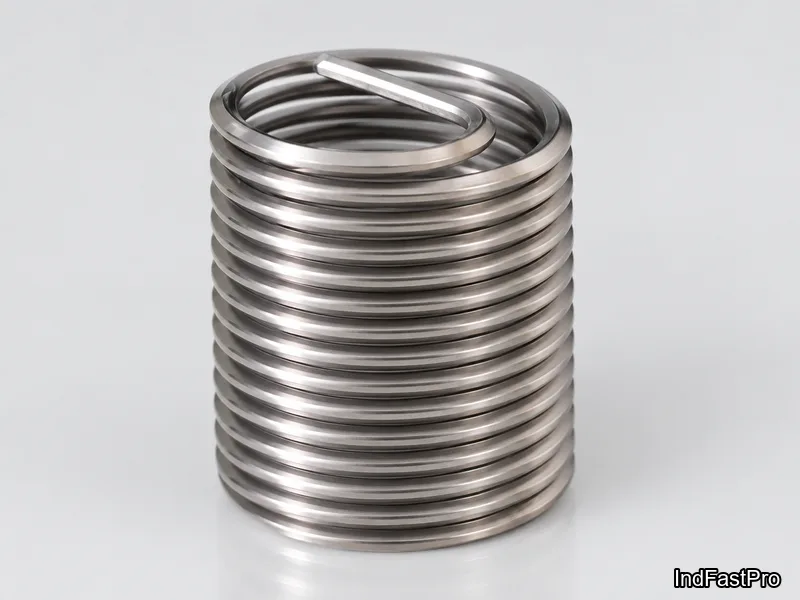
Helical wire thread inserts that create or repair internal threads in metal — installed into an STI-tapped receiving hole so the original screw size is retained, for stripped-thread repair and aluminum reinforcement.
Last updated: 2026-11
Specifications
Wire thread inserts — also called helical or coil thread inserts — are made from precision-formed wire wound into a helical shape. They create or repair internal threads in metal parts while preserving the nominal screw size: the receiving hole is drilled to the correct diameter and tapped with a special STI (Screw Thread Insert) tap, whose thread is larger than the final internal thread the screw will use. For a final M6 × 1.0 screw, the receiving thread is not a standard M6 × 1.0 tapped hole — it is an M6 × 1.0 STI thread; using a normal metric tap makes the installation fail, because the insert will not seat correctly and the final thread loses proper geometry and strength. The collected sources list their core uses as repairing stripped internal threads, reinforcing threads in aluminum and other soft metals, improving wear resistance in frequently assembled joints, and restoring damaged machine parts without replacing the component.
| Construction | Precision-formed wire wound into a helical shape; provides a new internal thread within the parent material while the original fastener size is retained |
|---|---|
| Receiving hole preparation | Drilled to the specified diameter, then tapped with an STI (Screw Thread Insert) tap — the STI thread is larger than the final internal thread; a standard tap of the nominal size will not seat the insert |
| Worked example | Final screw M6 × 1.0 → receiving hole prepared to STI dimensions (not a standard M6 × 1.0 tap); after installation the internal thread is the intended M6 × 1.0 for the mating screw |
| Primary applications | Stripped-thread repair; thread reinforcement in aluminum and other soft metals; wear resistance in frequently assembled joints; durable threads in lightweight housings, brackets and fixture plates |
| Parent-material engagement context | Wrought aluminum needs 2.0 × d minimum thread engagement (1.5–2.5 × d design range) per the collected engagement chart — the reinforcement case where helical inserts preserve the screw size while adding durable thread |
| MOQ / lead time | Not owner-confirmed for this family — confirmed at quotation |
Materials
- Stainless steel
- Carbon steel
- Brass (material per collected guide; confirm required insert material on the RFQ)
Ordering & documentation
Documents
Shipments of Wire Thread Inserts are backed by Mill Test Certificate (MTC), Dimensional Report, Salt Spray Test Report on request, with full batch traceability from raw material to finished product. Quality management for Wire Thread Inserts orders follows the owner-confirmed compliance list: ISO 9001:2015, RoHS, REACH. Exact document sets are confirmed on the order.
Quotation
- The product family (Wire Thread Inserts), product standard/designation and drawing or part number.
- The dimensions that apply to this part — such as size, pitch, length, thickness, fit, grip or groove geometry.
- Material/grade, heat-treatment condition and surface finish, together with the service environment.
- Quantity per size, delivery destination and required test or traceability documents.
Sample & supply
Minimum order quantities and lead times for wire thread inserts are confirmed at quotation — send insert type, thread size and installation method on the RFQ and the quote will carry a firm schedule; sample availability is confirmed with the quotation.
Storage & shipping
Wire Thread Inserts are packed for export and shipped factory-direct to buyers in Europe, Asia, the Americas and the Middle East. Store wire thread inserts dry and protected until installation, and keep coated parts in their packaging until use; specific packing and preservation requirements can be stated on the order and confirmed at quotation.
Frequently asked questions
Why can't I tap a normal M6 hole for an M6 wire thread insert?
The STI receiving thread is deliberately larger than the final thread so the coiled wire fits between it and the screw. The collected guide is explicit: a normal metric tap makes the installation fail — the insert will not seat correctly and the final thread will not have proper geometry or strength. State the insert type on the RFQ so hole preparation is quoted with the right STI tap.
When is a wire insert better than re-tapping the hole oversized?
When the nominal screw size must be preserved — repair of stripped threads without re-drilling the whole assembly to a larger size, and aluminum joints serviced repeatedly. The collected sources list wear resistance in frequently assembled joints and restoration of damaged machine parts without replacing the component as the core wire-insert uses.
What should an RFQ for wire thread inserts state?
State the insert type (wire/helical), nominal thread size and pitch, insert material, parent material (aluminum housings and cast parts are the typical cases), and whether the hole is through or blind. Commercial terms are confirmed at quotation.
Request a Quote
Get factory-direct pricing from the manufacturer.
What to include in your Wire Thread Inserts inquiry
- ✓ Identify insert type (helical/tangless, solid, self-tapping, key-locking, heat-set or rivet nut) and internal thread.
- ✓ Give insert length, parent-material type/hardness, available wall thickness and hole dimensions.
- ✓ State installation method and tooling, including tapping or prepared-hole requirements.
- ✓ Describe required pull-out/torque-out resistance, anti-rotation or locking needs and service environment.
- ✓ Factory-direct pricing for your Wire Thread Inserts
- ✓ Standard and custom specifications
- ✓ Factory-direct export to buyers in Europe, Asia, the Americas and the Middle East
- ✓ Full fastener family support