
Screws
Screws are externally threaded fasteners used to join materials, available in machine, driver, and metric styles with a range of head types, materials, and strength grades.
Last updated: 2026-11
Specifications
Current supplyable range — owner-confirmed scope of supply; requirements outside this range are confirmed per quotation.
| diameter | Up to M36 / 1-1/2" (36 mm) |
|---|---|
| length | Up to 300 mm |
| thread | Metric (M), UNC/UNF, BSW/BSF |
| coating | Zinc plated (blue/yellow), Geomet, Dacromet, hot-dip galvanized |
| moq | 10000 pieces |
| lead time | 3-7 days (stock) |
| head type | Hex socket cap, countersunk, button head; machine / self-tapping / set screws |
| drive type | Hex socket, Phillips, slotted, Torx, square |
| price from | USD 0.005-0.03/pc |
Materials
- steel
- stainless steel
- brass
- nylon
Engineering guidance
Four decisions cover most screw selections: which screw family matches the base material and joint, which head and drive the assembly tolerates, which material and case hardness survive the driving process, and where each type stops working. Each section below states the family-level rule; the mechanism-level treatment lives in the guides under Related knowledge, and the per-standard dimensions are on the designation pages under Available grades.
Screw families: where the thread does the work
Machine screws carry a uniform thread over the whole threaded length and are meant for a nut or a tapped hole; wood screws are the visual counterpoint — their threads taper toward the point, which is why the two are not interchangeable. Self-tapping screws cut or form their own mate in the base material, and the type letter is a thickness rating: Type A runs in thin sheet metal (roughly 0.015–0.050 in thick), while Type B — larger root diameter, finer pitch — covers the 0.050–0.200 in range plus non-ferrous castings and plastics. Thread-forming, thread-cutting and thread-rolling variants differ in whether they displace or remove material, and which chip clearing and tightening-torque behaviour follows; the self-tapping screw types guide under Related knowledge tabulates that split.
Self-drilling screws (TEK-pattern) add the drilling step: a drill-bit point with flutes drills, taps and fastens in one operation with no pilot hole. The TEK number is a point-length rating matched to metal thickness — the common 25-to-16-gauge sheet runs a TEK 3, 14 gauge and thicker needs TEK 4–5, and the longest points are the ones used on structural steel. Wood screws and the family selection logic by base material are compared in the screw family selection guide under Related knowledge.
Head style and drive: appearance, clearance, flushness
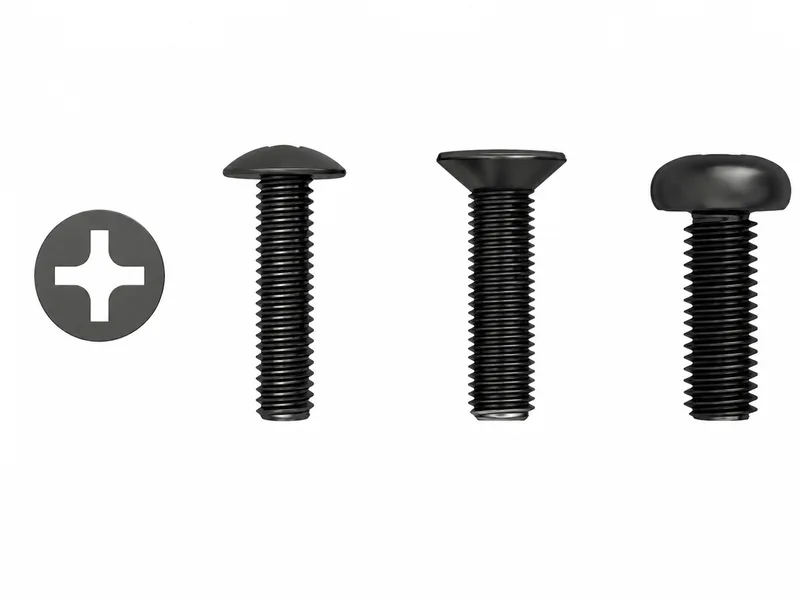
Head choice is set by the finished surface the assembly needs. Round and pan heads stand proud of the surface and leave room for a washer under them; flat countersunk heads sit flush for a snag-free fit where the assembled part meets another surface. Countersinking also costs head height, so a flush head trades clamping bearing area for profile — where both matter, the hex-vs-socket-head comparison under Related knowledge shows the trade-off on a real joint.
Drive choice follows the assembly tooling and the torque the joint sees: slotted and Phillips remain the two most common machine-screw drives, with Torx and hex socket available where higher torque transmission matters and the RFQ names the tooling. If you are matching an existing assembly, name the drive you have; if you are designing new, name the drive on the inquiry so the quote confirms head style and tooling together.
Materials and case hardness
Machine screws span the widest material range of the family — steel, stainless steel, brass and nylon are all standard — because the joint, not the driving process, picks the strength. Tapping and self-drilling screws are the opposite: the point has to stay harder than the base material it drives into, so they are case-hardened carbon steel (surface hardness Rockwell C45 minimum with a C28–38 tempered core; self-drilling points harder still at C52–58 surface and C32–40 core) or 410 stainless, which heat-treats to about Rockwell C40 while keeping corrosion resistance.
This hardness split drives the coating decision: hardened tapping and self-drilling screws carry the hydrogen-embrittlement constraints of any electroplated hardened part, so zinc-flake and mechanical-deposition systems are preferred at the high-hardness end. The coating systems and their selection logic are the surface finishes family, one level up from this page.
Operating limits and thread matching
Two limits end most misapplications. First, machine-screw threads must match the pre-tapped hole exactly — diameter and pitch together — because the mating hole is typically tapped for one specific size and thread type, so a thread "close enough" is not quotable. Second, self-drilling screws are a metal-to-metal fastener: the drill point cuts a hole nearly the size of the screw's threaded portion, which gives the threads nothing to bite in wood — wood-to-metal work needs a reamer-style (winged) screw or a separate pilot, and the sheet-thickness windows in the first section bound how far each tapping type can reach.
Within those limits the supply range runs to M36 / 1-1/2" diameter and 300 mm length across metric and inch threads; sizes, drives or head combinations outside the standard list are confirmed at quotation rather than assumed.
How do you verify what a screw quote claims?
A hardness figure on a quotation or a listing — the Rockwell C45 minimum surface with a C28–38 core window for tapping screws, the C52–58 surface for self-drilling points — is a claim about a heat lot, and only a Rockwell test on a prepared cross-section verifies it. A certificate that does not name the test method, the scale and the sampled lot has not verified anything; treat it as an assertion and ask which lot was tested. Surface hardness alone also cannot tell you how the part will perform under load: case hardening raises the surface without moving the core, so two screws with nearly identical surface readings can fail very differently in torque-to-failure testing — when the joint is critical, the hardness check must be complemented with mechanical testing rather than trusted on its own.
A tightening torque is not a property of the screw alone — it is a joint measurement. ISO 16047 specifies the conditions for torque/clamp-force tests on threaded fasteners (metric M3–M39 in the steel grades covered by ISO 898-1 and 898-2), and unless the quoted value was measured on your thread size, your coating and your lubrication state, it does not transfer: friction on coated, lubricated or worn threads differs from uncoated steel, so the same wrench reading fails to deliver the same preload. Verify torque claims against the actual size-and-coating combination or order first-article testing; never assume a published table carries over beyond the conditions it was measured on.
Stainless A2/A4 screws fail differently — not by breaking but by seizing. Thread galling, a cold-welding action between pressure-loaded sliding threads, strikes stainless steel most often (especially against lock nuts), along with aluminum and titanium; once a fastener has seized it is typically impossible to remove without cutting the bolt or splitting the nut. The countermeasures are installation-side: slow the tightening speed (power tools build heat fast, and heat drives galling), keep threads clean and lubricated or coated, and stop immediately if a fastener binds before final tightening — back it off, let the heat dissipate, inspect the threads, and never reuse a part that shows galling damage. A galled screw must be replaced, not reworked.
Drive-in limits are the other place where quotes and reality part ways. A tapping screw driven into sheet thinner than its type window cannot build full thread engagement: too little material and the formed threads strip out under load — the joint fails by shear in the base metal rather than by breaking the screw, and there is no rework short of moving up a thickness class or healing the hole. Over-torque does the same damage from the other side, deforming the formed threads until they cannot carry clamp; torque-controlled drivers, not operator feel, are the only repeatable protection. Beyond the published thickness windows the driving process itself becomes the failure point, and no coating or grade choice repairs that — the fix is the correct screw type for the thickness, period.
This page states family-level ranges drawn from published manufacturer and standards references; it cannot verify the heat-lot hardness of a specific shipment, the torque behaviour of your joint, or the fit of a specific tapped hole. Those are order-time verifications: lot certificates, first-article inspection against your drawing, and joint-specific testing. Outside its verifiable statements the page routes you to the quotation, where the confirmations are made against the actual production lot.
Ordering & documentation
Documents
Shipments of Screws are backed by Mill Test Certificate (MTC), Dimensional Report, Salt Spray Test Report on request, with full batch traceability from raw material to finished product. Quality management for this screws line follows the owner-confirmed compliance list: ISO 9001:2015, RoHS, REACH. Exact document sets are confirmed on the order.
Quotation
- Screw type and standard, head style and drive recess.
- Nominal diameter, thread pitch, length and engagement/hole details where relevant.
- Material/property class, substrate material and thickness, and required coating or finish.
- Installation, locking or removal requirements, quantity and destination.
Sample & supply
Minimum order quantity for screws is 10,000 pieces (applies to the standard sizes and finishes for screws; mixed, special or custom variants are quoted — final commercial terms per quotation) Stock items for this family run 3–7 days. Quantities or variants outside the standard range are confirmed at quotation.
Storage & shipping
Screws are packed for export and shipped factory-direct to buyers in Europe, Asia, the Americas and the Middle East. Store these screws dry and protected until installation, and keep coated parts in their packaging until use; specific packing and preservation requirements can be stated on the order and confirmed at quotation.
Screw types & standards
Each linked screw type or standard has its own dimensions and use limits. Match head/drive, thread, substrate thickness, material condition and installation method to the specific application.
- DIN 912 Socket Head Cap Screws
- ISO 4762 Socket Head Cap Screws
- DIN 913 Socket Set Screws (Flat Point)
- DIN 7991 Countersunk Socket Head Cap Screws
- DIN 916 Socket Set Screws (Cup Point)
- DIN 7985 Cross Recessed Pan Head Screws
- DIN 914 Socket Set Screws (Cone Point)
- DIN 915 Socket Set Screws (Full Dog Point)
- DIN 7981 Pan Head Tapping Screws (ISO 7049)
- DIN 7982 Countersunk Tapping Screws (ISO 7050)
- DIN 7983 Raised Countersunk Tapping Screws (ISO 7051)
- DIN 963 Slotted Countersunk Machine Screws
- DIN 967 Cross Recessed Pan Head Screws with Collar
- DIN 965 Cross Recessed Countersunk Machine Screws
- DIN 964 Slotted Raised Countersunk Machine Screws
- DIN 966 Cross Recessed Raised Countersunk Machine Screws
- ASME B18.6.3 UNC Slotted Round Head Machine Screws
- ASME B18.6.3 UNC Slotted Pan Head Machine Screws
- ASME B18.6.3 UNC Slotted 82° Flat Countersunk Machine Screws
- ASME B18.6.3 UNC Cross Recessed Flat Countersunk Machine Screws
- ASME B18.6.3 UNC Cross Recessed Pan Head Machine Screws
- ASME B18.6.3 UNC Cross Recessed Fillister Head Machine Screws
- ASME B18.6.3 UNC Cross Recessed Truss Head Machine Screws
- DIN 7500 Trilobular Thread Rolling Screws
- DIN 7500 CE Pan Head Thread Forming Screws
- DIN 7500 ME Flat Countersunk Head Thread Forming Screws
- DIN 7500 D Hex Washer Head Thread Rolling Screws
- Type PT-Alternative Pan Phillips Thread Forming Screws
- Type PT-Alternative Pan TORX Thread Forming Screws
- ASME B18.6.3 Square Recessed Pan Head Machine Screws
- ASME B18.6.3 Square Recessed Flat Countersunk Head Machine Screws
- ASME B18.6.3 Combination Slotted & Square Recessed Pan Head Machine Screws
- ASME B18.6.3 Combination Slotted & Square Recessed Truss Head Machine Screws
- TX01 6-Lobe Pin TX Button Head Security Machine Screws
- TX02 6-Lobe Pin TX Countersunk Head Security Machine Screws
- TX04 6-Lobe Pin TX Self Tapping Security Screws
- TX05 6-Lobe Pin TX Countersunk Self Tapping Security Screws
- TX06 6-Lobe Pin TX Button Head Self Drill Security Screws
- TX07 6-Lobe Pin TX Countersunk Self Drill Security Screws
- TX08 6-Lobe Pin TX Pan Head Self Drill Security Screws
- TX20 6-Lobe Pin TX Pan Head Thread Forming Security Screws
- CL01 Clutch Head One Way Round Security Machine Screws
- CL02 Clutch Head Raised Countersunk Security Screws
- CL03 Clutch Head Round Self Tapping Security Screws
- CL04 Clutch Head Countersunk Self Tapping Security Screws
- CL05 Clutch Head Round Security Self Drilling Screws
- CL06 Clutch Head Countersunk Security Wood Screws
- 2H01 Two Hole Pan Pig Nose Security Machine Screws
- 2H02 Two Hole Countersunk Security Machine Screws
- 2H03 Two Hole Raised Countersunk Security Machine Screws
- 2H04 Two Hole Pan Self Tapping Security Screws
- 2H05 Two Hole Countersunk Self Tapping Security Screws
- 2H12 Two Hole Mush Head Security Machine Screws
- 2H13 Two Hole Raised Countersunk Self Tapping Security Screws
- 2H14 Two Hole Truss Head Self Tapping Security Screws
- TX09 5-Lobe Pin Button Security Machine Screws
- TX10 5-Lobe Pin TX Button Self Tapping Security Screws
- TX11 5-Lobe Pin TX CSK Self Tapping Security Screws
- TX22 7-Lobe Pin Button Security Machine Screws
- TX24 5-Lobe Pin TX Countersunk Security Machine Screws
- CP22 5-Lobe Pin TX Button Head Captive Screws
- CP23 5-Lobe Pin TX Countersunk Head Captive Screws
- TX25 6-Lobe Pin Torx Pan Security Wood Screw
- TX26 Security Pin TX Drive Cap Screw
- TX28 6-Lobe Pin TX Security Grub Screw — Cup Point
- TX29 Pin TX Button Flange Security Screws (ISO 7380-2 with Pin)
- TX30 6-Lobe Pin TX Pan Thread Forming Security Screw — Type B
- TX31 6-Lobe Pin TX Countersunk Thread Forming Security Screw
- TX32 6-Lobe Pin TX Security Grub Screw — Flat Point
- TX33 6-Lobe Pin TX Security Grub Screw — Dog Point
- TX34 6-Lobe Pin TX Security Grub Screw — Cone Point
- DIN 7513 Slotted Oval Head Thread Cutting Screws (Form GE)
- DIN 7516 Cross Recessed Countersunk Head Thread Cutting Screws (Form DE)
- DIN 7504-N Self-Drilling Screws (Pan Head, Phillips Recess)
- DIN 7504-K Self-Drilling Screws (Hexagon Head with Serration)
- DIN 7504-P Self-Drilling Screws (Countersunk Head, Phillips Recess)
- DIN 7504-M Self-Drilling Screws (Pan Head, Square Recess)
- TEKS/2 Self-Drilling Screws (Light Gauge Metals Point Class)
- TEKS/3 Self-Drilling Screws (Medium Gauge Metals Point Class)
- TEKS/4 Self-Drilling Screws (Heavier Gauge Metals Point Class)
- Special TEKS/2 Self-Drilling Screws (Heavier Gauge Long-Point Class)
- Stitch TEK Self-Drilling Screws (Sheet-to-Sheet Stitching)
- Plymetal TEK Self-Drilling Screws (Plywood-to-Metal)
- Plymetal TEK with Wings Self-Drilling Screws (Winged Board-to-Metal)
- Drywall TEK Self-Drilling Screws (Gypsum-to-Metal)
- Gypsum TEK Self-Drilling Screws (Heavy Gypsum to Steel)
- Ultra-Drive Button Head Security Machine Screws (UL01)
- Ultra-Drive Countersunk Security Machine Screws (UL02)
- Ultra-Drive Button Head Security Self Tapping Screws (UL03)
- Ultra-Drive Countersunk Security Self Tapping Screws (UL04)
- DIN 571 Hex Head Wood Screws (Lag Screws)
- DIN 97 Slotted Countersunk Head Wood Screws
- DIN 95 Slotted Raised Countersunk Head Wood Screws
- DIN 96 Slotted Round Head Wood Screws
- ISO 7380-1 Hexagon Socket Button Head Screws
- DIN 7984 Hexagon Socket Head Cap Screws with Low Head
- DIN 6912 Hexagon Socket Head Cap Screws, Low Head with Collar
- DIN 84 Slotted Cheese Head Screws
- ISO 4026 Flat Point Hex Socket Set Screws
- ISO 4027 Cone Point Hex Socket Set Screws
- ISO 4028 Dog Point Hex Socket Set Screws
- ISO 4029 Cup Point Hex Socket Set Screws
- ISO 7379 Hex Socket Head Shoulder Screws
- ASME B18.3 Hex Socket Head Shoulder Screws (Inch Series)
- DIN 927 Slotted Shoulder Screws
- ASME B18.3 Cup Point Set Screws (Inch Series)
- ISO 14583 Hexalobular Socket Pan Head Screws
- ISO 7380-2 Flanged Hex Socket Button Head Screws
- DIN 85 Slotted Pan Head Screws
- ISO 7045 Pan Head Screws with Cross Recess (H or Z)
- ISO 14581 Hexalobular Socket Countersunk Head Screws
- DIN 404 Slotted Capstan Screws
- DIN 417 Slotted Set Screws with Long Dog Point
- DIN 438 Slotted Set Screws with Cup Point
- DIN 551 Slotted Grub Screws with Flat Point
- DIN 553 Slotted Grub Screws with Cone Point
- ISO 1207 Slotted Cheese Head Screws
- ISO 14580 Hexalobular Socket Cheese Head Screws
- DIN 464 Knurled Thumb Screws
- DIN 653 Knurled Thumb Screws, Low Type
- DIN 316 Wing Screws with Rounded Wings
- DIN 427 Slotted Head Screws with Shank
- DIN 920 Slotted Pan Head Screws
- DIN 921 Slotted Pan Head Screws with Large Head
- DIN 923 Slotted Pan Head Screws
- DIN 15237 Seating Screws
- ISO 2009 Slotted Countersunk Flat Head Screws
- ISO 7046-1 Countersunk Flat Head Screws (H / Z Cross Recess)
- ISO 7047 Raised Countersunk Head Screws (H / Z Cross Recess)
- ISO 10642 Hex Socket Countersunk Head Cap Screws
- DIN 906 Hexagon Socket Pipe Plugs (Taper Thread)
- DIN 908 Hexagon Socket Screw Plugs (Cylindrical Thread)
- ANSI B18.3 Hex Socket Head Shoulder Screws
- ANSI B18.3 Hex Socket Set Screws, Cup Point
- ANSI B18.3 Hex Socket Set Screws, Flat Point
- ANSI B18.3 Hex Socket Set Screws, Dog Point
- ANSI B18.3 Hex Socket Set Screws, Cone Point
- ANSI B18.3 Button Socket Head Cap Screws
- ANSI B18.3 Flat Socket Head Cap Screws
- ISO 7046-2 Cross-Recessed Countersunk Flat Head Screws
- ISO 8676 Hex Head Screws (Fine Pitch, Fully Threaded)
- DIN 910 Hex Head Screw Plugs (Heavy Type, Cylindrical Thread)
- ISO 12474 Hex Socket Head Cap Screws (Fine Pitch)
- DIN 7500C Cross Recessed Pan Head Thread Rolling Screws
- DIN 7500M Cross Recessed Countersunk Head Thread Rolling Screws
- ASME/ANSI B16.14 Hexagon Socket Pipe Plugs
- ASME B18.11 Slotted Head Miniature Screws — Fillister / Pan / Flat Head Dimensions (30 UNM – 140 UNM)
- ISO 1478 Self-Tapping Screw Threads (ST) — Thread and Point Dimensions, ST 1.5 – ST 9.5 (mm)
- Socket Head Cap Screw Dimensions — ASME B18.3 Inch Ladder (#0 to 1-1/2) with Mechanical Properties
- Low Head Socket Cap Screw Dimensions — ASME B18.3 Inch Ladder (#8 to 1/2, Alloy)
- Spline Socket Keys (Inch Sizes) — Companion Drive Tool
- #0000 / #000 / #00 Miniature Machine Screw Threads
- DIN 465 Knurled Thumb Screws
- ISO 14579 Hexalobular Pan Head Screws
- ISO 14582 Hexalobular Countersunk High Head Screws
- ISO 14587 Hexalobular Raised Countersunk Tapping Screws
- ISO 1580 Slotted Pan Head Screws
- ISO 2010 Slotted Raised Countersunk Head Screws
- ISO 1479 Hexagon Head Tapping Screws
- ISO 1481 Slotted Pan Head Tapping Screws
- ISO 1482 Slotted Countersunk Head Tapping Screws
- ISO 1483 Slotted Raised Countersunk Head Tapping Screws
- ISO 7049 Cross Recessed Pan Head Tapping Screws (Types H and Z, Form C)
- ISO 7050 Cross Recessed Countersunk Head Tapping Screws (Form C)
- ISO 7051 Countersunk (Flat) Head Tapping Screws with Cross Recess (Form C)
- ISO 14584 Hexalobular Socket Raised Countersunk Head Screws
- ISO 14585 Hexalobular Pan Head Tapping Screws
- ISO 14586 Hexalobular Countersunk Head Tapping Screws
- ISO 15071 Hexalobular Socket Raised Countersunk Tapping Screws
- ISO 15480 Thread Forming Screws for Metric ISO Threads
- ISO 21269 Hexagon Socket Head Cap Screws, Fine Pitch
- ISO 4766 Slotted Set Screws, Flat Point
- ISO 7048 Cross-Recessed Cheese Head Screws
- ISO 7436 Slotted Set Screws, Cup Point
- ISO 7434 Slotted Set Screws, Cone Point
- ISO 7435 Slotted Set Screws, Long Cone Point
- ANSI/ASME B18.6.2 Square Head Set Screws, Inch Series
- DIN 6885 Parallel Keys — Deep Pattern
- DIN 6888 Woodruff Keys
- DIN 6911 Hexagon Socket Screw Keys with Pilot
- Legacy BS 3692 / BS 4320 Hexagon Bolts, Nuts and Washers
- DIN 193 Specifications
- DIN 196 Specifications
- ASME B18.6.7M Hex Head Machine Screws (Metric)
- ASME B18.6.3 Micro Machine Screws (Cross-Recess and Slotted)
- ANSI Hex Lag Screws — Thread, Head and Lead-Hole Tables
- AS/NZS 2465 Hexagon Screws (UNC and UNF Threads)
- BS 1083 Precision Hexagon Screws, Washer Faced (BSW and BSF Threads)
- BS 4190 Table 11 — ISO Metric Hexagon Head Screws, Faced Under Head Only
- BS 916 Hexagon Head Screws with B.S. Threads (1953, Table 1)
- DIN 34827 Hexalobular Socket Set Screws
- IS 1364 Part 2 Hexagon Head Screws (M1.6-M64)
- Woodruff Key Sizes (Inch Series)
- DIN 922 Slotted Pan Head Screws with Small Head and Full Dog Point
- ANSI/ASME B18.6.1 Wood Screws (Inch Series)
- ASME B18.6.3 Slotted Hex Head Machine Screws (Inch Series)
- DIN 318 Wing Screws, Edged Wings (American Form)
- DIN 561 Set Screws, Small Hexagon, Full Dog Point
- DIN 564 Set Screws, Half Dog Point and Flat Cone Point
- DIN 7971 Tapping Screws, Slotted Pan Head
- DIN 7972 Tapping Screws, Countersunk Slotted Flat Head
- DIN 7976 Tapping Screws, Hexagon Head
- DIN 968 Tapping Screws, Cross Recessed Pan Head with Collar
- DIN 7995 Cross Recessed Raised Countersunk Head Wood Screws
- DIN 7996 Cross Recessed Pan Head Wood Screws
- DIN 7997 Cross Recessed Countersunk Flat Head Wood Screws
Engineering references
Dimension charts and technical reference tables for screws — engineering aids for selection and verification, not a statement of the orderable range. Supply availability is confirmed per quotation.
- ASME B1.1 Thread Pitch Chart — UNC / UNF / UNEF / Constant-Pitch UN (0 – 2 in) — engineering reference
- ASME B1.13M Metric Screw Threads (M Profile) — External Thread Limiting Dimensions, 6g / 6h / 4g6g (M1.6 – M40) — engineering reference
- ISO 262 Metric Screw Threads — Selected Pitches for Screws, Bolts and Nuts (M1.6 – M64) — engineering reference
- DIN 103 Metric Trapezoidal Screw Threads — Limiting Dimensions, 7e External / 7H Internal (TR8 – TR40) — engineering reference
- ASME B1.1 UNC Thread Limiting Dimensions — External 2A / Internal 2B (#1 – 4 in) — engineering reference
- ASME B1.1 UNF Thread Limiting Dimensions — External 2A / Internal 2B (#0 – 1 1/2 in) — engineering reference
- ASME B1.20.1 NPT Taper Pipe Threads — Basic Dimensions 1/16 – 24 in — engineering reference
- ISO 228 / ISO 7 British Standard Pipe Threads — BSPP (G) / BSPT (R) Dimensions 1/16 – 6 (mm) — engineering reference
- ASME B1.13M Metric Internal Threads — 6H Limiting Dimensions (M1.6 – M200) — engineering reference
- ASME B1.10M Unified Miniature Screw Threads (UNM) — External + Internal Limits, 0.30 – 1.40 mm — engineering reference
- Thread Measuring Wires — Best-Size Wire Diameters for ISO Metric M Threads (0.2 – 8 mm pitch) — engineering reference
- Thread Measuring Wires — Best-Size Wire Diameters for UN Screw Threads (4 – 80 TPI) — engineering reference
- Metric Tap Drill Chart — ISO Coarse (M1.6 – M56) and Fine (M8 – M52) Threads, mm — engineering reference
- Roll Form Tap Drill Chart — Unified Threads (UNC/UNF/UNEF/UN) at 65% Thread, 0-80 to 2-4.5, inch — engineering reference
- Unified Tap Drill Chart — UNC / UNEF / UNF Reference, #0-80 to 1-3/4-5, inch — engineering reference
- Hex Key Sizes Chart — Inch Series per ASME B18.3 (0.028 – 3 in Across Flats), Short & Long Series — engineering reference
- Hexagon Socket Screw Key Chart — ISO 2936:2001 Metric, s 0.7 – 36 mm, Standard/Long/Extra-long — engineering reference
- ASME Screw Thread Standards Index — Complete B1 Series List with Scope Summaries — engineering reference
- Acme Thread Dimensions — ASME B1.5 General-Purpose 2G Limits of Size (1/4-16 to 5-2, inch) — engineering reference
- Stub Acme Thread Dimensions — ASME B1.8 2G Limits of Size (1/4-16 to 5-2, inch) — engineering reference
- ISO Screw Thread Standards Index — Complete List with Scope Summaries (M, Inch, Tr, Miniature, Gaging) — engineering reference
- Class 5 Interference-Fit Threads — engineering reference
- Metric Bolt, Screw and Nut Strength — ISO 898 Property Classes — engineering reference
- ANSI, ISO Thread Designations and References — engineering reference
- Metric Thread Stress and Shear Areas — engineering reference
- Legacy BS 3643 Metric Thread Limits of Size (6g / 6H Full Ladder) — engineering reference
- Legacy BS 3643 / ISO 965 Thread Tolerance Data — engineering reference
- ISO 724 Metric Thread Basic Dimensions (M1.6 - M100) — engineering reference
- ISO 965 Metric Thread Tolerance Classes — engineering reference
- Hardness Conversion Chart — engineering reference
- Fastener Finish K Factors — engineering reference
- DIN / ISO / EN Crossover Chart — engineering reference
- ISO Tolerance Zones (Shaft and Hole) — engineering reference
- Basic Metric Thread Chart (M1 – M100) — engineering reference
- Key Stock Specifications (Square, Rectangular, Flat) — engineering reference
- Chemical Resistance Table for Screws in A2 and A4 — engineering reference
- DIN / ISO Specifications List — engineering reference
- ANSI Inch Thread Stress and Shear Areas — engineering reference
- Keyseat Dimensions for Woodruff Keys (ANSI B17.2) — engineering reference
- Löwenherz Thread Size Chart — engineering reference
- Sheet Metal Thread Dimensions (Type AB and Type U Tapping Screws) — engineering reference
- Sheet Metal Self-Threading Screws — Types B/BP and BF/BT — engineering reference
- Torx (Hexalobular) Head Fastener Basic Dimensions — engineering reference
- Wrench Openings Table (Nut Across Flats, Jaw Allowance, Nut Sizes Served) — engineering reference
- Bolt Clearance Hole Sizes, Inch (ASME B18.2.8) — Normal, Close, Loose — engineering reference
- Metric Clearance Hole Sizes (ASME B18.2.8) — Close, Normal, Loose — engineering reference
- Thread and Bearing Friction Coefficient Ranges by Surface and Lubricant (VDI 2230) — engineering reference
- Screw/Nut and Thrust-Collar Friction Coefficients — engineering reference
Frequently asked questions
Which drive type should I choose — hex socket, Phillips, slotted, Torx or square?
All five drives are in the quoted range. The choice usually follows the assembly tooling you already run and the torque the joint needs; hex socket and Torx carry higher torque with less cam-out than slotted. If you are replacing an existing part, match the drive you have. If you are designing new, name the drive on the RFQ and the quote confirms tooling and head style together.
What is the MOQ and lead time for screws?
The minimum order quantity is 10,000 pieces. Stock items ship in 3–7 days. Head styles or drive combinations outside the standard list are confirmed at quotation.
What does a quotable screw inquiry need to state?
Head style (hex socket cap, countersunk, button head), screw type (machine, self-tapping or set), drive, diameter and length, thread type, material and coating, quantity per size, and destination country. For self-tapping screws, naming the base material thickness helps the quote confirm the right thread form.
How do I verify the hardness of tapping or self-drilling screws I receive?
Ask for the certificate before you accept the claim, and check that it names the method, the scale and the lot — a document that does not identify all three has not verified the part. The hardness figures on this page (Rockwell C45 minimum surface and C28–38 core for tapping screws, up to C52–58 surface on self-drilling points) come from published manufacturer references and can only be confirmed on your shipment by a Rockwell test on a prepared cross-section. Do not judge by surface feel or a single spot reading: case hardening raises the surface while the core stays softer, so two lots with the same surface reading can fail differently under load, and a reading taken beyond the valid scale range for the part thickness is rejected as unmeasurable. If the joint is critical, order first-article parts and have the hardness verified lot by lot — that is the only route that cannot be faked by a listing.
Why do A2/A4 stainless screws seize during tightening, and what prevents it?
Stainless threads seize through galling: pressure and friction break the thin protective oxide film, the exposed metal bonds across the mating threads, and the joint cold-welds until it cannot be turned in either direction — typically impossible to remove without cutting the screw or splitting the mating part. Stainless, especially against nylon-insert lock nuts, is the classic combination, and heat from fast tightening accelerates it. Prevention is installation-side and cheap: start threads by hand, slow the tightening speed down (do not run stainless screws in with a high-RPM tool), keep the threads clean, and use lubrication or a coating that separates the surfaces. If a screw begins to bind before it is tight, stop — back it off, wait for the heat to dissipate, inspect the threads and use a new part; a galled screw must never be reused, because the damaged threads will gall again beyond the original torque.
Does a quoted tightening torque stay valid if the coating changes?
No — torque is a friction measurement, and coating changes friction. The torque/clamp-force relationship is tested per ISO 16047 on defined thread sizes and surface conditions, so a torque validated on plain steel does not carry to zinc-plated, lubricated or PTFE-coated screws unless it was re-tested on that exact combination; the same wrench reading can deliver significantly different preload, and beyond the tested range the correlation is not equivalent. If your assembly torque is fixed by a specification, name the coating on the RFQ so the quote is keyed to the surface condition the torque was measured on; changing the coating afterwards re-opens the verification. Where the joint tolerance is narrow, order first-article testing on your size-and-coating combination rather than scaling a published value up to the next size.
Related knowledge
- Thread-Forming vs Thread-Cutting vs Thread-Rolling Self-Tapping Screws: What the Evidence Settles on Base Material
- Screw Family Selection by Base Material: Wood, Machine and Self-Tapping Threads, Engagement and Coating
- Hex Bolts vs Socket Head Cap Screws: What the Evidence Settles on Strength, Clearance and Cost
Request a Quote
Get factory-direct pricing from the manufacturer.
What to include in your Screws inquiry
- ✓ Identify the screw type and standard, including head style and drive recess.
- ✓ Give nominal diameter, thread pitch, length and engagement or hole details where relevant.
- ✓ State the material/property class, substrate material and thickness, and required coating or finish.
- ✓ Describe installation, locking or removal requirements, quantity and destination.
- ✓ Factory-direct pricing for your Screws
- ✓ Standard and custom specifications
- ✓ Factory-direct export to buyers in Europe, Asia, the Americas and the Middle East
- ✓ Full fastener family support