
Lifting Eye Bolts & Eye Nuts
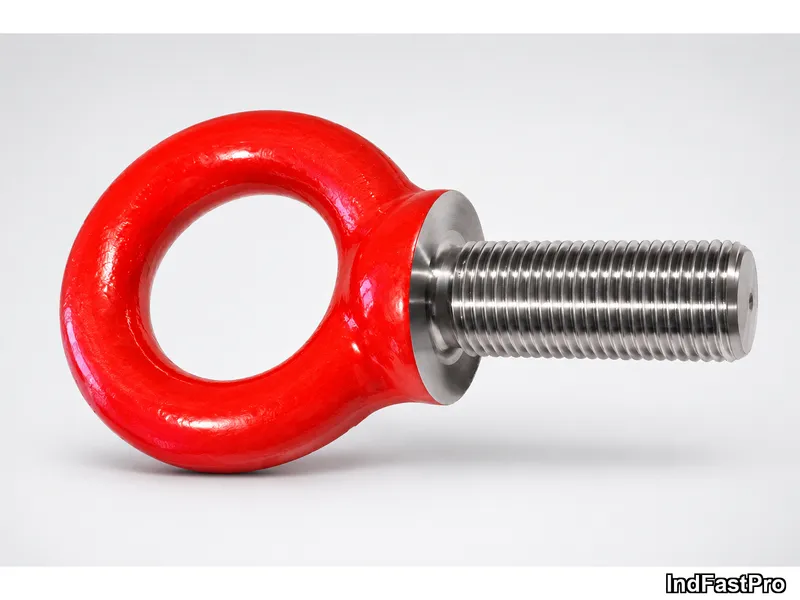
Load-attachment fasteners: DIN 580 lifting eye screws and DIN 444 type B eye bolts in A2/A4 stainless, DIN 582 lifting eye nuts (M6–M64 plus fine-pitch M72×6/M80×6/M100×6) and ASME B18.15 shoulder-type lifting eye bolts.
Last updated: 2026-11
Specifications
Industry-standard reference ranges — availability confirmed per quotation; not a stocked-range claim.
| Types | lifting eye screws (DIN 580) | eye bolts type B, medium coarse (DIN 444) | lifting eye nuts (DIN 582) | shoulder-type lifting eye bolts (ASME B18.15) |
|---|---|
| Thread range | M6–M64, plus fine pitch M72×6 / M80×6 / M100×6 (DIN 582 grid) | 1/4 in and up (ASME B18.15 nominal diameters) |
| load capacity | Plain-pattern 3/8 in eye bolt: breaking strength 5000 lbf min; rated capacity 1000 lbf at 0°, 375 lbf at 30°, 200 lbf at 60° (recovered calculator data) |
Materials
- A2 stainless steel
- A4 stainless steel
Engineering guidance
A lifting eye is the one fastener in the catalog whose failure mode is a dropped load, so the guidance here is about load geometry first and material second. Every figure on this page is the collected source's own, in the source's units; the angular capacity table for the actual size is the sizing input, not a vertical-rating shortcut.
Lift angle governs capacity
Rated capacity is a function of the angle between the sling and the load axis. In the collected per-size data for plain-pattern eye bolts, a 3/8 in size carries a rated capacity of 1000 lbf at 0°, dropping to 375 lbf at 30° and 200 lbf at 60° — a five-fold derating before the lift has even started. Larger plain-pattern sizes in the same table print "NR" (not rated) at 90°, meaning side-loading a plain eye bolt is outside its rating entirely, not merely reduced.
This is why shoulder-type eye bolts (ASME B18.15) exist: the shoulder seats against the mating surface and carries the bending that a plain pattern must not. The DIN 580 / DIN 582 eye screws and eye nuts carry the same geometry rule on their own rating tables. Match the eye style to the lift geometry first; widening the eye or upsizing the thread does not repair a side-load.
The DIN 580 / DIN 582 / DIN 444 / B18.15 split
The four designations divide by form, not by interchangeability. DIN 580 covers lifting eye screws — the male stud form that threads into a tapped hole; DIN 582 covers lifting eye nuts — the female form that threads onto a stud or bolt, collected across M6–M64 plus fine-pitch M72×6, M80×6 and M100×6. DIN 444 type B (medium coarse) is an eye bolt with a bolt shank for through-hole mounting, and ASME B18.15 covers shoulder-type lifting eye bolts in the inch series. A drawing that names one of these is naming a load path; substituting another form changes the rating basis.
Collected material coverage is A2 and A4 stainless steel across the DIN 580/DIN 444 forms — the same corrosion logic as every stainless decision, applied to a part that must not corrode under load.
How capacity claims are verified
Capacity is verified against a per-size capacity table or certificate from the manufacturer — never inferred from eye dimensions. The collected capacity data itself was recovered from a per-size rating table (breaking strength, proof load and rated capacity at 0°/30°/60°/90° for each thread size), which is the shape of documentation to demand with the order: state the thread size, the working load, and the lift angle, and require the rating for that geometry.
What this page cannot verify: the rated capacity of any specific manufacturer's eye beyond the sampled table rows rendered on the specification pages, and the inspection condition of an eye already in service (bent eyes, worn seats and re-tapped holes all invalidate a table rating). Those checks belong to the lift plan, not the order.
Ordering & documentation
Documents
Shipments of Lifting Eye Bolts & Eye Nuts are backed by Mill Test Certificate (MTC), Dimensional Report, Salt Spray Test Report on request, with full batch traceability from raw material to finished product. Quality management for this lifting eye bolts & eye nuts line follows the owner-confirmed compliance list: ISO 9001:2015, RoHS, REACH. Exact document sets are confirmed on the order.
Quotation
- Eye bolt, shoulder eye bolt or eye nut type and the applicable standard.
- Thread size, material/grade and the manufacturer’s working-load limit for the exact part.
- Lift angle, load direction, rigging arrangement and whether the shoulder seats fully against the component.
- Required inspection/certification; never infer a working-load rating from thread size alone.
Sample & supply
Minimum order quantities and lead times for lifting eye bolts & eye nuts are confirmed at quotation — send eye type and standard, thread size, material, working load and lift angle on the RFQ and the quote will carry a firm schedule; sample availability is confirmed with the quotation.
Storage & shipping
Lifting Eye Bolts & Eye Nuts are packed for export and shipped factory-direct to buyers in Europe, Asia, the Americas and the Middle East. Store these lifting eye bolts & eye nuts dry and protected until installation, and keep coated parts in their packaging until use; specific packing and preservation requirements can be stated on the order and confirmed at quotation.
Frequently asked questions
Why does a lifting eye bolt's capacity drop when the sling is not vertical?
Rated capacity is a function of lift angle. In the collected per-size data for a plain-pattern 3/8 in eye bolt, rated capacity runs 1000 lbf at 0°, 375 lbf at 30° and 200 lbf at 60° — and larger sizes in the table show "NR" (not rated) at 90°. Plan the lift so the sling stays near vertical, and treat the angular table for the actual size as the sizing input rather than the 0° figure.
DIN 580 or DIN 582 — what is the difference?
They are the two halves of a lifting point: DIN 580 covers lifting eye screws (the male stud-bolt form) and DIN 582 covers lifting eye nuts (the female, threaded onto a stud or bolt). Both are collected in A2 and A4 stainless steel; DIN 444 type B eye bolts and ASME B18.15 shoulder-type eye bolts are the bolt-shank variants with different load-geometry rules. Name the standard your drawing uses — they are not interchangeable forms.
What should a lifting-eye RFQ state beyond size and material?
Standard designation, thread size, material (A2/A4 stainless per the collected data) and the load the point must carry with its lift angle. Capacity ratings are verified against the manufacturer's per-size capacity table or certificate, not inferred from dimensions — state the working load and lifting direction on the RFQ so the quoted eye is rated for the actual geometry.
Request a Quote
Get factory-direct pricing from the manufacturer.
What to include in your Lifting Eye Bolts & Eye Nuts inquiry
- ✓ Identify eye bolt, shoulder eye bolt or eye nut type and the applicable standard.
- ✓ Give thread size, material/grade and the manufacturer’s working-load limit for the exact part.
- ✓ State the lift angle, load direction, rigging arrangement and whether the shoulder seats fully against the component.
- ✓ Provide the required inspection/certification and never infer a working-load rating from thread size alone.
- ✓ Factory-direct pricing for your Lifting Eye Bolts & Eye Nuts
- ✓ Standard and custom specifications
- ✓ Factory-direct export to buyers in Europe, Asia, the Americas and the Middle East
- ✓ Full fastener family support