
Weld Fasteners
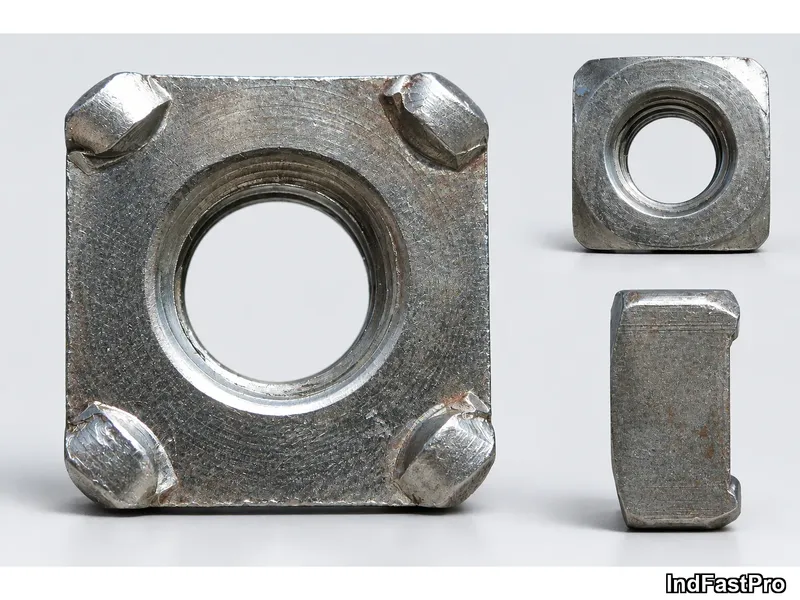
Weld nuts that fuse directly into sheet-metal assemblies — square weld nuts per DIN 928 and hex weld nuts per DIN 929 in carbon steel, coarse M3–M10 with fine-pitch options — replacing tapped holes where the far side of the panel is unreachable.
Last updated: 2026-11
Specifications
Industry-standard reference ranges — availability confirmed per quotation; not a stocked-range claim.
| Types | square weld nuts (DIN 928) | hex weld nuts (DIN 929) | projection weld nuts |
|---|---|
| Thread range | Coarse M3–M10 (DIN 929 grid M3, M4, M5, M6, M8, M10) | Fine-pitch options at larger sizes (e.g. M6×1, M8×1, M10×1/1.25) |
| Proof load | DIN 929 hex weld nut ensure-load, coarse: M3 3800 N · M4 6800 N · M5 11000 N | DIN 928 square weld nut ensure-load, coarse: M4 6800 N · M5 11000 N · M6 15500 N · M8 28300 N |
Materials
- carbon steel
Engineering guidance
Weld nuts trade installability for joint permanence: they fuse into the panel where the far side is unreachable and nothing can shake loose afterwards. The decisions that matter are the nut form the drawing calls for, the load the welded joint actually achieves, and what the coating test hours do and do not promise.
Form follows the panel: square DIN 928 vs hex DIN 929
The two collected standards divide the family by shape and size grid. DIN 928 square weld nuts run M4–M8 in the collected coarse table (with a fine-pitch option at M8); DIN 929 hex weld nuts run M3–M10 coarse with fine-pitch options appearing at the larger sizes (M6×1, M8×1, M10×1/1.25 in the collected columns). The hex form brings wrench flats for later service access; the square form resists rotation during welding. Projection weld nuts extend the same idea with predefined weld projections for high-volume panel lines.
Collected material coverage for the family is carbon steel — the weldability requirement is why: the nut must match the panel's welding behavior, which stainless and coated variants only satisfy with process-specific parameters. Treat "weldable" as a process question to settle at quotation with the sheet thickness stated.
Load figures and what they assume
Both collected sheets publish an ensure-the-load column: DIN 929 hex nuts at 3800 N (M3), 6800 N (M4) and 11000 N (M5) coarse; DIN 928 square nuts at 6800 N (M4), 11000 N (M5), 15500 N (M6) and 28300 N (M8) coarse — higher than the same-size hex at M6, which is the square form's weld-footprint advantage showing up in the numbers. These are the sheets' own figures for the nut as welded to their assumed panel.
The welded joint is the real limit: sheet thickness, electrode force and weld current decide how much of the nut's figure the joint delivers. Verify by test on the actual panel — the sheet figure sizes the candidate, the joint test qualifies it.
What salt-spray hours verify — and what they do not
Coating performance on welded fasteners is evaluated with standardized laboratory tests such as neutral salt spray (NSS) per ASTM B117: a controlled way to compare coating systems, identify corrosion tendencies, and verify that a fastener meets a specified corrosion-test requirement. That is the correct use — the hours are a coating comparison figure and a pass/fail against a spec line.
The collected guide is explicit about the limit: ASTM B117 should not be interpreted as a direct prediction of real-world service life, and the result is influenced by fastener material and surface treatment among other factors. Read "500 hours salt spray" as "passes a 500-hour NSS requirement", not as "lasts five hundred hours outdoors" — and state the coating system on the RFQ so the tested system is the delivered system.
Ordering & documentation
Documents
Shipments of Weld Fasteners are backed by Mill Test Certificate (MTC), Dimensional Report, Salt Spray Test Report on request, with full batch traceability from raw material to finished product. Quality management for this weld fasteners line follows the owner-confirmed compliance list: ISO 9001:2015, RoHS, REACH. Exact document sets are confirmed on the order.
Quotation
- Weld nut/stud type and standard, thread size and projection geometry.
- Parent-sheet material and thickness, mating component and access constraints.
- Welding process, electrode/material compatibility and any specified weld procedure or test.
- Post-weld coating, corrosion protection, quantity and inspection requirements.
Sample & supply
Minimum order quantities and lead times for weld fasteners are confirmed at quotation — send weld nut style, thread size and parent sheet thickness on the RFQ and the quote will carry a firm schedule; sample availability is confirmed with the quotation.
Storage & shipping
Weld Fasteners are packed for export and shipped factory-direct to buyers in Europe, Asia, the Americas and the Middle East. Store these weld fasteners dry and protected until installation, and keep coated parts in their packaging until use; specific packing and preservation requirements can be stated on the order and confirmed at quotation.
Frequently asked questions
Square (DIN 928) or hex (DIN 929) weld nut?
Both are resistance-welded into sheet metal; the collected specification sheets differ in shape and in the size grid they print — DIN 928 square runs M4–M8 in the collected coarse table, DIN 929 hex runs M3–M10 with fine-pitch options at the larger sizes. Follow the drawing's designation; if the joint is new, the hex form gives wrench flats for later service, the square form suits locations where rotation during welding must be minimal.
What loads do the collected weld-nut sheets publish?
The DIN 929 hex sheet carries an ensure-the-load column — 3800 N at M3, 6800 N at M4 and 11000 N at M5 in coarse thread; the DIN 928 square sheet lists 6800 N at M4, 11000 N at M5, 15500 N at M6 and 28300 N at M8. These are the sheets' own load figures; verify the welded-joint strength by test on your panel, since sheet thickness and welding parameters change the achievable load.
How is corrosion resistance verified on welded fasteners?
Coating performance is evaluated with standardized laboratory tests such as neutral salt spray (NSS) per ASTM B117, which lets coating systems be compared and a specified corrosion-test requirement be verified. The collected guide is explicit that B117 should not be read as a direct prediction of real-world service life — treat the hours as a coating comparison figure and confirm the coating spec (e.g. zinc plate, zinc flake) on the RFQ.
Request a Quote
Get factory-direct pricing from the manufacturer.
What to include in your Weld Fasteners inquiry
- ✓ Identify weld nut/stud type and standard, thread size and projection geometry.
- ✓ Give parent-sheet material and thickness, plus the mating component and access constraints.
- ✓ State the welding process, electrode/material compatibility and any specified weld procedure or test.
- ✓ Specify post-weld coating, corrosion protection, quantity and inspection requirements.
- ✓ Factory-direct pricing for your Weld Fasteners
- ✓ Standard and custom specifications
- ✓ Factory-direct export to buyers in Europe, Asia, the Americas and the Middle East
- ✓ Full fastener family support