
Series CFSO / CFSOS / CFSOA Self-Clinching Through-Threaded Standoffs
Through-threaded hex self-clinching standoffs — CFSO heat-treated carbon steel, CFSOS 300-series stainless and CFSOA 7075-T6 aluminum — installed flush in sheets from 0.040 in. (1.0 mm), unified #4-40 to #10-32 and metric M3 to M5, with per-thread mounting geometry and a full installation/performance table by thread-code group.
Last updated: 2026-11
Specifications
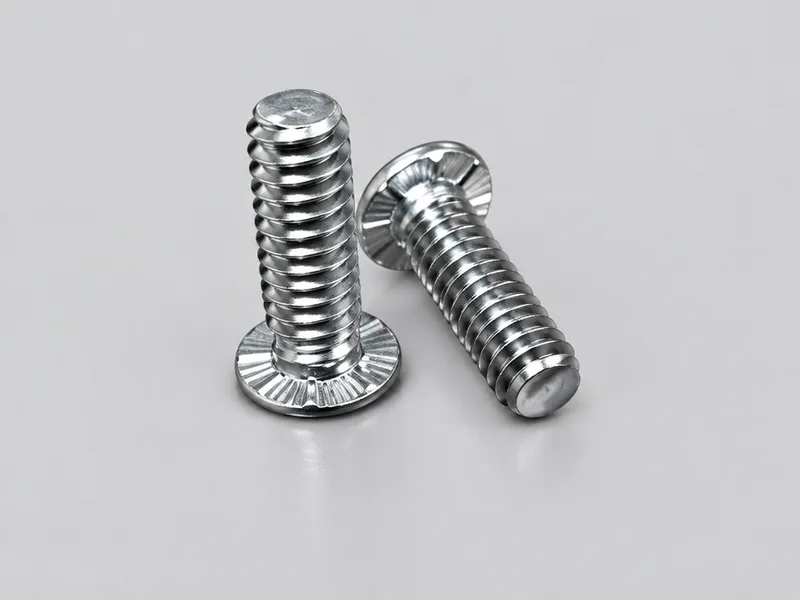
CFSO, CFSOS and CFSOA are hex through-threaded self-clinching standoffs: the standoff is pressed into a plain hole and the sheet metal cold-flows into the clinching feature, so the standoff becomes an integral, non-rotating part of the panel — no reaming, deburring or welding first. The three codes share one geometry per thread size and differ in material and the panel hardness they tolerate: CFSO is heat-treated carbon steel (zinc clear) for panels up to Rockwell B-80, CFSOS is 300-series stainless steel (passivated to ASTM A967) up to HRB 70, and CFSOA is 7075-T6 aluminum up to HRB 50. Threads are internal 2B per ANSI B1.1 (6H per ANSI/ASME B1.13M for metric). Most sizes come in two body diameters — the small-body 440-style code and the large-body 6440-style code (the leading digit is the body code in the part-number structure, e.g. CFSOS 6440-4). A typical designation reads CFSOS 6440-10: stainless standoff, large body, #4-40, length code -10.
| Series | CFSO (heat-treated carbon steel, zinc clear) — panels HRB 80 or less; CFSOS (300-series stainless, passivated per ASTM A967) — HRB 70 or less; CFSOA (7075-T6 aluminum, no finish) — HRB 50 or less |
|---|---|
| Threads | Internal 2B per ANSI B1.1 (6H per ANSI/ASME B1.13M metric): #4-40, #6-32, #8-32, #10-32; M3 x 0.5, M3.5 x 0.6, M4 x 0.7, M5 x 0.8 |
| Minimum sheet thickness | 0.040 in. unified; 1.0 mm (M3, M3.5); 1.27 mm (M4, M5) |
| Length ladders | Inch 0.125–1.0625 in. (codes -4 to -34 by thread); metric 3–25 mm (codes -3 to -25 by thread). Length tolerance +.002/-.005 in. (metric +.05/-.13 mm) |
| Unified geometry, small body (sampled) | #4-40: A .166 +.003/-.000, H .165 +.000/-.005, C .187, mounting hole .125 ±.005; #6-32: .213 / .212 / .250 / .156; #8-32: .281 / .280 / .312 / .188; #10-32: .281 / .280 / .312 / .203 — all min sheet .040 in. |
| Unified geometry, large body (sampled) | #4-40: A .213, H .212, C .250, hole .125; #6-32: .281 / .280 / .312 / .156; #8-32 and #10-32: .281 / .280 / .312, holes .188 and .203 |
| Metric geometry (sampled) | M3: A 4.22 +.08/-.00, H 4.2 +.00/-.13, C 4.8, hole 3.2 (large body 5.41 / 5.39 / 6.4 / 3.2); M3.5: 5.41 / 5.39 / 6.4 / 4.0; M4: 7.14 / 7.12 / 7.9 / 4.8; M5: 7.14 / 7.12 / 7.9 / 5.35 (holes ±.13 mm) |
| Installation | Press into a plain hole between parallel punch and anvil until the hex head embeds flush; avoid excessive squeeze. No secondary hole operations (no reaming or deburring) |
| Performance (sampled, .060 in. cold-rolled steel sheet) | 440 steel standoff: 2200 lbs installation, 225 lbs pushout, 19 in.-lbs torque-out, 330 lbs pull-through, max tighten 4.75 in.-lbs; 6440/632: 3300 / 420 / 35 / 380; 8632/832/1032: 4000 / 560 / 75 / 700 |
| Performance (sampled, 1.5 mm cold-rolled steel sheet) | M3: 9.8 kN installation, 1000 N pushout, 2.15 N·m torque-out, 1465 N pull-through; 3.5M3: 14.7 / 1860 / 3.95 / 1465; M4 & M5: 17.8 / 2490 / 8.47 / 3110 |
| Aluminum standoffs in steel sheet | Marked "nr" (not recommended) in the collected performance table — quote CFSOA only into aluminum or other soft panels |
| MOQ / lead time | Not owner-confirmed for this family — confirmed at quotation |
Materials
- Heat-treated carbon steel, zinc clear (CFSO)
- 300-series stainless steel, passivated per ASTM A967 (CFSOS)
- 7075-T6 aluminum, no finish (CFSOA)
Ordering & documentation
Documents
Shipments of Series CFSO / CFSOS / CFSOA Self-Clinching Through-Threaded Standoffs are backed by Mill Test Certificate (MTC), Dimensional Report, Salt Spray Test Report on request, with full batch traceability from raw material to finished product. Quality management for Series CFSO / CFSOS / CFSOA Self-Clinching Through-Threaded Standoffs orders follows the owner-confirmed compliance list: ISO 9001:2015, RoHS, REACH. Exact document sets are confirmed on the order.
Quotation
- The product family (Series CFSO / CFSOS / CFSOA Self-Clinching Through-Threaded Standoffs), product standard/designation and drawing or part number.
- The dimensions that apply to this part — such as size, pitch, length, thickness, fit, grip or groove geometry.
- Material/grade, heat-treatment condition and surface finish, together with the service environment.
- Quantity per size, delivery destination and required test or traceability documents.
Sample & supply
Minimum order quantities and lead times for series cfso / cfsos / cfsoa self-clinching through-threaded standoffs are confirmed at quotation — send series, thread size and parent sheet thickness on the RFQ and the quote will carry a firm schedule; sample availability is confirmed with the quotation.
Storage & shipping
Series CFSO / CFSOS / CFSOA Self-Clinching Through-Threaded Standoffs are packed for export and shipped factory-direct to buyers in Europe, Asia, the Americas and the Middle East. Store series cfso / cfsos / cfsoa self-clinching through-threaded standoffs dry and protected until installation, and keep coated parts in their packaging until use; specific packing and preservation requirements can be stated on the order and confirmed at quotation.
Frequently asked questions
Which of the three series should I quote for my panel?
Match the series to the panel material and hardness, then to corrosion needs. The collected catalog maps CFSO (heat-treated carbon steel) to panels of Rockwell B-80 or less, CFSOS (300-series stainless) to HRB 70 or less, and CFSOA (7075-T6 aluminum) to HRB 50 or less. Softer aluminum panels need the softer standoff material to clinch properly; stainless panels usually take CFSO for strength or CFSOS where the fastener itself must not rust. Note the performance table marks aluminum standoffs "nr" (not recommended) in steel sheet.
What do the performance figures mean for a through-threaded standoff?
Pushout is the axial force that shoves the installed standoff out of the sheet; torque-out is the rotation it survives before spinning; pull-through is the force pulling the head through the panel; installation force is what your press must deliver. In the collected table, the large-body #4-40 (6440) group reaches 3300 lbs installation / 420 lbs pushout / 35 in.-lbs torque-out in 0.060 in. cold-rolled steel, and the metric M4/M5 group reaches 17.8 kN / 2490 N / 8.47 N·m in 1.5 mm steel. Figures scale with sheet thickness and material — ask for the row of your exact thread, body and sheet at quotation.
What should an RFQ for these self-clinching standoffs state?
State the series (CFSO steel, CFSOS stainless, or CFSOA aluminum), thread size (for example #10-32 or M4 x 0.7), body size (small or large), nominal length L, sheet material, thickness and hardness, and quantity per size — plus destination country. Commercial terms are confirmed at quotation.
Request a Quote
Get factory-direct pricing from the manufacturer.
What to include in your Series CFSO / CFSOS / CFSOA Self-Clinching Through-Threaded Standoffs inquiry
- ✓ Identify the clinch-nut, stud or standoff series and the internal thread size.
- ✓ Specify parent-sheet material, hardness and actual thickness, not gauge alone.
- ✓ Provide prepared-hole diameter, edge distance and hole-to-hole spacing from the panel drawing.
- ✓ State locking/non-locking requirement, installation press/tooling and any push-out or torque-out acceptance data.
- ✓ Factory-direct pricing for your Series CFSO / CFSOS / CFSOA Self-Clinching Through-Threaded Standoffs
- ✓ Standard and custom specifications
- ✓ Factory-direct export to buyers in Europe, Asia, the Americas and the Middle East
- ✓ Full fastener family support