
Self-Clinching Fasteners
CFE-series self-clinching fasteners create load-bearing internal threads in thin sheet. Locking and non-locking series are available; confirm parent-sheet material, hardness, thickness and prepared-hole dimensions for the selected series.
Last updated: 2026-11
Specifications
Industry-standard reference ranges — availability confirmed per quotation; not a stocked-range claim.
| thread | #4-40, #6-32, #8-32, #10-32, 1/4-20, 1/4-28 (inch (source grid section 'sizes')) | M3 x 0.5, M4 x 0.7, M5 x 0.8, M6 x 1.0 (metric (source grid section 'sizes metric')) |
|---|---|
| coating | Black dry-film lubricant per MIL-46010 Type I over Cadmium; Internal 3B, ANSI B1.1 (6H, ANSI/ASME B1.13M) | Passivated ASTM A380; Internal 2B, ANSI B1.1 (6H, ANSI/ASME B1.13M) |
| standard | Thread locking performance for CFE & CFEO is equivalent to applicable NASM25027 specifications |
Reference notes (collected source statements, not supply-scope values):
- standard: Thread locking performance for CFE & CFEO is equivalent to applicable NASM25027 specifications
Selection guidance
How self-clinching fasteners hold in thin sheet, locking versus non-locking threads, the sheet-hardness envelope, and what to state on the RFQ.
How the clinch holds
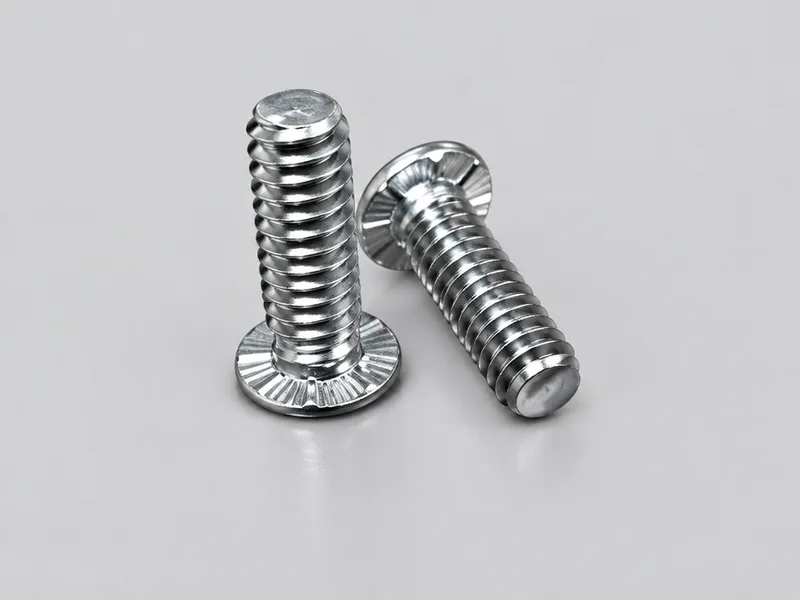
When pressed into ductile material, a self-clinching fastener displaces the host material around the mounting hole, causing it to cold flow into a specially designed annular recess in the shank or pilot of the fastener; a serrated clinching ring, knurl, ribs or the head then prevents rotation once inserted, making the fastener a permanent part of the sheet. The collected specification sheet for Series CFE & CFEO / CFEX & CFEOX rates the series for use in materials with Rockwell hardness of B-70 or less — harder sheets resist the cold flow, so state your sheet material and hardness on the RFQ.
Installation is a squeezing operation: place the fastener into the anvil hole and the mounting hole over the shank, keep the installation punch and anvil surfaces parallel, and apply squeezing force until the head contacts the sheet. The collected sheet tabulates the required installation force per thread size and sheet series — 1500 lbs for #4-40 on 0.040 in. cold-rolled steel up to 15.6 kN for M6 on 1.5 mm.
Locking versus non-locking threads
The same sheet carries both lines. Series CFE & CFEO are the self-locking nuts: black dry-film lubricant per MIL-46010 Type I over cadmium, internal 3B threads per ANSI B1.1 (6H metric per ANSI/ASME B1.13M), with thread-locking performance the sheet rates as equivalent to applicable NASM25027 specifications. Series CFEX & CFEOX are the non-locking counterparts: passivated per ASTM A380, internal 2B / 6H classes, free-running for screws that are repeatedly serviced. Thread sizes run #4-40 through 1/4-28 unified and M3 x 0.5 through M6 x 1.0 metric in both lines.
Pick the line by the joint, not by habit: vibration-critical or rarely serviced joints take the locking series; frequently serviced, non-vibration joints take the free-running series. Both install into the same sheet-hardness envelope, and the collected performance table (installation force, pushout, torque-out per thread size and sheet series) applies per line — quote the row for your size and sheet on the RFQ.
How do you verify an installed self-clinching fastener?
Thread acceptance on self-locking clinch nuts is not a plain Go/NoGo gaging call: the collected NASM25027 tech sheet notes the dry-film lubricant can keep a basic-size Go plug from entering, so the thread is accepted when a Class 3A screw (Class 4h on metric threads) enters a minimum of 3/4 of a turn, and the locknut will not accept the 3B/5H NoGo plug at all. Plan receiving inspection around a test screw, not a plug gage, and match the screw material to the nut - stainless screws for stainless locknuts.
Locking performance has exactly one regular lot-level test in the collected sheet: a 15-cycle reusability test, run with a maximum torque ceiling and a minimum breakaway torque on the 15th cycle, using the same screw for all 15 cycles. If your buyer or QA plan demands more than that, it is a customer addition, not a NASM25027 requirement - scope it and price it as such.
Two verification traps are worth stating on the drawing package. First, self-locking clinch nuts must receive no chemical treatment after installation - the collected sheet traces field complaints about poor locking to chemical processing, so install into the finished panel and keep any post-install masked spray painting off the threads. Second, the metric locking-torque values circulating with the NASM25027 inch table were created by the manufacturer from equivalent inch values, because the spec does not address metric threads at all - treat metric locking numbers as manufacturer-derived, not spec-mandated, when a customer audits them.
What this page cannot verify: whether a specific installed fastener reached full clinch in your panel (pushout and torque-out are destructive laboratory figures, not shop-floor checks), the actual hardness condition of your sheet lot, or the locking-torque curve of a particular production lot - those require the lot-level test above or a lab pull test. Confirm sheet hardness and thickness before installation and keep the install-force row for your size as the press-setup check.
Where does installation fail in a real panel?
Panel condition decides whether the clinch forms at all. The collected manufacturing notes call for panel material in the annealed condition and warn against installing adjacent to bends or other highly cold-worked areas - cold-worked sheet resists the plastic displacement the clinch depends on, so a hole that installs fine in the flat may under-clinch near a formed edge. Sequence the panel so clinch installation happens before forming where the layout allows it.
Mating screw fit is part of the specification, not a preference: screws used with self-clinching locking fasteners should be Class 3A (4h metric) fit, or no smaller than Class 2A/6g. A looser screw fit shows up later as low breakaway torque on the locking line - specify the fit class next to the thread callout.
The thin-sheet floor differs by product line, so quote the line before the panel: SP / PEM 300 clinch nuts carry load-bearing threads in stainless sheets as thin as 0.030 in / 0.8 mm; self-clinching studs install permanently in sheets as thin as 0.020 in / 0.51 mm; standoffs mount into sheets as thin as 0.025 in / 0.63 mm; and heavy-duty HFH studs are rated for high-strength applications in sheets as thin as 0.050 in / 1.3 mm, with grade 8 / property class 10.9 variants meeting 150 ksi / 1040 MPa minimum strength. State product line, thread size and sheet thickness together on the RFQ so the quoted minimum matches the joint.
Ordering & documentation
Documents
Shipments of Self-Clinching Fasteners are backed by Mill Test Certificate (MTC), Dimensional Report, Salt Spray Test Report on request, with full batch traceability from raw material to finished product. Quality management for this self-clinching fasteners line follows the owner-confirmed compliance list: ISO 9001:2015, RoHS, REACH. Exact document sets are confirmed on the order.
Quotation
- Clinch-nut, stud or standoff series and internal thread size.
- Parent-sheet material, hardness and actual thickness, not gauge alone.
- Prepared-hole diameter, edge distance and hole-to-hole spacing from the panel drawing.
- Locking/non-locking requirement, installation press/tooling and any push-out or torque-out acceptance data.
Sample & supply
Minimum order quantities and lead times for self-clinching fasteners are confirmed at quotation — send series, thread size and parent sheet thickness on the RFQ and the quote will carry a firm schedule; sample availability is confirmed with the quotation.
Storage & shipping
Self-Clinching Fasteners are packed for export and shipped factory-direct to buyers in Europe, Asia, the Americas and the Middle East. Store these self-clinching fasteners dry and protected until installation, and keep coated parts in their packaging until use; specific packing and preservation requirements can be stated on the order and confirmed at quotation.
Clinch series & types
Each clinch-nut or related series has its own thread, sheet-hardness/thickness, hole and installation requirements. Confirm the parent sheet and hole preparation before selecting a part.
Choosing between clinch-nut series? See the clinch nut type comparison — S/CLS/SP, CLA, SMPS/SMPP, SH and the locking series side by side.
- Series CFE & CFEO Self-Locking Self-Clinching Nuts
- Series CFEX & CFEOX Non-Locking Self-Clinching Nuts
- Series S / CLS / SP Self-Clinching Nuts
- Series SH Hard Panel Self-Clinching Nuts
- Series SMPS / SMPP Thin-Sheet Self-Clinching Nuts
- FH & FHS Self-Clinching Threaded Studs
- SO / SOS / SOA Self-Clinching Through-Hole Standoffs
- BSO / BSOS / BSOA Self-Clinching Blind Standoffs
- Series CFSO / CFSOS / CFSOA Self-Clinching Through-Threaded Standoffs
- TCH & TCHS Thin-Sheet Self-Clinching Studs (Non-Flush)
- PEM RT Free-Running Self-Clinching Locknuts
- SL TRI-DENT Prevailing-Torque Self-Clinching Locknuts
- H / HNL High Pushout Self-Clinching Nuts
- CLA Aluminum Self-Clinching Nuts
- CFBSO Self-Clinching Blind Standoffs (Carbon Steel)
- CFBSOS Self-Clinching Blind Standoffs (Stainless Steel)
- CFBSOA Self-Clinching Blind Standoffs (Aluminum)
- Self-Clinching Nut Dimensions — Inch Series Ladder (#4-40 to 1/4-20)
- Self-Clinching Stud Dimensions — Designation Ladder (4-40-0 to 1/4-20-2)
Engineering references
Dimension charts and technical reference tables for self-clinching fasteners — engineering aids for selection and verification, not a statement of the orderable range. Supply availability is confirmed per quotation.
- Installing Self-Clinching Standoffs (CFSO / CFBSO Series Installation Guide) — engineering reference
Frequently asked questions
What sheets can self-clinching fasteners be installed into?
The collected specification sheet rates Series CFE/CFEO/CFEX/CFEOX for use in materials with Rockwell hardness of B-70 or less; the fastener displaces the host material around the mounting hole so it cold flows into an annular recess, which is what locks the nut in. State sheet material, thickness and hardness on the RFQ — harder or brittle sheets need the fastener type confirmed before ordering.
Locking or non-locking — which line do I quote?
Self-locking CFE & CFEO carry dry-film lubricant per MIL-46010 Type I over cadmium with locking performance equivalent to NASM25027 — the choice for vibration-critical or rarely serviced joints. Non-locking CFEX & CFEOX are passivated per ASTM A380 with free-running 2B/6H threads — the choice for screws that are repeatedly removed. Both run #4-40 to 1/4-28 unified and M3 to M6 metric.
What is the MOQ and lead time for self-clinching fasteners?
Commercial terms for this family are confirmed at quotation together with series, thread sizes, sheet thickness and hardness — state the series (self-locking or non-locking), thread size and pitch per size, sheet material and hardness, and quantity on the RFQ.
Request a Quote
Get factory-direct pricing from the manufacturer.
What to include in your Self-Clinching Fasteners inquiry
- ✓ Identify the clinch-nut, stud or standoff series and the internal thread size.
- ✓ Specify parent-sheet material, hardness and actual thickness, not gauge alone.
- ✓ Provide prepared-hole diameter, edge distance and hole-to-hole spacing from the panel drawing.
- ✓ State locking/non-locking requirement, installation press/tooling and any push-out or torque-out acceptance data.
- ✓ Factory-direct pricing for your Self-Clinching Fasteners
- ✓ Standard and custom specifications
- ✓ Factory-direct export to buyers in Europe, Asia, the Americas and the Middle East
- ✓ Full fastener family support