
Anchors
L-shape anchor bolts (bent anchor bolts) available in a range of diameters and lengths with specified hook and thread lengths, including F1554 Grade 36, 55, and 105 steel options.
Last updated: 2026-11
Specifications
Current supplyable range — owner-confirmed scope of supply; requirements outside this range are confirmed per quotation.
| diameter | Up to M36 / 1-1/2" (36 mm) |
|---|---|
| length | Up to 300 mm |
| thread | Metric (M), UNC/UNF, BSW/BSF |
| coating | Zinc plated (blue/yellow), Geomet, Dacromet, hot-dip galvanized |
| moq | 500-1000 pieces |
| lead time | 15-30 days |
| price from | USD 0.1-0.5/pc |
Selection guidance
How L-shape anchor bolts are used, what ASTM F1554 grades mean, and what to confirm before you send a drawing.
Where L-shape anchor bolts are used
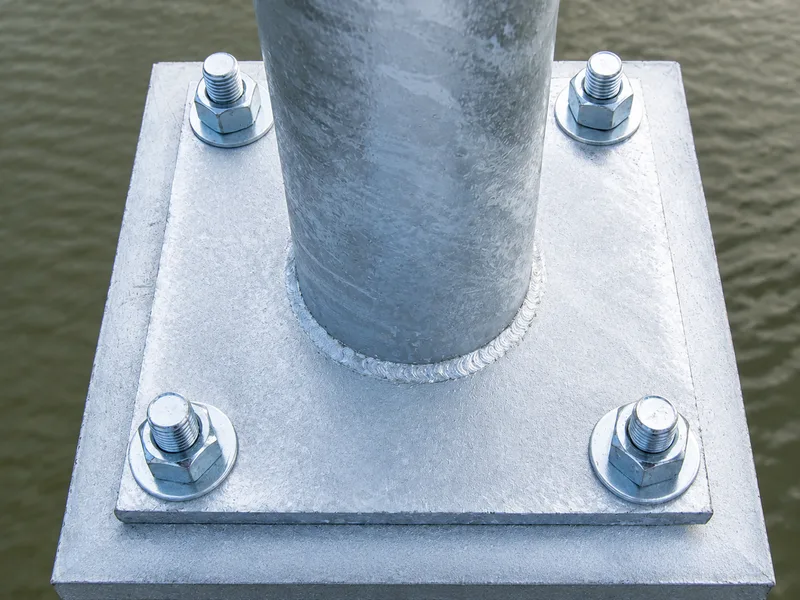
L-shape anchor bolts are embedded in concrete and used to support structural steel columns, light poles, highway signs, and heavy equipment. The hooked end serves to create resistance so the bolt does not pull out of the concrete foundation when force is applied — which is why the hook and the embedded length, not just the threaded end, carry the design.
The base specification covering foundation anchor bolts is ASTM F1554, which covers anchor bolts designed to anchor structural supports to concrete foundations. F1554 covers headed bolts, straight rods, and bent anchor bolts; the three grades — 36, 55, and 105 — designate the minimum yield strength of the anchor bolt in ksi.
Choosing between F1554 Grade 36, 55 and 105
Grade 36 is low-carbon, 36 ksi yield steel. Grade 55 is a high-strength, low-alloy 55 ksi yield steel (modified mild steel). Grade 105 is an alloy, heat-treated, high-strength 105 ksi yield steel (medium-carbon alloy steel). The grade choice follows the structural design: the engineer of record selects the grade the foundation design assumes, and substituting a different grade is not a purchasing decision.
Our owner-confirmed line covers all three grades in diameters up to M36 / 1-1/2" and lengths up to 300 mm, with hot-dip galvanizing available as a value-added process. If your drawing names F1554 with a grade and a coating, the quote can be matched to it directly; if the drawing is silent on grade, confirm it with your engineer before ordering rather than defaulting to the lowest cost option.
Dimensions: what varies between charts
Bent anchor bolt dimensions do not follow a single industry-wide table. Published charts from two distributors both list nominal diameters from 3/8 through 1-1/4 with lengths from 6 to 36 inches, but the hook dimensions and thread lengths differ between them and vary by diameter — one chart lists a 1-inch hook with 1/2-inch thread on 3/8 bolts, another lists a 1-1/2-inch hook with 2-inch thread on 1/2 bolts. The catalog records the union of published lengths, and thread length is deliberately left unspecified because no single value holds across diameters and sources.
The practical consequence for procurement: read the hook and thread-length callout from your actual drawing, not from a generic chart, and put those two numbers on the RFQ alongside diameter, length, grade, and coating. For adhesive anchor systems, distributor cross-reference tables can suggest equivalent products across brands, but such tables are explicitly reference-only — the engineer of record is ultimately responsible for the acceptance of any adhesive product.
When does a wedge anchor work — and which base materials does it fail in?
The wedge anchor holds by mechanical expansion, not by adhesion or thread interlock: turning the nut clockwise pulls the anchor body up through the nut, sliding the expansion clip down the cone-shaped, necked-down portion of the body so the clip expands against the wall of the drilled hole. That mechanism is why the wedge anchor can only be used in solid concrete — the expansion clip sits on the anchor body at a location whose tolerance is critical, so brick and hollow block, where the clip cannot develop its grip, are base materials a wedge anchor must not be specified into. Natural stone is a qualified hedge: a wedge anchor may work there, but the holding values are not tested because each natural stone is different and inconsistent.
How close to an edge — or to another anchor — can expansion anchors be placed?
Expansion anchors apply radial pressure to the surrounding concrete. If an anchor is too close to an edge or to another anchor, the concrete failure zones can interact and reduce the resistance of the fastening. Do not apply a universal diameter ratio: minimum edge distance, anchor spacing, embedment and member thickness are product-specific values defined by the selected anchor approval and manufacturer design table. They vary with the anchor model and diameter, embedment, concrete strength and whether the concrete is cracked or uncracked, as well as the design load.
Before specifying an expansion anchor, use the current ETA/ICC-ES evaluation or equivalent approval and the installation table for that exact product. Check the required centre spacing, edge distances, minimum member thickness, embedment and installation torque together; a generic rule of thumb is not a substitute for the tested design data.
What kills holding power after the hole is drilled?
The most common installation mistake happens before the anchor is even installed: a hole too large in diameter, too shallow, drilled at an angle, or left uncleared of dust and debris. Oversize holes are easy to miss because installation can still look correct — normal resistance during driving, head seated against the fixture — while the actual load capacity is significantly lower than expected, because with a larger hole the thread (or clip) engagement with the concrete is shallower. A worn drill bit is a direct cause of oversize holes, which is why bit inspection is a safety step rather than a formality.
Drilling dust is not harmless either. It raises installation torque, prevents the anchor from seating fully, and debris accumulated at the hole bottom reduces the effective embedment depth — and therefore tensile strength. And if a concrete screw begins spinning without advancing, more torque never restores the load capacity: the correct fix is a new fastening point at the required edge distances and spacing, or a chemical anchor, which is generally less sensitive to minor drilling inaccuracies.
Do torque-controlled anchors need a calibrated torque wrench?
Most expansion and undercut anchors are torque-controlled: the correct expansion or undercut in the borehole is only guaranteed if the prescribed torque has been applied with a calibrated torque wrench. Free-hand tightening mis-scales with anchor size — smaller diameters get tightened excessively, large diameters not tightly enough — and too little or too much effort can lead to failure of the attachment point. For procurement this is a quote-line check: confirm the prescribed install torque ships with the anchor data, and flag orders where site tooling cannot provide a calibrated wrench.
Which anchor material survives which environment?
Anchor material is chosen for the environment before it is chosen for strength. Zinc-plated wedge anchors are for dry environments where no moisture is present; where moisture is present, hot-dip galvanized is the option to consider; 303 or 304 stainless steel is for anchors that will be submerged in water; and water containing chemicals such as chlorine calls for 316 stainless steel. Getting this wrong rarely shows up at installation — corrosion shows up as a failed attachment years later, which is why the service environment belongs on the RFQ alongside diameter and embedment.
What this page cannot verify
This page cannot verify holding values for any specific anchor diameter, embedment depth, or concrete strength. Published design values live in each manufacturer’s evaluation document — the European Technical Assessment (ETA) or its regional equivalent — and minimum edge distances, anchor spacing, embedment depth, hole diameter, and installation torque must be determined in accordance with that assessment and the applicable design standards, not from generic tables. Confirm the exact product’s evaluation report for the values your application is designed to, and match the drawing’s diameter, grade, coating, and thread callout against the confirmed order before release.
How much load can you actually put on an anchor?
Start from what the published number is: the concrete-anchor tables in this family are average ultimate load values in 2,000 PSI concrete, offered only as a guide and not guaranteed. The generally accepted safe working load is a 4:1 safety factor — one quarter of the ultimate — with applicable codes governing the specific ratio for your job. That arithmetic matters at quote time: a 1/2" wedge anchor lists 2,999 lbs pull-out and 5,564 lbs shear at its minimum embedment, so the working tension you can defend from that table is on the order of 750 lbs, not three thousand.
Family choice moves the number as much as diameter does, which is why comparing anchors across families by part size alone misleads. At minimum embedment the same 1/2" nominal size in the sleeve-anchor table carries 1,676 lbs pull-out against the wedge’s 2,999 — and at the small end the gap is wider still: a 1/4" sleeve lists 168 lbs pull-out where a 1/4" wedge lists 877. The drop-in table sits between: 939 lbs at 1/4", 3,105 at 1/2" and 6,678 at 3/4". The rule of thumb: pick the family the base material allows, then compare like for like at the stated embedment — never carry an ultimate value across tables without checking each row’s own minimum embedment.
How do you size embedment and anchor length so the published values apply?
Every published load row is conditioned on reaching that row’s minimum embedment, and the minimums climb steeply with diameter: the wedge-anchor ladder runs from 1-1/8" at 1/4" through 2-1/4" at 1/2" to 5-1/2" at 1-1/4". The drop-in family states the same idea as a ratio — minimum embedment for satisfactory performance is 4-1/2 bolt diameters, and deeper embedment yields higher tension and shear capacity — so under-embedding is not a mild penalty, it voids the row you quoted.
Length then follows from three stacked items, not from the embedment alone: the thickness of the material being fastened, plus the minimum embedment, plus the thickness of the nut and washer — their sum is the minimum wedge-anchor length. Drill depth gets one more allowance: the hole should be at least the anchor length minus the fixture thickness, which leaves room for concrete cuttings that will not fully clean out. And setting the expansion is a torque item, not a feel item: the per-diameter torque bands run from 5-10 ft-lbs at 1/4" through 50-60 at 1/2" up to 400-450 at 1-1/4", so an installed anchor whose torque never entered its band has not developed the expansion the load table assumes.
Ordering & documentation
Documents
Shipments of Anchors are backed by Mill Test Certificate (MTC), Dimensional Report, Salt Spray Test Report on request, with full batch traceability from raw material to finished product. Quality management for this anchors line follows the owner-confirmed compliance list: ISO 9001:2015, RoHS, REACH. Exact document sets are confirmed on the order.
Quotation
- This listed family is cast-in foundation anchor rods, including L-shaped/bent rods; identify the ASTM F1554 grade or drawing.
- Rod diameter/thread, overall length, hook length, projection and thread length as separate dimensions.
- Supported base-plate details and concrete design inputs, embedment, edge distance and spacing from the engineer’s design.
- Corrosion protection, quantity, destination and required material/lot certificates.
Sample & supply
Minimum order quantity for anchors is 500–1,000 pieces (applies to the standard sizes and finishes for anchors; mixed, special or custom variants are quoted — final commercial terms per quotation) Standard production for this family run 15–30 days. Quantities or variants outside the standard range are confirmed at quotation.
Storage & shipping
Anchors are packed for export and shipped factory-direct to buyers in Europe, Asia, the Americas and the Middle East. Store these anchors dry and protected until installation, and keep coated parts in their packaging until use; specific packing and preservation requirements can be stated on the order and confirmed at quotation.
Anchor grades & reference types
The first three links are ASTM F1554 Grade 36, 55 and 105 foundation-anchor-rod pages within the owner-confirmed cast-in L/bent anchor scope. The post-installed concrete screw, wedge, sleeve, drop-in and adhesive anchors, plus masonry/toggle products below, are technical selection references only; they are not a statement of current owner-confirmed supply and are confirmed separately per quotation.
Choosing between anchor families? See the anchor family comparison — concrete screw, wedge, sleeve, drop-in and chemical side by side.
Frequently asked questions
F1554 Grade 36, 55 or 105 — which grade do I order?
The grade is the minimum yield strength in ksi: 36 low-carbon, 55 high-strength low-alloy, 105 heat-treated alloy. The grade follows the structural design, so order what the engineer of record specified — substituting a grade is not a purchasing decision. All three grades are covered in diameters up to M36 / 1-1/2" with hot-dip galvanizing available.
Why do anchor bolt dimension charts disagree on hook and thread length?
Published charts differ by supplier and diameter — there is no single industry-wide table. Read the hook and thread-length callout from your actual drawing and put those two numbers on the RFQ alongside diameter, length, grade and coating. If your drawing is silent, the quote confirms the dimensions with you before production rather than defaulting to a generic chart.
What is the MOQ and lead time for anchors?
The minimum order quantity is 500–1,000 pieces. Standard production runs 15–30 days. Bent or custom hook geometries are quoted against the drawing.
Request a Quote
Get factory-direct pricing from the manufacturer.
What to include in your Anchors inquiry
- ✓ This listed family is cast-in foundation anchor rods, including L-shaped/bent rods; identify the ASTM F1554 grade or drawing.
- ✓ Give rod diameter/thread, overall length, hook length, projection and thread length as separate dimensions.
- ✓ Provide the supported base plate/structure details and the concrete design inputs, embedment, edge distance and spacing from the engineer’s design.
- ✓ State corrosion protection, quantity, destination and required material/lot certificates.
- ✓ Factory-direct pricing for your Anchors
- ✓ Standard and custom specifications
- ✓ Factory-direct export to buyers in Europe, Asia, the Americas and the Middle East
- ✓ Full fastener family support