
Self-Clinching Stud Dimensions — Designation Ladder (4-40-0 to 1/4-20-2)
Shank, sheet and nut data for self-clinching studs by designation — 4-40, 6-32, 8-32, 10-24/10-32 and 1/4-20, each in shank-height variants -0/-1/-2 — with minimum sheet thickness, installation hole size and nut/hide figures, transcribed row-for-row from the collected chart.
Last updated: 2026-11
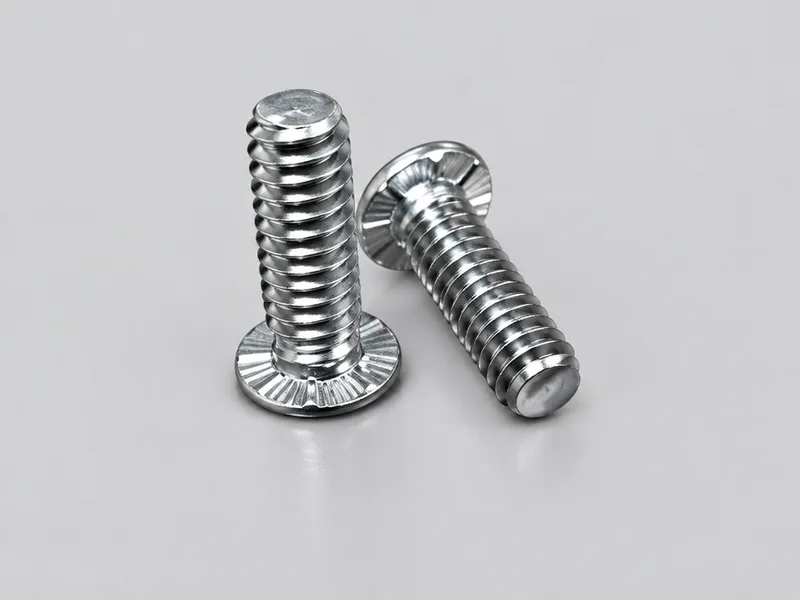
Specifications
Self-clinching studs give a thin panel a male machine thread standing proud of the surface — the mount point for boards, brackets and standoffs — and the designation encodes everything: thread size, then the shank-height variant, so 4-40-0, 4-40-1 and 4-40-2 are the same #4-40 thread on shanks of three different heights. The collected chart tabulates the ladder designation by designation: the three small sizes (#4-40, #6-32, #8-32) in -0/-1/-2 variants, #10 in both 10-24 and 10-32 threads with the same three heights, and 1/4-20 starting at -1 (the source prints no -0 variant). Each row carries the figures a panel layout needs: shank height maximum, the minimum sheet thickness the variant clinches into (from a 0.030–0.039 band on -0 variants to 0.056 in on the -2s), the installation hole size (+.003/-.000, 0.166 in on #4 scaling to 0.344 on 1/4-20), and the mating nut figures — nut diameter, nut height, and the T column as printed. The ladder makes the sheet-versus-protrusion trade explicit: taller shanks (-2) need thicker sheet to carry the clinch, so a 0.040 in panel takes a -0 or -1 stud and a heavier mount goes on thicker stock. The source packs its variant rows — values split designation-by-designation in the table, with the split-band and hyphen-drop print quirks carried as flags rather than smoothed over. Shear/torque-out performance, plating and metric designations are not tabulated — per RFQ.
| Family | Self-clinching studs, inch series; #4-40, #6-32, #8-32, #10-24, #10-32 and 1/4-20 across shank-height variants -0/-1/-2 (1/4-20 from -1) |
|---|---|
| Per-row data (in) | Shank height max, minimum sheet thickness, installation hole +.003/-.000, nut diameter (C), nut height max (E), T figure as printed |
| Shank-height variants | -0/-1/-2 = increasing shank height (e.g. #4: 0.030 / 0.038 / 0.054 max); taller variants need thicker sheet (0.030-.039 → 0.040 → 0.056 minimum) |
| Installation hole | 0.166 (#4) → 0.1875 (#6) → 0.213 (#8) → 0.250 (#10) → 0.344 (1/4-20) in, tolerance +.003/-.000 — the printed band governs the panel layout |
| Not tabulated | Shear/torque-out performance, plating, metric designations, hide/flush variants — per RFQ |
| Designation | Shank Height Max (A) | Min. Sheet Thickness | Hole in Sheet +.003/-.000 | Nut Dia. (C) | Nut Hgt. Max (E) | T |
|---|---|---|---|---|---|---|
| 4-40-0 | .030 | .030-.039 | .166 | .165 | .25 | .07 |
| 4-40-1 | .038 | .040 | .166 | .165 | .25 | .07 |
| 4-40-2 | .054 | .056 | .160 | .165 | .25 | .07 |
| 6-32-0 | .030 | .030-.039 | .1875 | .187 | .28 | .07 |
| 6-32-1 | .038 | .040 | .1875 | .187 | .28 | .07 |
| 6-32-2 | .054 | .056 | .1875 | .187 | .28 | .07 |
| 8-32-0 | .030 | .030-.039 | .213 | .212 | .31 | .09 |
| 8-32-1 | .038 | .040 | .213 | .212 | .31 | .09 |
| 8-32-2 | .054 | .056 | .213 | .212 | .31 | .09 |
| 10-24-0 | .030 | .030-.039 | .250 | .249 | .34 | .09 |
| 10-24-1 | .038 | .040 | .250 | .249 | .34 | .09 |
| 10-24-2 | .054 | .056 | .250 | .249 | .34 | .09 |
| 10-32-0 | .030 | .030-039 | .250 | .249 | .34 | .09 |
| 10-32-1 | .038 | .040 | .250 | .249 | .34 | .09 |
| 10-32-2 | .054 | .065 | .250 | .249 | .34 | .09 |
| 1/4-20-1 | .054 | .056 | .344 | .343 | .44 | .17 |
| 1/4-20-2 | .087 | .091 | .344 | .343 | .44 | .17 |
- Row 1 (4-40-0): The 4-40-0 row prints its sheet-thickness band as a range (.030-.039); 10-24 rows print ".030-039" (hyphen dropped) — both as printed.
- The 1/4-20 ladder starts at -1 (no -0 variant printed by the source); hole-size column for 1/4-20 prints .344 across both variants.
Materials
- Steel and stainless body variants exist across the family; the chart is geometry data — state panel material and hardness at RFQ
Ordering & documentation
Documents
Shipments of Self-Clinching Stud Dimensions — Designation Ladder (4-40-0 to 1/4-20-2) are backed by Mill Test Certificate (MTC), Dimensional Report, Salt Spray Test Report on request, with full batch traceability from raw material to finished product. Quality management for Self-Clinching Stud Dimensions — Designation Ladder (4-40-0 to 1/4-20-2) orders follows the owner-confirmed compliance list: ISO 9001:2015, RoHS, REACH. Exact document sets are confirmed on the order.
Quotation
- The product family (Self-Clinching Stud Dimensions — Designation Ladder (4-40-0 to 1/4-20-2)), product standard/designation and drawing or part number.
- The dimensions that apply to this part — such as size, pitch, length, thickness, fit, grip or groove geometry.
- Material/grade, heat-treatment condition and surface finish, together with the service environment.
- Quantity per size, delivery destination and required test or traceability documents.
Sample & supply
Minimum order quantities and lead times for self-clinching stud dimensions — designation ladder (4-40-0 to 1/4-20-2) are confirmed at quotation — send series, thread size and parent sheet thickness on the RFQ and the quote will carry a firm schedule; sample availability is confirmed with the quotation.
Storage & shipping
Self-Clinching Stud Dimensions — Designation Ladder (4-40-0 to 1/4-20-2) are packed for export and shipped factory-direct to buyers in Europe, Asia, the Americas and the Middle East. Store self-clinching stud dimensions — designation ladder (4-40-0 to 1/4-20-2) dry and protected until installation, and keep coated parts in their packaging until use; specific packing and preservation requirements can be stated on the order and confirmed at quotation.
Frequently asked questions
How do I pick the shank-height variant, and what does the -0/-1/-2 choice cost at assembly?
The variant is fixed by two figures your panel already decides: how far the thread must stand proud of the surface (the mated hardware's engagement depth plus any standoff) and how thick the sheet is. The chart's sheet column is the binding one — each height variant carries its own minimum sheet thickness (0.030–0.039 in band for the -0s, 0.040 for the -1s, 0.056 for the -2s on the small sizes) — because the clinch needs enough panel material to fill the stud's retaining groove; a -2 stud on 0.040 in sheet is under-filled no matter how hard you press. So the sequence runs: engagement requirement first (pick the tallest variant that clears the mounted part), then verify the panel meets that variant's minimum thickness, then lay the hole at the printed size with its +.003/-.000 band. Where a design misses — a deep engagement need on thin sheet — the fix is a flush stud into a thicker local boss or a different insert family, not over-pressing. What the chart cannot decide: the load figures (shear and torque-out are not tabulated here), plating stack effects on the hole, and stainless or metric equivalents — quote those through the RFQ with the panel spec attached.
Commercial terms for clinch studs?
Commercial terms are confirmed at quotation.
Which documents can I request with an order of Self-Clinching Stud Dimensions — Designation Ladder (4-40-0 to 1/4-20-2)?
Orders can be documented with a mill test certificate (MTC), a dimensional report and a salt spray test report, with full batch traceability from raw material to finished product; availability of each document for this designation is confirmed at quotation.
What should an RFQ for Self-Clinching Stud Dimensions — Designation Ladder (4-40-0 to 1/4-20-2) state?
State the full designation (Self-Clinching Stud Dimensions — Designation Ladder (4-40-0 to 1/4-20-2)), thread size and pitch or diameter, length or head dimension, finish, quantity per size, plus the destination country and any required certificate such as a mill test report per EN 10204 3.1; dimensions and schedule for this designation are confirmed with the quotation.
Request a Quote
Get factory-direct pricing from the manufacturer.
What to include in your Self-Clinching Stud Dimensions — Designation Ladder (4-40-0 to 1/4-20-2) inquiry
- ✓ Identify the clinch-nut, stud or standoff series and the internal thread size.
- ✓ Specify parent-sheet material, hardness and actual thickness, not gauge alone.
- ✓ Provide prepared-hole diameter, edge distance and hole-to-hole spacing from the panel drawing.
- ✓ State locking/non-locking requirement, installation press/tooling and any push-out or torque-out acceptance data.
- ✓ Factory-direct pricing for your Self-Clinching Stud Dimensions — Designation Ladder (4-40-0 to 1/4-20-2)
- ✓ Standard and custom specifications
- ✓ Factory-direct export to buyers in Europe, Asia, the Americas and the Middle East
- ✓ Full fastener family support