
DIN 7344 Coiled Spring Pins, Heavy Duty
DIN 7344 heavy-duty coiled spring pins, Ø1.5 to Ø6: pin diameters with tolerances, hole sizes, chamfer, single and double shear strength rows, and the length ladder to 50 mm.
Last updated: 2026-11
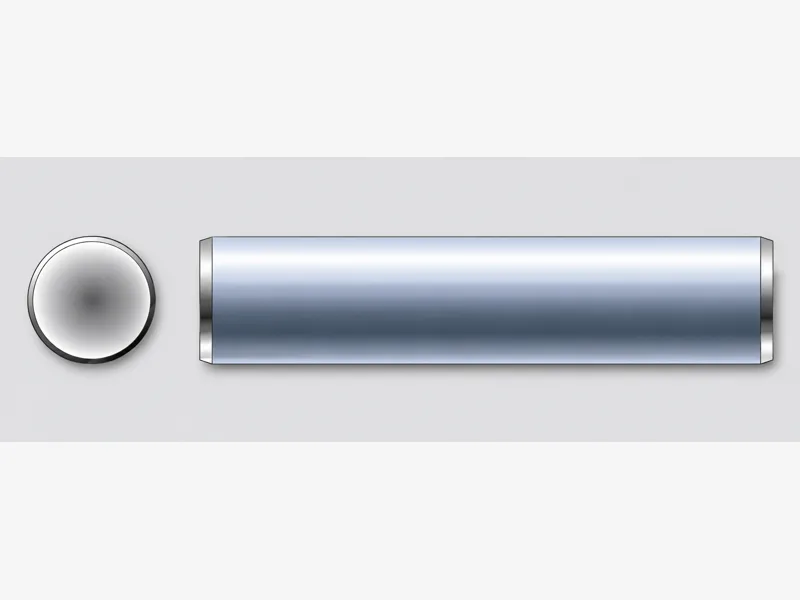
Specifications
DIN 7344 is the heavy-duty member of the coiled spring pin family — the withdrawn source page tabulates Ø1.5 to Ø6 with the numbers that separate it from the standard-duty DIN 7343 (registered separately): pin diameter d min/max and the hole-side d1 max/min, chamfer a ≈, wall s, and — the rows the lighter standard does not carry — minimum single shear strength and minimum double shear in kp (double shear 182 at Ø1.5 up to 2700 at Ø6). The collected geometry also prints the hole dimension the joint is built around (d1 max/min per size), and the second table gives the commercial length ladder 4 to 50 mm with mass. The coiled section works by spring-back — the pin compresses into the hole and pushes out — so the hole size band is part of the joint design, and the shear rows are the acceptance numbers: heavy duty takes roughly double the shock and shear of standard duty at the same pin diameter.
| Standard / scope | DIN 7344 coiled spring pins, heavy duty — Ø1.5 to Ø6, withdrawn (source label); standard-duty counterpart DIN 7343 registered separately |
|---|---|
| Pin / hole diameters | d min/max and hole-side d1 max/min per size — the interference band that drives the spring-back |
| Shear strength | Minimum single shear and minimum double shear rows (kp) per size — double shear 182 (Ø1.5), 686 (Ø3), 2700 (Ø6) — the acceptance rows the joint qualifies against |
| Chamfer / wall | a ≈ and wall s per size — insertion lead and coil section |
| Commercial lengths l | Ladder 4 to 50 mm; approximate mass per 1000 pcs (ρ=7,85 kg/dm³) tabulated per size/length |
| Not tabulated | Material/spring temper, hole material guidance, fatigue data — per RFQ |
| d nom diameter | Ø1.5 | Ø2 | Ø2.5 | Ø3 | Ø4 | Ø5 | Ø6 |
|---|---|---|---|---|---|---|---|
| d min | 1.61 | 2.11 | 2.62 | 3.12 | 4.15 | 5.15 | 6.18 |
| d max | 1.71 | 2.21 | 2.73 | 3.25 | 4.3 | 5.35 | 6.4 |
| d1 mx | 1.4 | 1.9 | 2.35 | 2.85 | 3.8 | 4.8 | 5.8 |
| d1 min | 1.3 | 1.75 | 2.2 | 2.7 | 3.6 | 4.5 | 5.4 |
| a ≈ | 0.5 | 0.7 | 0.8 | 1 | 1.3 | 1.7 | 2 |
| s | 0.17 | 0.22 | 0.28 | 0.33 | 0.45 | 0.56 | 0.67 |
| Minimum shear strength, single (kp) | 91 | 157 | 237 | 343 | 614 | 946 | 1350 |
| Minimum Double Shear (kp) | 182 | 314 | 474 | 686 | 1228 | 1892 | 2700 |
- Source spanning title row carried verbatim: "Dimensions in mm - source DIN 7344 Withdrawn Publication date: 04 - 1969".
| d nominal size | 1.5 | 2 | 2.5 | 3 | 4 | 5 | 6 | |
|---|---|---|---|---|---|---|---|---|
| nominal length l | ||||||||
| 4 | 0.043 | |||||||
| 5 | 0.053 | |||||||
| 6 | 0.064 | 0.11 | 0.17 | |||||
| 8 | 0.085 | 0.15 | 0.23 | 0.33 | ||||
| 10 | 0.107 | 0.19 | 0.29 | 0.41 | 0.74 | |||
| 12 | 0.128 | 0.23 | 0.34 | 0.5 | 0.89 | 1.37 | ||
| 14 | 0.15 | 0.27 | 0.4 | 0.58 | 1.04 | 1.6 | 2.35 | |
| 16 | 0.171 | 0.30 | 0.46 | 0.66 | 1.19 | 1.83 | 2.69 | |
| 18 | 0.34 | 0.51 | 0.75 | 1.33 | 2.06 | 3.03 | ||
| 20 | 0.38 | 0.57 | 0.83 | 1.48 | 2.28 | 3.36 | ||
| 22 | 0.63 | 0.91 | 1.63 | 2.51 | 3.7 | |||
| 24 | 0.69 | 0.99 | 1.78 | 2.74 | 4.04 | |||
| 26 | 1.08 | 1.93 | 2.97 | 4.37 | ||||
| 28 | 1.16 | 2.08 | 3.2 | 4.7 | ||||
| 30 | 1.24 | 2.22 | 3.43 | 5.04 | ||||
| 32 | 1.32 | 2.37 | 3.66 | 5.37 | ||||
| 36 | 2.67 | 4.11 | 6.05 | |||||
| 40 | 2.96 | 4.57 | 6.72 | |||||
| 45 | 5.14 | 7.56 | ||||||
| 50 | 5.71 | 8.41 |
- Source spanning title row carried verbatim: "DIN 7344 - Approximate mass, in kg x1000 pcs, (ρ=7,85 kg/dm 3 )".
- Row-width mismatch in the source grid: source rows carry differing non-empty cell counts (9/8/1/2/4/5/6/7) — grid padded empty; per-row pre-pad widths: 9,8,1,2,2,4,5,6,7,8,8,8,8,8,8,8,8,8,8,8,8,8,8.
Materials
- Heavy-duty coiled pins order in high-carbon spring steel, oil-quenched and tempered, with the coil rolled from hardened strip — the shear rows assume that temper; stainless versions trade shear capacity, so re-qualify the load rows before substituting. The hole is half the joint: drilled to the printed d1 band in steel-type housings, and softer housings want the hole at the bottom of the band. State housing material and shock severity on the RFQ
Ordering & documentation
Documents
Shipments of DIN 7344 Coiled Spring Pins, Heavy Duty are backed by Mill Test Certificate (MTC), Dimensional Report, Salt Spray Test Report on request, with full batch traceability from raw material to finished product. Quality management for DIN 7344 Coiled Spring Pins, Heavy Duty orders follows the owner-confirmed compliance list: ISO 9001:2015, RoHS, REACH. Exact document sets are confirmed on the order.
Quotation
- The product family (DIN 7344 Coiled Spring Pins, Heavy Duty), product standard/designation and drawing or part number.
- The dimensions that apply to this part — such as size, pitch, length, thickness, fit, grip or groove geometry.
- Material/grade, heat-treatment condition and surface finish, together with the service environment.
- Quantity per size, delivery destination and required test or traceability documents.
Sample & supply
Minimum order quantities and lead times for din 7344 coiled spring pins, heavy duty are confirmed at quotation — send pin type, diameter, length and material on the RFQ and the quote will carry a firm schedule; sample availability is confirmed with the quotation.
Storage & shipping
DIN 7344 Coiled Spring Pins, Heavy Duty are packed for export and shipped factory-direct to buyers in Europe, Asia, the Americas and the Middle East. Store din 7344 coiled spring pins, heavy duty dry and protected until installation, and keep coated parts in their packaging until use; specific packing and preservation requirements can be stated on the order and confirmed at quotation.
Frequently asked questions
When does the heavy-duty DIN 7344 pin earn its place over standard-duty DIN 7343?
At the shock and shear numbers. The two standards share the coiled principle and overlapping sizes, but DIN 7344 carries the higher shear rows — at Ø6, 2700 kp minimum double shear against the lighter standard's class — because the coil is rolled from thicker, harder strip. The choice rule: if the joint sees impact, reversing loads or a single shear plane carrying real load (PTO drives, pivot pins on moving equipment, shear-safe coupling pins), heavy duty pays for itself in pin life; for location and light retention the standard-duty pin drives easier and costs less. Note the withdrawn label: order by DIN 7344 as the legacy drawings print, and quote the load row you qualified against — the shear table is what makes the substitution question answerable at all.
How is the hole size chosen for a coiled pin, and what fails if it is wrong?
From the table: each pin size prints the hole-side d1 max/min band, and the hole is drilled inside it — the pin enters undersized, then its coil springs out to fill the band with radial pressure. That pressure is the joint: too big a hole and the pin sits loose, hammering in the bore until the hole walls egg out; too small and insertion load climbs until the pin buckles or the housing cracks. The printed band is narrower than a drill size, so production usually reams or uses the drill that lands mid-band. In soft housings take the hole near the band minimum (more spring compression), in hard or thin-wall housings near the maximum (less hoop stress). Send housing material and hole process with the RFQ — the shear rows only hold in the printed band.
Which documents can I request with an order of DIN 7344 Coiled Spring Pins, Heavy Duty?
Orders can be documented with a mill test certificate (MTC), a dimensional report and a salt spray test report, with full batch traceability from raw material to finished product; availability of each document for this designation is confirmed at quotation.
What should an RFQ for DIN 7344 Coiled Spring Pins, Heavy Duty state?
State the full designation (DIN 7344 Coiled Spring Pins, Heavy Duty), thread size and pitch or diameter, length or head dimension, finish, quantity per size, plus the destination country and any required certificate such as a mill test report per EN 10204 3.1; dimensions and schedule for this designation are confirmed with the quotation.
Request a Quote
Get factory-direct pricing from the manufacturer.
What to include in your DIN 7344 Coiled Spring Pins, Heavy Duty inquiry
- ✓ Identify the pin type and its standard (for example parallel dowel or slotted spring pin).
- ✓ Give nominal diameter, length and required fit/tolerance; include the mating-hole size and whether it is drilled or reamed.
- ✓ State material, heat-treatment condition and corrosion finish, plus any specified shear or retention duty.
- ✓ Give quantity per size, destination and inspection/certificate requirements.
- ✓ Factory-direct pricing for your DIN 7344 Coiled Spring Pins, Heavy Duty
- ✓ Standard and custom specifications
- ✓ Factory-direct export to buyers in Europe, Asia, the Americas and the Middle East
- ✓ Full fastener family support