
Rivets
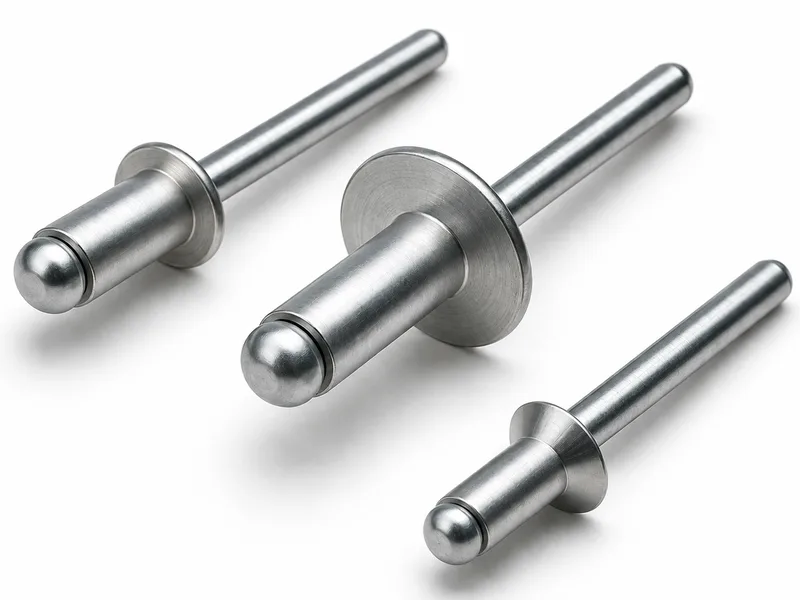
Blind, solid and structural rivets for industrial fastening. The owner-confirmed range includes open-end blind rivets to DIN 7337 / ISO 15977 and IFI-114 references, with materials and variants confirmed against the selected rivet type and drawing.
Last updated: 2026-11
Specifications
Current supplyable range — owner-confirmed scope of supply; requirements outside this range are confirmed per quotation.
| diameter | Up to M36 / 1-1/2" (36 mm) |
|---|---|
| length | Up to 300 mm |
| coating | Zinc plated (blue/yellow), Geomet, Dacromet, hot-dip galvanized |
| standard | DIN 7337 / ISO 15977 (open-end blind rivets); IFI-114 |
| moq | 10000-50000 pieces |
| lead time | 10-20 days |
| head type | Blind (pop), solid, structural rivets |
| price from | USD 0.005-0.02/pc |
Reference notes (collected source statements, not supply-scope values):
- materials:: Alloy steel Grade 8.8-12.9
Materials
- Carbon steel 10B21/10B33/35K/45K
- Stainless steel A2-70 (304) / A4-80 (316)
- Brass CW614N
- Aluminum 6061
Rivet-specific specification boundaries
Standards apply to defined rivet forms, not automatically to every item in a broad rivet family. ISO 15977 covers open-end blind rivets with a break-pull mandrel and protruding head, with an aluminium-alloy body, a steel mandrel and nominal diameters from 2.4 mm to 6.4 mm. It should not be read as the dimensional or performance specification for solid rivets, structural rivets, or other body/mandrel combinations.
The owner-declared material list above includes the notation “Alloy steel Grade 8.8–12.9”. Do not interpret that notation as an ISO 898-1 rivet property class: ISO 898-1 specifies mechanical properties for carbon- and alloy-steel bolts, screws and studs, not rivets. For a load-bearing riveted joint, confirm the exact rivet body and mandrel materials, grip range for the full material stack, prepared-hole size, and rivet-specific tensile and shear data for the selected part.
Selection guidance
Rivets are chosen by joint access and duty: blind (one-side) vs solid (two-side) vs self-piercing, then by grip range against the measured stack. Each grade below carries its own collected-source row.
How do you verify a blind rivet size against the actual joint?
Read the trade size correctly first: blind rivet trade sizes are number pairs, where the first number is the rivet diameter in 32nds of an inch and the second the maximum grip length in 16ths of an inch - trade size 46 is a 1/8-inch diameter rivet (4/32) with a 3/8-inch maximum grip (6/16). The table then pins each size to its grip window: size 46 covers 0.313" to 0.375" of stack at a 0.500" rivet length. Grip range is not a nominal label - it is the total material thickness the rivet is designed to clamp, and using a rivet outside its specified grip range may result in poor blind-side formation, insufficient clamping or reduced joint performance. So the first verification is a measurement: clamp the actual stack, then match the number to the grip window, not the other way round.
Then verify the two dimensions the drawing never states: the hole and the length. GESIPA gives an illustrative recommendation of a hole approximately 0.1 mm larger than the rivet diameter, such as a 4.9 mm hole for a 4.8 mm rivet - exact values must come from the selected rivet's product data. Length must cover the full joint: a rivet that is too short may not form a secure closing head, and one that is unnecessarily long may clamp poorly, leave excessive material behind the joint or behave unpredictably during installation.
What this page cannot verify: set quality on the actual installation tool (mandrel pull force, air pressure), hole alignment through the real layers, and blind-side formation on your specific substrate - those are proven on a test set-up, not from a size table.
Which rivet construction survives the duty: standard, structural, or self-piercing?
Standard blind rivets serve light- and medium-duty fastening; structural blind rivets are engineered for more demanding applications requiring increased shear strength, tensile strength and resistance to vibration, still with one-side access - the applications concentrate in truck and trailer manufacturing, commercial vehicles, transport equipment, metal fabrication and industrial assembly. The selection ladder is order-sensitive: measure the combined thickness of all materials being joined and select a grip range that includes the total; then consider the shear (forces across the joint) and tensile (forces pulling materials apart) loads; then match diameter and material configuration to the joint design and environment. Head style is a duty decision too: a large bearing surface is ideal for fastening soft and brittle materials such as plywood, plastics, and vinyl, while the low-profile dome provides adequate bearing for most general applications.
Self-piercing riveting is a different mechanism, not a stronger pop rivet: no pre-drilled hole, the rivet pierces the top sheet and flares into the bottom. Geometry is tightly standardized - typically a 3 or 5 mm shank, with rivet length chosen to be approximately equal to the combined thickness of the sheets to be joined, plus 75% of the rivet shank diameter. Hardness is the verification point: the rivet must be hard enough to pierce the top sheet but sufficiently ductile to flare properly in the bottom sheet - if the hardness is too low, the rivet may collapse during the process; if it is too high, it may cause thinning or piercing of the bottom sheet, or cracks in the flared rivet tail. Production SPR rivets are case-hardened boron steel (SAE 10B35, 480 HV +/-30), aimed at aluminium, prepainted and dissimilar stacks that are difficult or unsuitable to weld.
Ordering & documentation
Documents
Shipments of Rivets are backed by Mill Test Certificate (MTC), Dimensional Report, Salt Spray Test Report on request, with full batch traceability from raw material to finished product. Quality management for this rivets line follows the owner-confirmed compliance list: ISO 9001:2015, RoHS, REACH. Exact document sets are confirmed on the order.
Quotation
- Blind, solid or structural rivet type and the applicable product standard.
- Rivet-body diameter and grip range for the complete material stack, plus the prepared-hole size.
- Head style/clearance and body and mandrel materials separately for blind rivets.
- For load-bearing joints, required rivet-specific tensile and shear values; do not substitute a bolt property class.
- Finish, quantity, destination and any lot-test or traceability documents required.
Sample & supply
Minimum order quantity for rivets is 10,000–50,000 pieces depending on size (applies to the standard sizes and finishes for rivets; mixed, special or custom variants are quoted — final commercial terms per quotation) Standard production for this family run 10–20 days. Quantities or variants outside the standard range are confirmed at quotation.
Storage & shipping
Rivets are packed for export and shipped factory-direct to buyers in Europe, Asia, the Americas and the Middle East. Store these rivets dry and protected until installation, and keep coated parts in their packaging until use; specific packing and preservation requirements can be stated on the order and confirmed at quotation.
Rivet types & standards
The owner-confirmed family-level supply ceiling is up to M36 diameter and 300 mm length; it is not a dimensional claim for every rivet subtype. The pages below cover distinct blind, solid, structural, tubular and rivet-nut forms. For each order, confirm the subtype-specific standard, diameter and length range, grip range, head style, body/mandrel materials and rivet-specific strength data against the exact drawing or manufacturer series. Do not transfer the family ceiling to an individual subtype or treat ISO 15977 as covering every blind-rivet variant.
Choosing between blind rivets? See the blind rivet type comparison — open-end, closed-end, multi-grip and structural side by side.
- Open-End Blind Rivets (DIN 7337 dimensions; ISO 15977 specified variant)
- Closed-End Blind Rivets
- Structural Blind Rivets
- Rivet Nuts (Blind Threaded Inserts)
- DIN 660 Round Head Solid Rivets
- DIN 661 Countersunk Solid Rivets
- DIN 7340 Tubular Rivets
- Flat Head Round Body Open-End Rivet Nuts
- Closed-End Rivet Nuts
- Countersunk Head Rivet Nuts
- Full Hex Body Rivet Nuts
- Half-Hex Body Rivet Nuts
- Knurled Round Body Rivet Nuts (Thin-Wall / Low-Profile)
- High-Strength Rivet Nuts (Class 10 / Grade 8)
- Multi-Grip Blind Rivets
- Peel Blind Rivets
- Tri-Fold Blind Rivets
- Hammer-Drive Blind Rivets
- Grooved Blind Rivets
- Knurled Blind Rivets (Electrical Earthing)
- High-Strength Blind Rivets for Thin & Fragile Materials
- Semi-Tubular Rivets
- Self-Piercing Rivets (SPR)
- Hardened Steel Self-Piercing Rivets
- Self-Piercing Rivets — Inch Work-Thickness Series
- Commercial Solid Rivets (Inch Series, Per-Head-Type)
- Aerospace Solid Rivets (MS / AN / NAS Series)
- DIN 7338 Rivets for Brake and Clutch Linings
- DIN 674 Flat Round Head Rivets
- DIN EN ISO 16583 Open End Blind Rivets, Countersunk Head, Cu/St (Break Pull Mandrel)
- DIN 302 Countersunk Head Rivets
- DIN 662 Mushroom Head Rivets
- DIN 6791 Semi-Tubular Pan Head Rivets
- DIN 6792 Semi-Tubular Countersunk Head Rivets
- DIN 7331 Compression Rivets
- DIN 7339 Hollow Rivets, One Piece, Drawn from Strip
Engineering references
Dimension charts and technical reference tables for rivets — engineering aids for selection and verification, not a statement of the orderable range. Supply availability is confirmed per quotation.
- Solid Rivet Head Dimensions by Head Type — engineering reference
Frequently asked questions
Open-end blind rivets or structural rivets — which do I need?
DIN 7337 dimensional references and ISO 15977 conformity are not interchangeable claims. ISO 15977 applies only to protruding-head open-end blind rivets with an aluminum body, steel mandrel and 2.4–6.4 mm nominal diameter; countersunk aluminum-body/steel-mandrel variants within 2.4–5.0 mm are covered by ISO 15978. Other material and head combinations require the exact manufacturer series. Structural rivets are specified separately to IFI-114. Name the subtype, body/mandrel materials, head form and grip range on the RFQ.
Which rivet material suits my environment?
The owner-declared material list includes carbon steel (10B21/10B33/35K/45K), stainless A2-70 (304) and A4-80 (316), an alloy-steel entry written as “Grade 8.8–12.9”, brass CW614N and aluminum 6061. That 8.8–12.9 notation is not a rivet property class and must not be used as an ISO 898-1 mechanical grade for a riveted joint. For blind rivets, specify body and mandrel materials separately; for solid or structural rivets, name the product standard and require rivet-specific tensile and shear data for the selected part. Aluminum body rivets suit general outdoor weight-sensitive work; A4 stainless suits marine and chemical exposure. If the service environment is aggressive, state it in the RFQ so the material pairing can be confirmed.
What is the MOQ and lead time for rivets?
The minimum order quantity is 10,000–50,000 pieces depending on size. Standard production runs 10–20 days. Head options and coatings outside the standard list are confirmed at quotation.
Request a Quote
Get factory-direct pricing from the manufacturer.
What to include in your Rivets inquiry
- ✓ Identify blind, solid or structural rivet type and the applicable product standard.
- ✓ Give rivet-body diameter and grip range for the complete material stack, plus the prepared-hole size.
- ✓ Specify head style/clearance and state body and mandrel materials separately for blind rivets.
- ✓ For load-bearing joints, provide required rivet-specific tensile and shear values; do not substitute a bolt property class.
- ✓ State finish, quantity, destination and any lot-test or traceability documents required.
- ✓ Factory-direct pricing for your Rivets
- ✓ Standard and custom specifications
- ✓ Factory-direct export to buyers in Europe, Asia, the Americas and the Middle East
- ✓ Full fastener family support