
Hammer-Drive Blind Rivets
Hammer-drive blind rivets — set by hammering the mandrel head, no rivet gun needed. The aluminium body splits into three symmetric legs for a strong clamp in wood, plastic, brick, concrete and cladding, into through or pocket holes — even into cellular concrete without drilling. Extra-large flange heads.
Last updated: 2026-11
Specifications
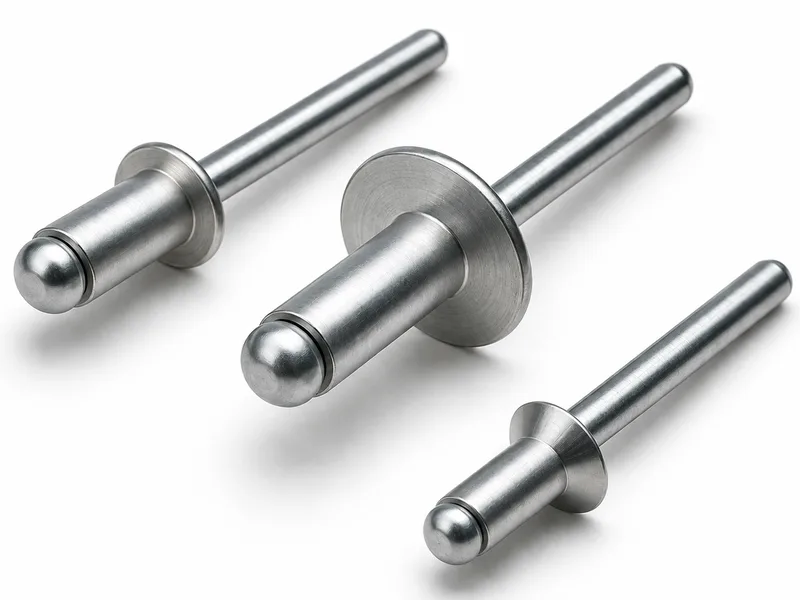
The hammer-drive rivet removes the tool from blind fastening: it sets by striking the mandrel head with a hammer, driving the mandrel into the body so the aluminium body splits into three symmetric legs and locks. The collected manufacturer line states the working envelope plainly — fast and strong clamping through simple hammering; usable with through or pocket holes; fixable into wood, plastic, brick, concrete or cladding; usable with any hollow or solid material; and, notably, into cellular concrete without drilling at all. That last point is the practical differentiator: on blockwork and aero-concrete walls where a drill-and-plug fixing is overkill or the base material is too weak to thread, a hammer-drive rivet gives a permanent point in one strike. The collected line ships it as an extra-large flange (TEL) head for maximum bearing on soft base materials, in aluminium body with A2 stainless mandrel, with separate published data for pocket-hole and through-hole installation — the grip figure means the maximum grip thickness in pocket-hole use and reads differently from the through-hole table, so select from the table that matches the job. The blind-side trade is the same as any split-body rivet: the three legs need clearance and bear widely, and the set is permanent.
| Type | Hammer-drive blind rivet — set by hammering the mandrel head; no rivet gun required |
|---|---|
| Setting mechanism | Mandrel driven into the body by hammer strike; body splits into three symmetric legs for perfect fastening (manufacturer line) |
| Base materials (manufacturer line) | Wood, plastic, brick, concrete, cladding — any hollow or solid material; usable in cellular concrete without drilling |
| Hole options | Through hole or pocket hole — pocket-hole and through-hole data are published separately and read differently (grip column = max grip thickness "S" in the pocket table) |
| Head style | Extra-large flange (TEL) — maximum bearing on soft base materials |
| Representative series data (pocket hole, 4.8 mm, aluminium body / stainless steel A2 mandrel) | dk 12.0 at L 10/12; dk 14.5 at L 16–50; drill 5.0; tensile 2000 N, shear 4500 N; max grip by length — L 10 → 5, L 12 → 7, L 16 → 11, L 20 → 15, L 25 → 20, L 30 → 25, L 35 → 30, L 40 → 35, L 45 → 40, L 50 → 45 mm |
| Series scope | Ø 6 and 6.4 mm, other lengths and steel-mandrel variants beyond the tabulated rows |
| Applications (manufacturer line) | Swimming-pool construction, warehouse and ceiling work |
| MOQ / lead time | 10,000–50,000 pieces by size; 10–20 days |
Materials
- Aluminium body / stainless steel A2 mandrel
- Steel mandrel variants
Ordering & documentation
Documents
Shipments of Hammer-Drive Blind Rivets are backed by Mill Test Certificate (MTC), Dimensional Report, Salt Spray Test Report on request, with full batch traceability from raw material to finished product. Quality management for Hammer-Drive Blind Rivets orders follows the owner-confirmed compliance list: ISO 9001:2015, RoHS, REACH. Exact document sets are confirmed on the order.
Quotation
- The product family (Hammer-Drive Blind Rivets), product standard/designation and drawing or part number.
- The dimensions that apply to this part — such as size, pitch, length, thickness, fit, grip or groove geometry.
- Material/grade, heat-treatment condition and surface finish, together with the service environment.
- Quantity per size, delivery destination and required test or traceability documents.
Sample & supply
Minimum order quantity for hammer-drive blind rivets is 10,000–50,000 pieces depending on size (applies to the standard sizes and finishes for hammer-drive blind rivets; mixed, special or custom variants are quoted — final commercial terms per quotation) Standard production for hammer-drive blind rivets run 10–20 days. Quantities or variants of hammer-drive blind rivets outside the standard range are confirmed at quotation.
Storage & shipping
Hammer-Drive Blind Rivets are packed for export and shipped factory-direct to buyers in Europe, Asia, the Americas and the Middle East. Store hammer-drive blind rivets dry and protected until installation, and keep coated parts in their packaging until use; specific packing and preservation requirements can be stated on the order and confirmed at quotation.
Frequently asked questions
When does a hammer-drive rivet beat a normal blind rivet or a wall plug?
When the base material is weak, the work is intermittent, or the tool is the constraint. Against a standard blind rivet: the hammer-drive needs no rivet gun and sets in masonry-type bases the gun rivet cannot grip — but it is slower per point on long production runs. Against a wall plug and screw: it is a permanent, vibration-stable point in one strike, and it works in cellular concrete without any drilling — where a plug has nothing solid to thread into. It is the maintenance and construction answer, not a production-line rivet.
What is the MOQ and lead time for these rivets?
Minimum order quantity is 10,000–50,000 pieces depending on size and material. Standard production lead time is 10–20 days. Common blind rivet sizes are widely stocked — confirm the exact schedule against quantity and size mix at quotation.
What should an RFQ for these rivets state?
State the rivet subtype (open-end, closed-end, structural blind rivet or rivet nut), body diameter, grip range or total material thickness, head style (dome, countersunk or large flange), body and mandrel materials (for example aluminum body with steel mandrel, or all-stainless), finish, required certificates such as a mill test report per EN 10204 3.1, and quantity per size — plus destination country.
Request a Quote
Get factory-direct pricing from the manufacturer.
What to include in your Hammer-Drive Blind Rivets inquiry
- ✓ Identify blind, solid or structural rivet type and the applicable product standard.
- ✓ Give rivet-body diameter and grip range for the complete material stack, plus the prepared-hole size.
- ✓ Specify head style/clearance and state body and mandrel materials separately for blind rivets.
- ✓ For load-bearing joints, provide required rivet-specific tensile and shear values; do not substitute a bolt property class.
- ✓ State finish, quantity, destination and any lot-test or traceability documents required.
- ✓ Factory-direct pricing for your Hammer-Drive Blind Rivets
- ✓ Standard and custom specifications
- ✓ Factory-direct export to buyers in Europe, Asia, the Americas and the Middle East
- ✓ Full fastener family support