
Self-Piercing Rivets (SPR)
Self-piercing rivets — semi-hollow rivets driven by a press through the top sheet without a pre-drilled hole, the die flaring the tail into the bottom sheet for a mechanical interlock. Metric series 2–5 mm shank with published fastening ranges 0.3–4.3 mm, JIS-method joint strength tests, installation acceptance criteria and a measured shear comparison against resistance spot welding.
Last updated: 2026-11
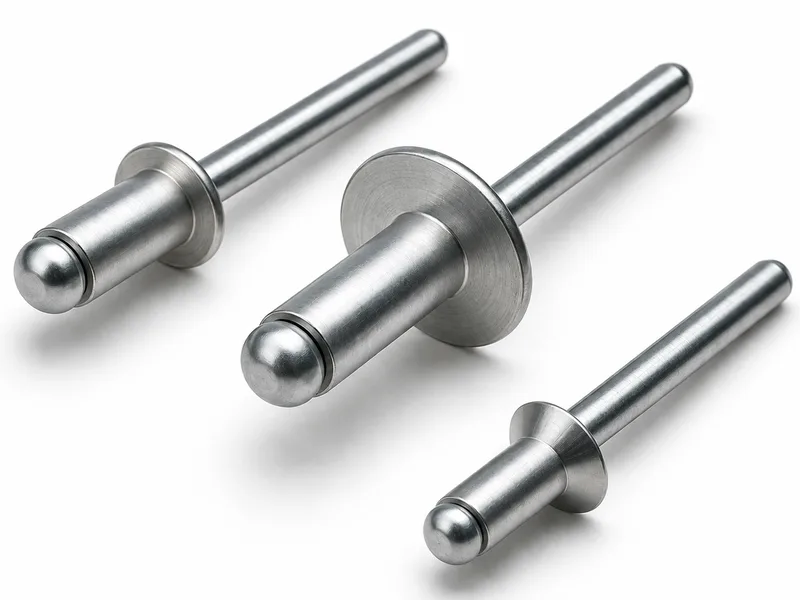
Specifications
A self-piercing rivet joins sheets the way no blind rivet can start and no spot welder needs to finish: pressed straight through the top sheet — no hole drilled, no plug removed, no weld access — until the die below flares the semi-hollow tail into the bottom sheet, locking the stack mechanically. The collected manufacturer series runs five shank diameters (2, 3, 3.6, 4 and 5 mm) with a ladder of under-head lengths per diameter, each mapped to a recommended total material thickness from 0.3 up to 4.3 mm; the published tables assume SPCC (painted or plated) parent sheet at about Hv120 and state plainly that the final size is subject to trial fastening. Joint strength is published as measured test data, not a standard minimum: on cold-rolled steel at mid-range grip, a 3 × 3.5 rivet fractured at 1.18 kN tensile / 1.97 kN shear, rising to 9.10 / 11.20 kN for the 5 × 7 size — with the manufacturer's own instruction to design to a safety factor of at least three to one. Against resistance spot welding on comparable aluminum stacks, the collected comparison puts SPR shear at or above the weld spot at every thickness step. Acceptance of a set joint has its own criteria (see the specification rows): head seating without gap, buck-tail free of large cracks, a constriction around the full tail circumference, and a curl diameter in the 1.5–1.7 × d guide band. SPR is a system purchase — rivet, die and press force are chosen together — so confirm the combination against your sheet build at quotation.
| Type | Self-piercing rivet — pressed through the top sheet without pre-drilling; tail flared by the die into the bottom sheet for a mechanical interlock |
|---|---|
| Size series (collected table) | Shank d 2, 3, 3.6, 4, 5 mm; head D 3.7–9.6 mm; head height H 0.6–1.8 mm; under-head length ladders per diameter — see the specification table |
| Fastening range (published) | 0.3–0.6 mm (d 2) up to 3.7–4.3 mm (d 5, L 7.0) — per length, assuming SPCC painted/plated sheet at about Hv120 or equivalent |
| Sizing rules (industry guidance) | Typical shank diameters 3 or 5 mm; rivet length ≈ combined sheet thickness + 75% of shank diameter; head diameter typically 2–3 mm greater than shank |
| Joint strength (measured, JIS Z 3136/3137 methods) | 2 × 2 → 0.24 kN tensile / 0.58 kN shear; 3 × 3.5 → 1.18 / 1.97; 3.6 × 4.5 → 2.97 / 4.21; 4 × 5.5 → 4.80 / 6.90; 5 × 7 → 9.10 / 11.20 — cold-rolled steel at mid-range grip; design to a safety factor of at least 3:1 (manufacturer test note) |
| Shear vs resistance spot welding (collected comparison) | SPR vs RSW, shear kN at equal stack: 1.28 vs 1.13 (3 × 3 in 0.4+0.4); 2.16 vs 2.06 (3.6 × 3.9); 3.44 vs 3.14 (4 × 4); 4.60 vs 4.41 (5 × 5.5); 5.90 vs 5.79 (5 × 5.5); 9.05 vs 8.92 (5 × 6.5) — manufacturer-published test |
| Installation acceptance criteria | No space under head; curl height ≈ 0.5 × shank d (guide); buck-tail free of large cracks; constriction around full tail circumference; near-uniform buck-tail shape; curl diameter ≈ 1.5–1.7 × shank d (guide) |
| Process caveat | Rivet size is subject to trial fastening; non-standard workpieces (material types, extreme thickness imbalance, stacks outside the published range) are make-to-order consultations |
| Head styles | Low round (standard series); flat and countersunk made to order |
| MOQ / lead time | 10,000–50,000 pieces by size; 10–20 days |
| Nominal diameter (d) | Shank tolerance | Head diameter D (tolerance) | Head height H (±0.05) | A (mm) | L options → recommended total material thickness (mm) |
|---|---|---|---|---|---|
| 2 | +0.02 | 3.7 (0/−0.3) | 0.6 | 1.2 | L 2.0 → 0.3–0.6 |
| 3 | ±0.05 | 5.5 (0/−0.3) | 1.0 | 1.8 | L 2.3 → 0.4–0.8; L 3.0 → 0.4–1.2 |
| 3.6 | ±0.05 | 6.6 (0/−0.3) | 1.2 | 2.2 | L 3.5 → 0.9–1.6; L 3.9 → 1.0–1.8; L 4.2 → 1.6–2.1; L 4.5 → 2.1–2.6 |
| 4 | ±0.05 | 7.4 (0/−0.4) | 1.5 | 2.4 | L 4.0 → 1.2–1.8; L 4.5 → 1.8–2.3; L 5.0 → 2.3–2.8; L 5.5 → 2.8–3.2 |
| 5 | ±0.05 | 9.6 (0/−0.4) | 1.8 | 2.9 | L 5.5 → 2.0–2.7; L 6.0 → 2.7–3.2; L 6.5 → 3.2–3.7; L 7.0 → 3.7–4.3 |
Materials
- Steel (high-carbon) — standard specification
- Stainless steel — special specification (on request)
- Aluminum — special specification (on request)
Ordering & documentation
Documents
Shipments of Self-Piercing Rivets (SPR) are backed by Mill Test Certificate (MTC), Dimensional Report, Salt Spray Test Report on request, with full batch traceability from raw material to finished product. Quality management for Self-Piercing Rivets (SPR) orders follows the owner-confirmed compliance list: ISO 9001:2015, RoHS, REACH. Exact document sets are confirmed on the order.
Quotation
- The product family (Self-Piercing Rivets (SPR)), product standard/designation and drawing or part number.
- The dimensions that apply to this part — such as size, pitch, length, thickness, fit, grip or groove geometry.
- Material/grade, heat-treatment condition and surface finish, together with the service environment.
- Quantity per size, delivery destination and required test or traceability documents.
Sample & supply
Minimum order quantity for self-piercing rivets (spr) is 10,000–50,000 pieces depending on size (applies to the standard sizes and finishes for self-piercing rivets (spr); mixed, special or custom variants are quoted — final commercial terms per quotation) Standard production for self-piercing rivets (spr) run 10–20 days. Quantities or variants of self-piercing rivets (spr) outside the standard range are confirmed at quotation.
Storage & shipping
Self-Piercing Rivets (SPR) are packed for export and shipped factory-direct to buyers in Europe, Asia, the Americas and the Middle East. Store self-piercing rivets (spr) dry and protected until installation, and keep coated parts in their packaging until use; specific packing and preservation requirements can be stated on the order and confirmed at quotation.
Frequently asked questions
How is a self-piercing rivet different from a blind rivet if both avoid drilling?
A blind rivet does not avoid drilling — it avoids back-side access: you drill a hole, then pull a mandrel to expand the body. A self-piercing rivet removes the hole itself: the press drives the rivet straight through the top sheet, the pierced plug stays in the joint, and the die below flares the tail to interlock with the bottom sheet. The consequences run both ways: SPR needs no drilling operation or hole alignment (and no hole in coated or prepainted panels to touch up), but it needs press force, a matched die, and access to both sides — the die side is not optional as it is with a blind rivet. Blind rivets also span far wider grip ladders per size; SPR is selected as a rivet-and-die system against a specific sheet build.
What makes an SPR joint acceptable — how is it inspected?
By the geometry of the set cross-section. The external criteria from the collected installation guide: the head must seat with no gap around it, the curl height should land near half the shank diameter, the flared tail (buck-tail) must show no large cracks, a constriction should ring the full circumference, and the curl diameter should fall in the 1.5–1.7 × d guide band with an almost uniform shape. Industry practice additionally reads the sectioned joint on three measured attributes — bottom thickness (how much parent sheet remains under the rivet foot), undercut (how far the flared foot hooks past the pierced interface), and spread (how much the foot flared relative to the shank). These are joint-acceptance checks for a process, not per-rivet catalog numbers: validate them on your material combination, which is also why the manufacturer requires trial fastening to fix the final size.
What is the MOQ and lead time for these rivets?
Minimum order quantity is 10,000–50,000 pieces depending on size and material. Standard production lead time is 10–20 days. Common blind rivet sizes are widely stocked — confirm the exact schedule against quantity and size mix at quotation.
What should an RFQ for these rivets state?
State the rivet subtype (open-end, closed-end, structural blind rivet or rivet nut), body diameter, grip range or total material thickness, head style (dome, countersunk or large flange), body and mandrel materials (for example aluminum body with steel mandrel, or all-stainless), finish, required certificates such as a mill test report per EN 10204 3.1, and quantity per size — plus destination country.
Request a Quote
Get factory-direct pricing from the manufacturer.
What to include in your Self-Piercing Rivets (SPR) inquiry
- ✓ Identify blind, solid or structural rivet type and the applicable product standard.
- ✓ Give rivet-body diameter and grip range for the complete material stack, plus the prepared-hole size.
- ✓ Specify head style/clearance and state body and mandrel materials separately for blind rivets.
- ✓ For load-bearing joints, provide required rivet-specific tensile and shear values; do not substitute a bolt property class.
- ✓ State finish, quantity, destination and any lot-test or traceability documents required.
- ✓ Factory-direct pricing for your Self-Piercing Rivets (SPR)
- ✓ Standard and custom specifications
- ✓ Factory-direct export to buyers in Europe, Asia, the Americas and the Middle East
- ✓ Full fastener family support