
Closed-End Rivet Nuts
Closed-end rivet nuts seal the thread from the blind side: the body end is closed before setting, so fluid and dust cannot reach the screw through the insert. Available across round and hex body lines, open and closed as a standard catalog option, with sealed variants on select large-flange styles — the answer for enclosures, wash-down areas and pressure-washed equipment.
Last updated: 2026-11
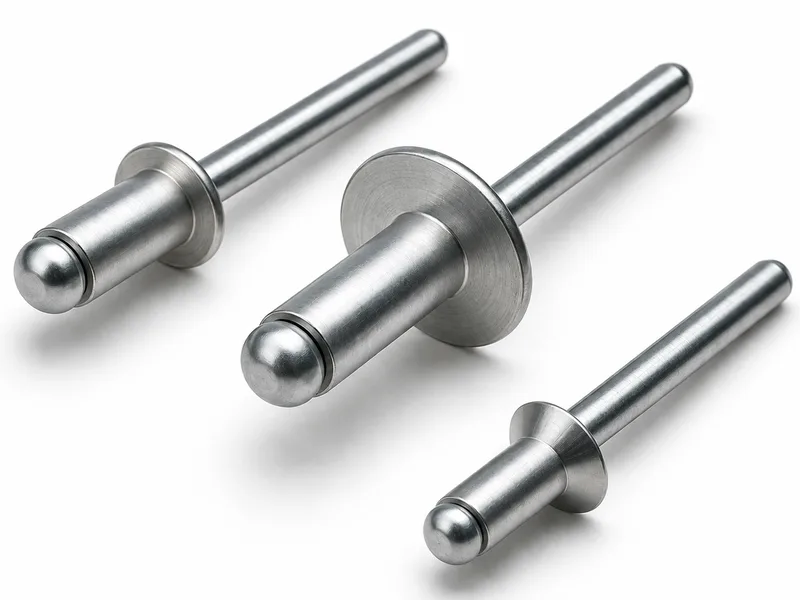
Specifications
A closed-end rivet nut is the standard insert with the blind-side end sealed: the body is closed before setting, so after collapse there is no through-channel from the screw down through the sheet. The manufacturer line lists open and closed end options across most of the range and reserves sealed-end variants on select large-flange styles specifically for added protection against fluid or dust ingress — a deliberate escalation for joints where the thread is on the wet or dirty side of the panel. The catalog facet split is the same two-way choice: closed or open. Note what the closed end does not do — it is not a gasket for the clearance hole around the insert; the seal is through the body, not around it. The typical application set is enclosure panels, electrical cabinets, vehicle underbodies and wash-down equipment: anywhere the blind side sees moisture or contamination that would otherwise wick to the screw and corrode the joint from the inside.
| Type | Closed-end rivet nut — blind-side body end sealed before setting; no through-channel from the installed thread |
|---|---|
| Sealing scope | Seals the insert body against fluid and dust from the blind side; the clearance hole around the insert still needs its own sealing measure if the panel is a weather line |
| Availability | Manufacturer line: "Open and closed end options available across most of the range, with sealed-end options on select large-flange styles for added protection against fluid or dust ingress" |
| Body line availability (high-strength line) | High-strength line carries the option across designs: "hex body, round body, open end, and closed end designs" |
| Wedge-body sealed option | Wedge-design round body line adds a patent-pending closed-end design that "provides a sealed option that does not compromise the biting effect of the wedges" |
| Catalog end-type facet | Catalog facets split the category into End Type: Closed / Open — closed end is a standard selectable configuration, not a specialty order |
| MOQ / lead time | 10,000–50,000 pieces by size; 10–20 days |
| Thread | Body diameter max (mm) | Head diameter (mm) | Hole in sheet (mm) | Grip range options (mm) | Min sheet (mm) |
|---|---|---|---|---|---|
| M4x0.7 | 5.98 | 9 | 6 | 0.5-2.5 | 0.5 |
| M5x0.8 | 6.98 | 10 | 7 | 0.5-3.0 | 0.5 |
| M6x1 | 8.98 | 13 | 9 | 0.5-3.0 | 0.5 |
| M8x1.25 | 10.98 | 16 | 11 | 0.5-3.0 | 0.5 |
| M10x1.5 | 12.98 | 19 | 13 | 0.7-3.5 | 0.7 |
| M12x1.75 | 15.98 | 23 | 16 | 1.0-4.0 | 1.0 |
Materials
- Steel
- Stainless steel
- Aluminum
Ordering & documentation
Documents
Shipments of Closed-End Rivet Nuts are backed by Mill Test Certificate (MTC), Dimensional Report, Salt Spray Test Report on request, with full batch traceability from raw material to finished product. Quality management for Closed-End Rivet Nuts orders follows the owner-confirmed compliance list: ISO 9001:2015, RoHS, REACH. Exact document sets are confirmed on the order.
Quotation
- The product family (Closed-End Rivet Nuts), product standard/designation and drawing or part number.
- The dimensions that apply to this part — such as size, pitch, length, thickness, fit, grip or groove geometry.
- Material/grade, heat-treatment condition and surface finish, together with the service environment.
- Quantity per size, delivery destination and required test or traceability documents.
Sample & supply
Minimum order quantity for closed-end rivet nuts is 10,000–50,000 pieces depending on size (applies to the standard sizes and finishes for closed-end rivet nuts; mixed, special or custom variants are quoted — final commercial terms per quotation) Standard production for closed-end rivet nuts run 10–20 days. Quantities or variants of closed-end rivet nuts outside the standard range are confirmed at quotation.
Storage & shipping
Closed-End Rivet Nuts are packed for export and shipped factory-direct to buyers in Europe, Asia, the Americas and the Middle East. Store closed-end rivet nuts dry and protected until installation, and keep coated parts in their packaging until use; specific packing and preservation requirements can be stated on the order and confirmed at quotation.
Frequently asked questions
Does a closed-end rivet nut make the panel watertight?
It closes the path through the insert, not around it. After setting, a closed-end body leaves no channel from the screw down through the sheet, so fluid and dust on the blind side cannot reach the thread — that is what it is for. The clearance hole between insert and sheet is a separate joint: if the panel itself is a weather line, the sealant or gasket the design calls for still applies. Use the closed end wherever the blind side sees moisture, dust or washing — enclosures, underbodies, wash-down frames — and treat it as thread protection rather than a gasket.
What does the closed end cost me compared with an open-end insert?
Mainly availability breadth and a little set length: the closed end is a standard configuration across most body lines, but the deepest size-ladder coverage in the catalogs sits on the open-end line, and a closed body is marginally longer for the same thread. There is no strength penalty in the selection logic — body shape (round, knurled, half hex, full hex) still decides torque resistance exactly as it does for open ends. If the blind side is benign, the open-end insert remains the economical default; specify closed end where the environment gives you a reason.
What is the MOQ and lead time for these rivets?
Minimum order quantity is 10,000–50,000 pieces depending on size and material. Standard production lead time is 10–20 days. Common blind rivet sizes are widely stocked — confirm the exact schedule against quantity and size mix at quotation.
What should an RFQ for these rivets state?
State the rivet subtype (open-end, closed-end, structural blind rivet or rivet nut), body diameter, grip range or total material thickness, head style (dome, countersunk or large flange), body and mandrel materials (for example aluminum body with steel mandrel, or all-stainless), finish, required certificates such as a mill test report per EN 10204 3.1, and quantity per size — plus destination country.
Request a Quote
Get factory-direct pricing from the manufacturer.
What to include in your Closed-End Rivet Nuts inquiry
- ✓ Identify blind, solid or structural rivet type and the applicable product standard.
- ✓ Give rivet-body diameter and grip range for the complete material stack, plus the prepared-hole size.
- ✓ Specify head style/clearance and state body and mandrel materials separately for blind rivets.
- ✓ For load-bearing joints, provide required rivet-specific tensile and shear values; do not substitute a bolt property class.
- ✓ State finish, quantity, destination and any lot-test or traceability documents required.
- ✓ Factory-direct pricing for your Closed-End Rivet Nuts
- ✓ Standard and custom specifications
- ✓ Factory-direct export to buyers in Europe, Asia, the Americas and the Middle East
- ✓ Full fastener family support