
Closed-End Blind Rivets
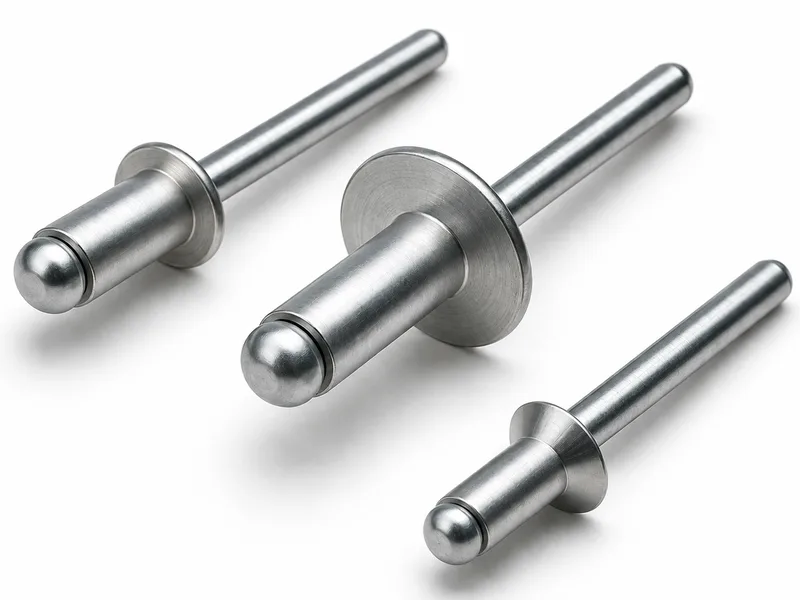
Closed-end blind rivets — the sealed-body variant of the break-mandrel blind rivet. The cupped body closes the mandrel channel for a watertight joint, with locked-mandrel retention and stainless options rated above 1000 hours salt spray. For curtain wall, roofing and outdoor enclosures.
Last updated: 2026-11
Specifications
A closed-end blind rivet is the break-mandrel blind rivet with the blind end closed: the body is cupped, so when the mandrel is drawn and snaps, nothing leaves an open channel through the set rivet. The collected industry guide puts the sealed type at a fully watertight joint with the core shaft locked in place — which also removes the loose-mandrel rattle and corrosion path of an open-end set — and names stainless options resistant to salt spray beyond 1000 hours. That combination is why the closed-end rivet is the default for curtain wall panels, metal roofing and façade fixings, where the rivet is the weather line. It installs one-sided like any blind rivet, on the same drills and tools; the trade-offs are a slightly stiffer set and a shorter standard size ladder than the open-end line. Where the hole is not a leakage path, the open-end rivet stays the economical choice.
| Type | Closed-end (sealed-body) break-mandrel blind rivet — no open channel through the set rivet |
|---|---|
| Sealing | Fully sealed joint; mandrel locked in the body — guides rate the sealed type as watertight with locked-core vibration behavior |
| Corrosion (stainless option) | Stainless closed-end option referenced at over 1000 hours salt-spray resistance (guide figure, not a tested coupon) |
| Sheet thickness scope | Blind rivets generally suit 0.3–3.0 mm sheets; select grip range from the specific body line |
| Standard (dome head, alu/steel) | IFI-126 — closed-end, dome head, aluminum body / steel mandrel break-mandrel blind rivets (collected distributor catalog table) |
| Body diameters (imperial series) | 1/8, 5/32, 3/16, 1/4 in — work hole sizes .129–.133 / .160–.164 / .192–.196 / .257–.261 in, drill #30 / #20 / #11 / F |
| Grip ranges (per part number) | Stepped ladder from .020–.062 in up to .750 in (3/16 line) and .625 in (1/4 line); select by total stack thickness |
| Minimum shear (ultimate) | 240 lb (1/8) · 350 lb (5/32) · 500 lb (3/16) · 900 lb (1/4) — aluminum body / steel mandrel |
| Minimum tensile (ultimate) | 280 lb (1/8) · 480 lb (5/32) · 690 lb (3/16) · 1100 lb (1/4) — aluminum body / steel mandrel |
| Strength vs open end | Closed-end rivets provide greater tensile and shear strength than similar-sized open end rivets; the mandrel head stays fully enclosed in the closed end |
| Head styles | Dome; countersunk — per body line |
| Applications | Curtain wall panels, metal roofing, façades, outdoor enclosures — anywhere the rivet is the weather line |
| MOQ / lead time | 10,000–50,000 pieces by size; 10–20 days |
| Body Dia. | Work Hole & Drill | Grip Range (G) | Body Length Max (L) | Head Dia. Nom (B) | Head Ht Max (C) | Shear (lbf) | Tensile (lbf) | Part Numbers (POP® / SSD / Avdel®) |
|---|---|---|---|---|---|---|---|---|
| .094 (3/32) | .097/.100 — #41 | .020-.125 | .250 | .188 / .180 | .024 / .032 | 230 | 320 | PTTD302 / — / CCPS-03-02 |
| .094 (3/32) | .097/.100 — #41 | .126-.250 | .375 | .188 / .180 | .024 / .032 | 230 | 320 | PTTD304 / — / CCPS-03-04 |
| .125 (1/8) | .129/.133 — #30 | .031-.062 | .203 | .250 | .040 | 550 | 700 | PTTD401 / SSD41SSBS / CCPS-04-01 |
| .125 (1/8) | .129/.133 — #30 | .063-.125 | .265 | .250 | .040 | 550 | 700 | PTTD402 / SSD42SSBS / CCPS-04-02 |
| .125 (1/8) | .129/.133 — #30 | .126-.187 | .328 | .250 | .040 | 550 | 700 | PTTD403 / SSD43SSBS / CCPS-04-03 |
| .125 (1/8) | .129/.133 — #30 | .188-.250 | .390 | .250 | .040 | 550 | 700 | PTTD404 / SSD44SSBS / CCPS-04-04 |
| .125 (1/8) | .129/.133 — #30 | .251-.312 | .453 | .250 | .040 | 550 | 700 | PTTD405 / SSD45SSBS / CCPS-04-05 |
| .125 (1/8) | .129/.133 — #30 | .313-.375 | .515 | .250 | .040 | 550 | 700 | PTTD406 / SSD46SSBS / CCPS-04-06 |
| .125 (1/8) | .129/.133 — #30 | .376-.500 | .640 | .250 | .040 | 550 | 700 | PTTD408 / SSD48SSBS / CCPS-04-08 |
| .157 (5/32, 316 SS) | .160/.164 — #20 | .256-.335 | .472 | .256 | .059 | 899 | 1011 | PTTD412 (316 STAINLESS) / — / — |
| .156 (5/32) | .160/.164 — #20 | .063-.125 | .290 | .312 | .047 | 900 | 1130 | PTTD502 / SSD52SSBS / CCPS-05-02 |
| .156 (5/32) | .160/.164 — #20 | .126-.187 | .353 | .312 | .047 | 900 | 1130 | PTTD503 / SSD53SSBS / CCPS-05-03 |
| .156 (5/32) | .160/.164 — #20 | .188-.250 | .415 | .312 | .047 | 900 | 1130 | PTTD504 / SSD54SSBS / CCPS-05-04 |
| .156 (5/32) | .160/.164 — #20 | .251-.375 | .540 | .312 | .047 | 900 | 1130 | PTTD506 / SSD56SSBS / CCPS-05-06 |
| .187 (3/16) | .192/.196 — #11 | .063-.125 | .315 | .375 | .055 | 1000 | 1375 | PTTD602 / SSD62SSBS / CCPS-06-02 |
| .187 (3/16) | .192/.196 — #11 | .126-.250 | .440 | .375 | .055 | 1000 | 1375 | PTTD604 / SSD64SSBS / CCPS-06-04 |
| .187 (3/16) | .192/.196 — #11 | .251-.375 | .565 | .375 | .055 | 1000 | 1375 | PTTD606 / SSD66SSBS / CCPS-06-06 |
| .187 (3/16) | .192/.196 — #11 | .376-.500 | .690 | .375 | .055 | 1000 | 1375 | PTTD608 / SSD68SSBS / CCPS-06-08 |
| .187 (3/16) | .192/.196 — #11 | .501-.625 | .815 | .375 | .055 | 1000 | 1375 | PTTD610 / SSD610SSBS / CCPS-06-10 |
| .187 (3/16) | .192/.196 — #11 | .626-.750 | .950 | .375 | .055 | 1000 | 1375 | PTTD612 / SSD612SSBS / CCPS-06-12 |
| .187 (3/16) | .192/.196 — #11 | .751-1.00 | 1.190 | .375 | .055 | 1000 | 1375 | PTTD616 / SSD616SSBS / CCPS-06-16 |
| .250 (1/4) | .257/.261 — F | .020-.250 | .500 | .500 | .069 | 1400 | 1920 | PTTD804 / — / CCPS-08-04 |
| .250 (1/4) | .257/.261 — F | .251-.375 | .625 | .500 | .069 | 1400 | 1920 | PTTD806 / — / CCPS-08-06 |
| .250 (1/4) | .257/.261 — F | .376-.500 | .750 | .500 | .069 | 1400 | 1920 | PTTD808 / — / CCPS-08-08 |
- Row 1 (.094 (3/32)): The 3/32″ closed-end block prints two head-diameter (.188/.180) and two head-height (.024/.032) values across its two grip rows; the per-row assignment is not recoverable from the extraction — both printed in source order.
- Row 10 (.157 (5/32, 316 SS)): The PTTD412 row is labeled (316 STAINLESS) in the source, uses a non-round grip window (.256-.335) and off-ladder strengths (899/1011) — a distinct 316-alloy line inside the sheet, verbatim.
- Row 22 (.250 (1/4)): The 1/4″ closed-end dome block has no SSD-series numbers and starts at grip .020-.250 — verbatim.
- Row 1 (.094 (3/32)): The 3/32″ closed-end block has no SSD-series number, and the closed-end tensile (320) matches the open-end sheet — verbatim.
| Body Dia. | Work Hole & Drill | Grip Range (G) | Body Length Max (L) | Head Dia. Nom (B) | Head Ht Max (C) | Shear (lbf) | Tensile (lbf) | Part Numbers (POP® / SSD / Avdel®) |
|---|---|---|---|---|---|---|---|---|
| .125 (1/8) | .129/.133 — #30 | .031-.125 | .265 | .375 | .065 | 550 | 700 | PTTL402 / SSD42SSBSLF / CCLS-04-02 |
| .125 (1/8) | .129/.133 — #30 | .126-.187 | .328 | .375 | .065 | 550 | 700 | PTTL403 / SSD43SSBSLF / CCLS-04-03 |
| .125 (1/8) | .129/.133 — #30 | .188-.250 | .390 | .375 | .065 | 550 | 700 | PTTL404 / SSD44SSBSLF / CCLS-04-04 |
| .156 (5/32) | .160-.164 — #20 | .251-.375 | .525 | .468 | .083 | 900 | 1130 | PTTL506 / SSD56SSBSLF / CCLS-05-06 |
| .187 (3/16) | .192/.196 — #11 | .062-.250 | .550 | .615 | .082 | 1150 | 1300 | PTTL604 / — / CCLS-06-04 |
| .187 (3/16) | .192/.196 — #11 | .251-.375 | .575 | .615 | .082 | 1150 | 1300 | PTTL606 / — / CCLS-06-06 |
| .187 (3/16) | .192/.196 — #11 | .375-.500 | .800 | .615 | .082 | 1150 | 1300 | PTTL608 / SSD68SSBSLF / CCLS-06-08 |
| .187 (3/16) | .192/.196 — #11 | .500-.625 | .815 | .615 | .082 | 1150 | 1300 | PTTL610 / SSD610SSBSLF / CCLS-06-10 |
| .187 (3/16) | .192/.196 — #11 | .626-.750 | .950 | .615 | .082 | 1150 | 1300 | PTTL612 / SSD612SSBSLF / CCLS-06-12 |
- Row 5 (.187 (3/16)): The 3/16″ closed-end large-flange block lists 5 grip rows but only 3 SSD-series numbers (68/610/612 — they sit on the .375-.500, .500-.625 and .626-.750 rows); the .062-.250 and .251-.375 rows carry no SSD number. Grip windows also print .062/.375 where the dome ladder of the same diameter prints .063/.376 — verbatim.
- Row 4 (.156 (5/32)): Closed-end large-flange strengths at 3/16″ (1150/1300) differ from the closed-end dome sheet (1000/1375) — verbatim, source prints different typical strengths per head style.
| Body Dia. | Work Hole & Drill | Grip Range (G) | Body Length Max (L) | Head Dia. (B) | Head Ht (C) | Shear (lbf) | Tensile (lbf) | Part Numbers (POP® / SSK / Avdel®) |
|---|---|---|---|---|---|---|---|---|
| .094 (3/32) | .097/.100 — #41 | .020-.125 | .250 | .174 REF. | .039 MAX | 230 | 280 | PTTK302 / — / CCCS-03-02 |
| .094 (3/32) | .097/.100 — #41 | .126-.250 | .375 | .174 REF. | .039 MAX | 230 | 280 | PTTK304 / — / CCCS-03-04 |
| .125 (1/8) | .129/.133 — #30 | .031-.125 | .275 | .220 REF. | .039 MAX | 550 | 700 | PTTK402 / SSK42SSBS / CCCS-04-02 |
| .125 (1/8) | .129/.133 — #30 | .126-.187 | .328 | .220 REF. | .039 MAX | 550 | 700 | PTTK403 / SSK43SSBS / CCCS-04-03 |
| .125 (1/8) | .129/.133 — #30 | .188-.250 | .400 | .220 REF. | .039 MAX | 550 | 700 | PTTK404 / SSK44SSBS / CCCS-04-04 |
| .187 (3/16) | .192/.196 — #11 | .126-.250 | .425 | .348 REF. | .071 MAX | 1000 | 1375 | PTTK604 / SSK64SSBS / CCCS-06-04 |
| .187 (3/16) | .192/.196 — #11 | .376-.500 | .690 | .348 REF. | .071 MAX | 1000 | 1375 | PTTK608 / SSK68SSBS / CCCS-06-08 |
- Row 1 (.094 (3/32)): The 3/32″ closed-end countersunk block has no SSK-series numbers and prints tensile 280 (vs 320 on the open-end sheet) — verbatim.
- Row 1 (.094 (3/32)): The 3/32″ closed-end countersunk block's PDF text extraction prints the diameter fraction (3/32″) twice and no work-hole/drill stack; the hole/drill values (.097/.100 — #41) are corroborated by the three sister 3/32″ blocks on the same sheets, which all print them identically.
Materials
- Aluminum body / steel mandrel
- Stainless steel body / stainless steel mandrel
- Steel body / steel mandrel
Ordering & documentation
Documents
Shipments of Closed-End Blind Rivets are backed by Mill Test Certificate (MTC), Dimensional Report, Salt Spray Test Report on request, with full batch traceability from raw material to finished product. Quality management for Closed-End Blind Rivets orders follows the owner-confirmed compliance list: ISO 9001:2015, RoHS, REACH. Exact document sets are confirmed on the order.
Quotation
- The product family (Closed-End Blind Rivets), product standard/designation and drawing or part number.
- The dimensions that apply to this part — such as size, pitch, length, thickness, fit, grip or groove geometry.
- Material/grade, heat-treatment condition and surface finish, together with the service environment.
- Quantity per size, delivery destination and required test or traceability documents.
Sample & supply
Minimum order quantity for closed-end blind rivets is 10,000–50,000 pieces depending on size (applies to the standard sizes and finishes for closed-end blind rivets; mixed, special or custom variants are quoted — final commercial terms per quotation) Standard production for closed-end blind rivets run 10–20 days. Quantities or variants of closed-end blind rivets outside the standard range are confirmed at quotation.
Storage & shipping
Closed-End Blind Rivets are packed for export and shipped factory-direct to buyers in Europe, Asia, the Americas and the Middle East. Store closed-end blind rivets dry and protected until installation, and keep coated parts in their packaging until use; specific packing and preservation requirements can be stated on the order and confirmed at quotation.
Frequently asked questions
Is a closed-end rivet truly watertight?
It is sealed as a fastener, not as a gasket: the cupped body closes the mandrel channel, so water cannot wick through the center of the rivet the way it can in an open-end set — the industry guide rates the type as fully sealed with the core shaft locked. What it does not do is seal the clearance hole around the rivet. For a weather line — curtain wall, roofing, enclosures — the closed-end rivet removes the through-path; for a pressure boundary, add the sealant or gasket the joint design calls for and treat the rivet as the mechanical fastener, not the gasket.
What is the MOQ and lead time for these rivets?
Minimum order quantity is 10,000–50,000 pieces depending on size and material. Standard production lead time is 10–20 days. Common blind rivet sizes are widely stocked — confirm the exact schedule against quantity and size mix at quotation.
What should an RFQ for these rivets state?
State the rivet subtype (open-end, closed-end, structural blind rivet or rivet nut), body diameter, grip range or total material thickness, head style (dome, countersunk or large flange), body and mandrel materials (for example aluminum body with steel mandrel, or all-stainless), finish, required certificates such as a mill test report per EN 10204 3.1, and quantity per size — plus destination country.
Request a Quote
Get factory-direct pricing from the manufacturer.
What to include in your Closed-End Blind Rivets inquiry
- ✓ Identify blind, solid or structural rivet type and the applicable product standard.
- ✓ Give rivet-body diameter and grip range for the complete material stack, plus the prepared-hole size.
- ✓ Specify head style/clearance and state body and mandrel materials separately for blind rivets.
- ✓ For load-bearing joints, provide required rivet-specific tensile and shear values; do not substitute a bolt property class.
- ✓ State finish, quantity, destination and any lot-test or traceability documents required.
- ✓ Factory-direct pricing for your Closed-End Blind Rivets
- ✓ Standard and custom specifications
- ✓ Factory-direct export to buyers in Europe, Asia, the Americas and the Middle East
- ✓ Full fastener family support