
ISO 15976 Closed End Blind Rivets, Protruding Head, St/St (Break Pull Mandrel)
ISO 15976-2002 closed end blind rivets with break pull mandrel and protruding head, St/St: shank and head diameters, head height, mandrel diameter, grip L1, and the shear/tensile/mandrel-break load rows per size.
Last updated: 2026-11
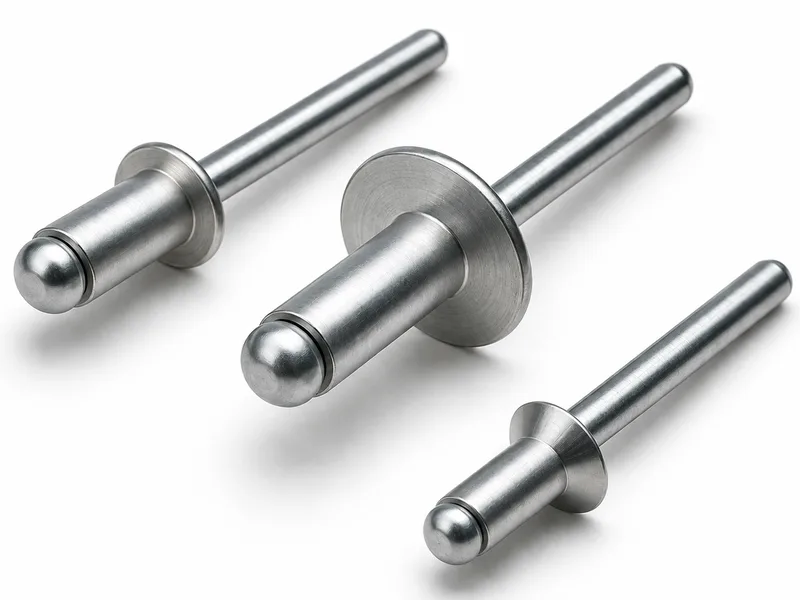
Specifications
ISO 15976 is the metric St/St (steel body, steel mandrel) closed-end blind rivet — the capped cup that seals the finished joint against moisture and gas, which is why it is the default call-out where an open-end rivet would let water or air down the mandrel hole. The collected 2002-edition table carries four sizes (read vertically by the d max/min rows: 3.28/3.05, 4.08/3.85, 4.88/4.65, 6.48/6.25 — the ≈3.2/4/4.8/6.4 class) with protruding head diameter dk max/min (6.7/5.8 to 13.4/11.6), head height k max (1.3 to 2.7), mandrel d1 max (2 to 3.9) and minimum grip L1 (25, 25, 27, 27). The load rows are the acceptance numbers behind the sealed joint: minimum shear 1150/1700/2400/3600 N, minimum tensile 1300/1550/2800/4000 N, and maximum mandrel break load 4000/5700/7500/10500 N — the wide gap between the working minimums and the break load is the setting window the tool must cover. Compared with the copper-body ISO 16583 countersunk open-end series in the same family, this St/St closed-end series carries roughly one-and-a-half to twice the shear per size, at the price of a domed head that sits proud of the surface.
| Standard / scope | ISO 15976-2002 closed end blind rivets, break pull mandrel, protruding head — St/St (steel body / steel mandrel), four sizes as tabulated |
|---|---|
| Shank d max/min | 3.28/3.05, 4.08/3.85, 4.88/4.65, 6.48/6.25 — the size identification, read vertically |
| Head dk / height k / mandrel d1 | dk max/min 6.7/5.8, 8.4/6.9, 10.1/8.3, 13.4/11.6; k max 1.3/1.7/2/2.7; d1 max 2/2.35/2.95/3.9 |
| Grip L1 min | 25, 25, 27, 27 — minimum grip per size; the length ladder beyond L1 per RFQ |
| Load rows | Min shear 1150/1700/2400/3600 N; min tensile 1300/1550/2800/4000 N; max mandrel break 4000/5700/7500/10500 N |
| Not tabulated | Grip ladder, hole sizes, edge distances, fatigue and sealing-pressure ratings — per RFQ |
| Attribute | Sub-label | |||||
|---|---|---|---|---|---|---|
| d | max | 3.28 | 4.08 | 4.88 | 6.48 | |
| d | min | 3.05 | 3.85 | 4.65 | 6.25 | |
| d k | max | 6.7 | 8.4 | 10.1 | 13.4 | |
| d k | min | 5.8 | 6.9 | 8.3 | 11.6 | |
| k | max | 1.3 | 1.7 | 2 | 2.7 | |
| d 1 | max | 2 | 2.35 | 2.95 | 3.9 | |
| L 1 | min | 25 | 25 | 27 | 27 | |
| Shear load/N(min) | Shear load/N(min) | Shear load/N(min) | 1150 | 1700 | 2400 | 3600 |
| Tensile load/N(min) | Tensile load/N(min) | Tensile load/N(min) | 1300 | 1550 | 2800 | 4000 |
| Mandrel break load/N(max) | Mandrel break load/N(max) | Mandrel break load/N(max) | 4000 | 5700 | 7500 | 10500 |
- The label table alternates two-cell rows (attribute + sub-label) and three-cell rows (the load labels) — source rows carry differing non-empty cell counts (2/3), grid padded empty.
Materials
- St/St is the strength combination of the blind-rivet families: a steel body and steel mandrel give the highest load rows among the common materials, which is why this series out-pulls the Cu-body open-end ladders size for size. The trade is corrosion — bare St/St serves protected or indoor joints; for weather exposure state the finish the drawing calls up (zinc-plated body or a different body/mandrel combination) on the RFQ. The closed-end cup also means the mandrel hole is sealed after setting, but only the joint designer can confirm that matters for the application — send the sheet thicknesses and grip so we quote the length, not just the diameter
Ordering & documentation
Documents
Shipments of ISO 15976 Closed End Blind Rivets, Protruding Head, St/St (Break Pull Mandrel) are backed by Mill Test Certificate (MTC), Dimensional Report, Salt Spray Test Report on request, with full batch traceability from raw material to finished product. Quality management for ISO 15976 Closed End Blind Rivets, Protruding Head, St/St (Break Pull Mandrel) orders follows the owner-confirmed compliance list: ISO 9001:2015, RoHS, REACH. Exact document sets are confirmed on the order.
Quotation
- The product family (ISO 15976 Closed End Blind Rivets, Protruding Head, St/St (Break Pull Mandrel)), product standard/designation and drawing or part number.
- The dimensions that apply to this part — such as size, pitch, length, thickness, fit, grip or groove geometry.
- Material/grade, heat-treatment condition and surface finish, together with the service environment.
- Quantity per size, delivery destination and required test or traceability documents.
Sample & supply
Minimum order quantity for iso 15976 closed end blind rivets, protruding head, st/st (break pull mandrel) is 10,000–50,000 pieces depending on size (applies to the standard sizes and finishes for iso 15976 closed end blind rivets, protruding head, st/st (break pull mandrel); mixed, special or custom variants are quoted — final commercial terms per quotation) Standard production for iso 15976 closed end blind rivets, protruding head, st/st (break pull mandrel) run 10–20 days. Quantities or variants of iso 15976 closed end blind rivets, protruding head, st/st (break pull mandrel) outside the standard range are confirmed at quotation.
Storage & shipping
ISO 15976 Closed End Blind Rivets, Protruding Head, St/St (Break Pull Mandrel) are packed for export and shipped factory-direct to buyers in Europe, Asia, the Americas and the Middle East. Store iso 15976 closed end blind rivets, protruding head, st/st (break pull mandrel) dry and protected until installation, and keep coated parts in their packaging until use; specific packing and preservation requirements can be stated on the order and confirmed at quotation.
Frequently asked questions
Why choose a closed end rivet instead of the cheaper open end one?
Sealing. An open-end break-mandrel rivet leaves the mandrel hole open down the middle of the set rivet, so water, gas or dust can pass through the joint; the closed-end type (ISO 15976 here) cups over, sealing that path. Typical triggers are outdoor enclosures, HVAC and appliance panels, lighting housings — anywhere the rivet is the only thing between the weather and the inside. The cost gap is small next to a warranty return; the check to run first is strength, because the closed-end St/St rows (shear 1150 to 3600 N across the four sizes) are actually higher than most open-end equivalents at the same diameter.
What does the mandrel break load row mean for setting, and how do I read the table?
Two things. Reading: the columns carry no printed size labels — identify each size vertically by its d max/min rows (≈3.2/4/4.8/6.4 class) and read every other attribute down that column. The break load row (4000/5700/7500/10500 N max) is the force at which the mandrel snaps during setting: it is an upper bound, not a joint rating. Your setting tool must be able to deliver somewhat more than the break load to pull the rivet reliably, but the joint itself is qualified on the minimum shear and tensile rows, which sit at a third to half of the break numbers. If the tool under-breaks, the mandrel pulls out of the cup without setting; oversized hydraulics on the small sizes can deform thin sheets — match the tool nose to the size range you set most.
What is the MOQ and lead time for ISO 15976 Closed End Blind Rivets, Protruding Head, St/St (Break Pull Mandrel)?
Orders under this designation have a minimum order quantity of 10,000–50,000 pieces depending on size. Standard production ships in 10–20 days. Final commercial terms are confirmed per quotation.
What should an RFQ for ISO 15976 Closed End Blind Rivets, Protruding Head, St/St (Break Pull Mandrel) state?
State the full designation (ISO 15976 Closed End Blind Rivets, Protruding Head, St/St (Break Pull Mandrel)), thread size and pitch or diameter, length or head dimension, finish, quantity per size, plus the destination country and any required certificate such as a mill test report per EN 10204 3.1; dimensions and schedule for this designation are confirmed with the quotation.
Request a Quote
Get factory-direct pricing from the manufacturer.
What to include in your ISO 15976 Closed End Blind Rivets, Protruding Head, St/St (Break Pull Mandrel) inquiry
- ✓ Identify blind, solid or structural rivet type and the applicable product standard.
- ✓ Give rivet-body diameter and grip range for the complete material stack, plus the prepared-hole size.
- ✓ Specify head style/clearance and state body and mandrel materials separately for blind rivets.
- ✓ For load-bearing joints, provide required rivet-specific tensile and shear values; do not substitute a bolt property class.
- ✓ State finish, quantity, destination and any lot-test or traceability documents required.
- ✓ Factory-direct pricing for your ISO 15976 Closed End Blind Rivets, Protruding Head, St/St (Break Pull Mandrel)
- ✓ Standard and custom specifications
- ✓ Factory-direct export to buyers in Europe, Asia, the Americas and the Middle East
- ✓ Full fastener family support