
Washers
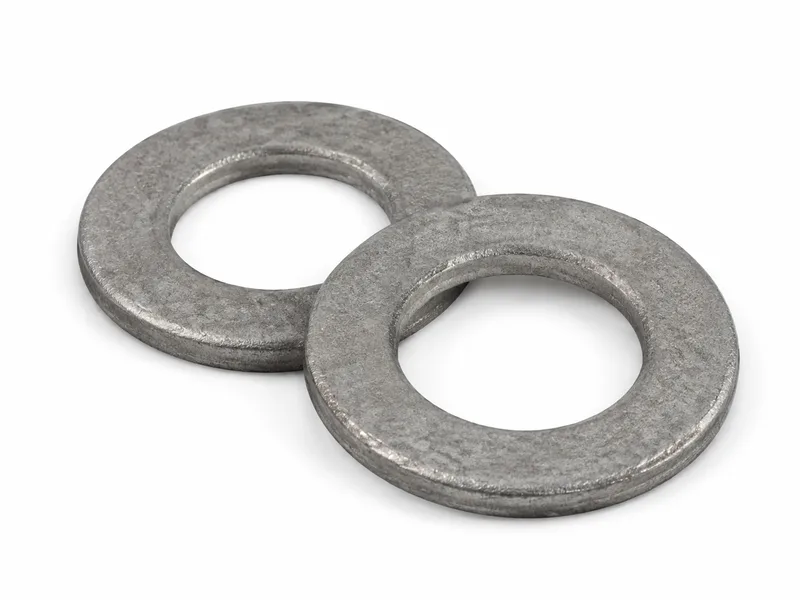
Flat washers support load distribution, protect bearing surfaces and help maintain the specified seating geometry in bolted assemblies. Locking and vibration-control functions depend on the selected washer design, not on a plain flat washer alone.
Last updated: 2026-11
Specifications
Current supplyable range — owner-confirmed scope of supply; requirements outside this range are confirmed per quotation.
| diameter | Up to M36 / 1-1/2" (36 mm) |
|---|---|
| coating | Zinc plated (blue/yellow), Geomet, Dacromet, hot-dip galvanized |
| standard | DIN 125 (flat washers type A/B); ISO 7089 / ISO 7090; USS / SAE patterns |
| moq | 10000 pieces |
| lead time | 3-7 days (stock) |
| price from | USD 0.002-0.01/pc |
Materials
- Low carbon steel
Ordering & documentation
Documents
Shipments of Washers are backed by Mill Test Certificate (MTC), Dimensional Report, Salt Spray Test Report on request, with full batch traceability from raw material to finished product. Quality management for this washers line follows the owner-confirmed compliance list: ISO 9001:2015, RoHS, REACH. Exact document sets are confirmed on the order.
Quotation
- Washer type and dimensional standard/series (flat, structural, spring or other specified form).
- Nominal mating-bolt size plus inside diameter, outside diameter and thickness from the drawing or standard.
- Material and any specified hardness class, coating or finish; washer hardness is not a bolt property class.
- Bearing surface, load or locking function, quantity and destination.
Sample & supply
Supply source for Washers: own manufacturing plus qualified outsourcing (per the owner-confirmed scope of supply (own production plus outsourcing)).
Minimum order quantity for washers is 10,000 pieces (applies to the standard sizes and finishes for washers; mixed, special or custom variants are quoted — final commercial terms per quotation) Stock items for this family run 3–7 days. Quantities or variants outside the standard range are confirmed at quotation.
Storage & shipping
Washers are packed for export and shipped factory-direct to buyers in Europe, Asia, the Americas and the Middle East. Store these washers dry and protected until installation, and keep coated parts in their packaging until use; specific packing and preservation requirements can be stated on the order and confirmed at quotation.
Washer types & standards
These are washer type and standard references, not strength grades. Compare inside/outside diameter, thickness, hardness/material, bearing surface and locking mechanism before substitution.
Choosing between types? See the washer type comparison — plain, fender, spring lock, hardened, USS and SAE side by side.
Choosing between plain-washer standards? See the plain washer standards comparison — DIN 125, ISO 7089, ISO 7090, DIN 433 and ASME B18.21.1 Type A/B side by side.
Choosing the material and coating? See washer material and coating selection — low-carbon steel at 200 HV, F436 hardened steel and spring steel compared, with plating, galvanizing and the checks that change with each.
Deciding which washer belongs on a bolt, and which look-alikes must not be substituted? Start from the washer selection hub — plain, spring-lock, toothed and conical washers by decision, current vs withdrawn standards, and what a certificate can verify.
The families behave differently once installed: a plain flat washer only spreads the clamp load and must be hard enough not to embed into the base material, a spring-lock washer works by keeping an edge or split under the nut so vibration has something to fight, and toothed variants bite into the surfaces at the cost of the finish — which is why they stay off coated and soft faces. Conical (disc) washers keep a bolted joint loaded when slight relaxation or thermal movement appears. Naming the base material, the coating and whether the joint sees vibration lets us quote the washer type that answers the actual failure mode instead of the most familiar one.
- DIN 125 Plain Flat Washers (Form A/B)
- DIN 9021 Fender Washers (Large OD)
- DIN 127 Helical Spring Lock Washers
- ASTM F436 Hardened Structural Washers
- USS Flat Washers (Inch Series)
- SAE Flat Washers (Inch Series)
- ISO 7090 Chamfered Flat Washers
- ISO 7089 Plain Flat Washers
- DIN 433 Small-OD Flat Washers
- DIN 7980 High-Collar Spring Lock Washers
- DIN 6796 Conical Spring Washers
- DIN 7349 Thick Flat Washers for Heavy-Type Spring Pins
- Wedge-Locking Washers (Nord-Lock Type Pair)
- Insulating Isolation Washer Sets
- Electrical-Insulating Flat Washers
- DIN 463 Tab Washers (2 Tabs)
- DIN 6797 Toothed Lock Washers (Types A / J / V)
- DIN 7989 Flat Washers for Steel Construction
- DIN 137 Spring Washers (Form A Curved / Form B Waved)
- DIN 6319 Spherical Washers (Form C) and Conical Seat Washers (Form D)
- DIN 988 Shim Rings
- DIN 6798 Type A Serrated Lock Washers (External Teeth)
- DIN 126 Flat Washers (Un-chamfered, Normal Series)
- DIN 436 Square Washers for Timber Bolts
- DIN 434 Square Taper Washers for U-Sections (Channel)
- DIN 2093 Disc Spring Washers (Belleville)
- DIN 462 Internal Tab Washers
- DIN 93 Tab Washers with Long Tab
- DIN 6340 Washers for Clamping Devices
- DIN 128A Spring Lock Washers, Type A
- DIN 128B Spring Lock Washers, Type B (Heavy Pattern)
- DIN 435 Square Taper Washers for I-Sections
- DIN 127B Helical Spring Lock Washers (Dimension Table)
- DIN 128A Spring Washers Type A (Curved)
- DIN 128B Spring Washers Type B (Wave)
- ASME B18.21.1 Type A Plain Washers — Inch Series, Narrow / Regular / Wide (0.072 – 4 in)
- ASME B18.21.1 Fender Washers — Inch Series, Extra-Wide Bearing (0.112 – 1 in)
- ASME B18.21.1 Helical Spring Lock Washers — Inch Series (0.072 – 4 in)
- ASME B18.21.1 Internal Tooth Lock Washers — Inch Series (No. 2 – 1 1/4 in)
- ASME B18.21.1 External Tooth Lock Washers — Inch Series (No. 3 – 1 1/4 in)
- ASME B18.21.1 Type B Plain Washers — Inch Series, Narrow / Regular / Wide (No.0 – 2 in)
- DIN 432 Tab Washers with External Tab
- DIN 1440 Washers for Pins (Medium Type)
- DIN 1441 Flat Washers for Clevis Pins (Coarse)
- EN 14399-6 Plain Chamfered Washers (System HV)
- DIN 6916 Plain Chamfered Washers
- DIN 6918 Square Taper Washers
- DIN 6798 J Serrated Lock Washers (Type J)
- DIN 6798 V Serrated Lock Washers (Type V)
- DIN 1052 Washers for Wood Constructions
- DIN 470 Sealing Discs
- DIN 7603 A Sealing Ring Washers (Form A)
- DIN 7603 C Sealing Ring Washers (Form C)
- DIN 25201 Dual Lock Washers
- ISO 7091 Plain Washers (Product Grade C)
- ISO 7092 Washers for Cheese Head Screws
- ISO 7093 Plain Washers (Outer Diameter About 3 d)
- ISO 7094 Washers for Timber Constructions
- ISO 8738 Washers for Pins
- ISO 7416 Washers for HV Connections
- DIN 74361 Countersunk Spring Lock Washers
- NFE 25-511 Conical Knurled Spring Washers
- ASTM F3394 Hardened Steel Backup and Reaction Washers
- DIN 440 Round Washers for Wood Construction (Form V / Form R)
- DIN 5406 MB Lockwashers for Rolling Bearings
- DIN 5417 Snap Rings for Bearings with Ring Groove
Frequently asked questions
USS or SAE pattern — which washer do I need?
Both patterns are in the quoted range. They differ in outside diameter and thickness for the same bolt size: USS washers are the wider, thicker pattern, SAE the narrower one. Match the pattern your drawing calls out; if the drawing is silent, name the bolt size and the intended seating and the quote confirms the pattern with you before production.
Which standard covers the flat washers, and what coatings are available?
Flat washers are quoted to DIN 125 (type A/B) and ISO 7089 / ISO 7090, plus USS / SAE patterns. Coatings follow the same list as the rest of the range: zinc plated (blue/yellow), Geomet, Dacromet and hot-dip galvanized. Size range runs to M36 / 1-1/2".
What is the MOQ and lead time for washers?
The minimum order quantity is 10,000 pieces. Stock items ship in 3–7 days; non-stock sizes or materials are confirmed at quotation.
Request a Quote
Get factory-direct pricing from the manufacturer.
What to include in your Washers inquiry
- ✓ Identify the washer form and dimensional standard (for example flat, fender, spring-lock or hardened structural washer).
- ✓ Give the mating bolt size plus inside diameter, outside diameter and thickness; include the applicable dimensional series.
- ✓ State washer material and any specified hardness class or coating. Washer hardness is not a bolt property class.
- ✓ Describe the bearing surface or locking function, quantity per size and destination.
- ✓ Factory-direct pricing for your Washers
- ✓ Standard and custom specifications
- ✓ Factory-direct export to buyers in Europe, Asia, the Americas and the Middle East
- ✓ Full fastener family support