
ASTM F3125 Grade A490 Bolts
Heavy hex structural bolts per ASTM F3125 Grade A490 — alloy steel, quenched and tempered, 150,000 psi minimum tensile, Types 1 and 3, never galvanized. The high-strength structural bolt for the heaviest connections.
Last updated: 2026-11
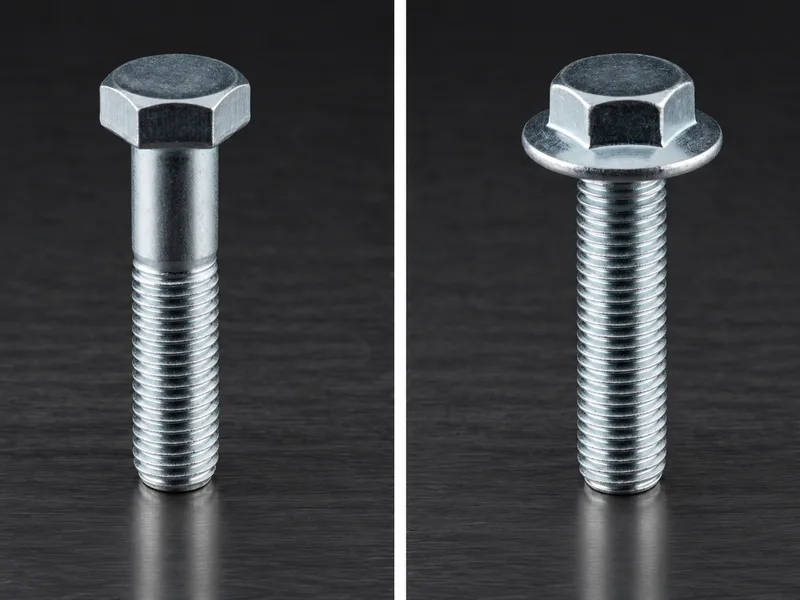
Specifications
A490 (standardized under ASTM F3125) is the high-strength counterpart to A325: quenched-and-tempered alloy steel at 150,000 psi minimum tensile, used where the heaviest or most critically loaded structural connections need more clamp force than A325 provides in the same footprint. Its strength comes with handling rules: A490 must never be hot-dip or mechanically galvanized (hydrogen embrittlement risk), it is more susceptible to stress corrosion and hydrogen cracking in service, and it is supplied with weathering-steel Type 3 option for bare atmospheric exposure. Where a job does not require the extra strength, A325 remains the more forgiving specification.
| Standard | ASTM F3125 Grade A490 (supersedes ASTM A490); heavy hex structural bolt |
|---|---|
| Material | Type 1: alloy steel, quenched and tempered; Type 3: weathering steel |
| Tensile strength, min | 150,000 psi minimum; vendor grade charts list 150/130 ksi across size groups |
| Galvanizing | Not permitted — hydrogen embrittlement risk from hot-dip or mechanical galvanizing; protect by painting or Type 3 weathering steel |
| Service caution | Higher susceptibility to stress corrosion cracking and hydrogen cracking than A325 |
| Installation | Pre-tensioned installation per structural bolting practice; matched heavy hex nuts and hardened washers |
| Typical applications | Very heavy and critical structural connections where A325 strength is insufficient |
| Fatigue design values | RCSC 5.5: allowable stress range Fsr = (Cf / nsr)^(1/3) ≥ FTH — Cf = 0.39 ksi³ and FTH = 7.0 ksi for Groups 120, 144 and 150 alike, so the fatigue allowance does not rise with grade |
| Overtapped coated nuts | Coated nuts are tapped oversize; only ASTM A563 DH/DH3 and A194 2H keep adequate stripping strength after overtapping, and the nut proof load must exceed the bolt tensile strength |
| Grade | Field | Recorded value |
|---|---|---|
| ASTM F3125 A490 Type 1 | Nominal size range | 1/2 in to 1 in |
| ASTM F3125 A490 Type 3 | Nominal size range | 1/2 in to 1-1/2 in |
| ASTM F3125 A490 Type 1 | Strength grade | ASTM F3125 Grade A490 Type 1 — proof load min 120 ksi; tensile 150 ksi min / 173 ksi max; hardness C33–C38; size range 1/2 in to 1 in |
| ASTM F3125 A490 Type 3 | Strength grade | ASTM F3125 Grade A490 Type 3 — proof load min 120 ksi; tensile 150 ksi min / 173 ksi max; hardness C33–C38; size range 1/2 in to 1-1/2 in |
Industry reference — figures as printed in the collected technical tables; availability confirmed per quotation.
Where this grade fits
A490 is the strongest structural grade and the most constrained: galvanizing is not permitted — the hydrogen embrittlement risk from hot-dip or mechanical galvanizing is why protection is by paint systems or by specifying Type 3 weathering steel. It also carries higher susceptibility to stress-corrosion and hydrogen cracking than A325, so inspection discipline matters more, not less, at this strength.
Deep read: Hydrogen Embrittlement in High-Strength Bolts: Which Grades Need Controls, Which Coatings and Baking Schedules Are Acceptable, and What to Require Before the RFQ · Fastener Failure Modes: Which Fatigue, Creep and SCC Controls the Evidence Supports
Materials
- Alloy steel, quenched and tempered (Type 1)
- Weathering steel (Type 3)
When the upgrade actually helps: grade A490 provides higher mechanical strength and may be considered where higher bolt strength can reduce the required number or diameter of bolts, subject to connection design and applicable code requirements. The reverse caveat is just as real: upgrading to A490 does not guarantee a stronger joint; plate bearing and tear-out frequently become controlling limit states — bolt-level capacity is not the joint's capacity, and switching to A490 often improves the bolt check without resolving plate-controlled limits. Prefer A325 when capacity is adequate; select A490 only when bolt-quantity or joint-layout constraints make A325 impractical.
What the upgrade costs beyond the bolt: A490 also demands stricter installation control and restricted coating choices, which may increase overall project cost despite superior mechanical performance. Only ASTM and RCSC-qualified alternative coating systems are allowed for A490 corrosion protection — in practice, A490 bolts must use alternative coatings such as zinc-flake (Geomet, Magni) or mechanically deposited zinc. The yield floor moves with the grade: the minimum yield strength for A490 is 130 ksi within its applicable F3125 size range, which matters when a connection schedule checks yield-based capacities rather than the headline 150 ksi tensile.
Reuse is prohibited, not discouraged: the RCSC specification places Group 150 heavy hex bolts — A490's group — in the shall-not-be-reused category alongside coated bolts of any group, because a Group 150 bolt has the ductility for one pretensioned installation but is not consistently ductile enough for a second. The elastic margin that lets a plain-finish A325 survive re-tightening does not carry at 150 ksi, so a bolt that has already been pretensioned is a one-cycle part: it goes in the structure once, and any bolt released and reinstalled has lost its qualification.
The coating whitelist is specific, not generic: per ASTM F3125 and the IFI-144 qualification investigations, A490 Type 1 bolts are approved for ASTM F1136 Grade 3 and F2833 Grade 1 coatings, and zinc-flake coatings applied per ASTM F3393 were tested to show they do not cause delayed cracking by internal hydrogen embrittlement or accelerate environmental hydrogen embrittlement. Galvanizing, metallizing, and mechanical coating of any kind remain not permitted — the RCSC states their effects on embrittlement and delayed cracking have not been fully investigated. The underlying metallurgy: A490 carries a 150 ksi minimum and a 173 ksi maximum tensile with a 38 HRC hardness ceiling as a safeguard against hydrogen embrittlement, but production targets sit slightly above the minimum, so hot-dip galvanizing's acid pickling — which introduces hydrogen that the zinc coating then seals in — lands exactly where the steel is most vulnerable to delayed brittle fracture in service.
Type 1 versus Type 3 is a corrosion-strategy choice, not a strength one — both types meet the same 150 ksi mechanicals. Type 3 weathering steel is designed to rust: its patina acts as a protective barrier that seals the bolt under the cyclic wet-dry atmospheric exposure it is specified for, which is why it is the bare-exposure answer. Type 1 alloy steel gets no such protection — any rust on it is just rust — so it needs a qualified coating or a paint system over primer. One procurement trap sits between them: when the bolt type is not specified on the drawing, either Type 1 or Type 3 may be supplied at the manufacturer's option, so a job that depends on the weathering patina must say Type 3 explicitly at RFQ.
Installation control is assembly control: A490 is pretensioned under the RCSC's four methods — turn-of-nut (1/3 turn past snug up to 4 diameters, 1/2 turn over 4 to 8, 2/3 turn over 8 to 12, verified by match-marks), calibrated wrench tied to tension by a daily Skidmore-Wilhelm check, twist-off TC bolts, and DTI washers read with a feeler gauge. Two rules cut across every method and bite hardest at A490's strength level: torque alone never accepts a high-strength bolt — the acceptance criterion is tension — and the bolt, nut, and washer are qualified as a lubricated lot, so mixing a nut from another bin or substituting a washer the procedure did not call for breaks the assembly the rotational-capacity test qualified.
What this page cannot verify: the governing design code and connection schedule for your project, and therefore whether the N/X/SC joint condition, bolt count or plate geometry makes A490 justified — that decision belongs to the connection designer, and an RFQ that states the governing specification gets a quote for the right grade instead of a guess. This page also cannot verify field installation torque values, the lot certs for the assembly that shows up on site, or the corrosion performance of any specific coating system — coating qualification names do not imply a stated protection life; confirm the lot certs match the delivered bolts at receiving.
Fatigue is where the upgrade buys nothing: the RCSC fatigue rule uses one constant-amplitude fatigue constant and one threshold for every high-strength group — for Group 120, 144, and 150 bolts alike, Cf = 0.39 ksi³ and FTH = 7.0 ksi — so a connection cycled in tension gets the same allowable stress range from a 150 ksi A490 as from a 120 ksi A325. What changes with the grade is the joint-type obligation: joints with Group 120 bolting assemblies subject to tensile fatigue are required pretensioned joints, and joints with Group 144 or Group 150 assemblies subject to tension or combined shear and tension — with or without fatigue — are required pretensioned as well. An RFQ that says "A490 for fatigue" without the connection designer's stress-range calculation is buying a harder-to-protect bolt for capacity the specification does not award.
The overtapped-nut rule tightens as the grade rises. Coating any structural bolt thread forces the nut to be tapped oversize, which cuts thread engagement and with it the stripping strength, and the RCSC permits only ASTM A563 Grades DH and DH3 and ASTM A194 Grade 2H as overtapped coated nuts — the requirement being that the nut's specified proof load sit above the bolt's tensile strength. At A490 that bar is at its highest: 150 ksi minimum tensile is where fewer nut grades clear it, and zinc-flake coated nuts — the permitted coating route on A490 — shall be overtapped in accordance with ASTM A563 just as galvanized ones are. The RCSC's own example of a mismatched assembly is a Grade C nut on an F3125 Grade A490 bolt; under-strength assemblies from excessive overtapping are caught only by testing the assembly in a bolt tension measurement device, never by eye.
The stress-raiser discipline is written into the specification commentary, not inferred: bolts above 180 ksi tensile (hardness above 39 HRC) are subject to embrittlement if hydrogen is present under high tensile stress, so care must be taken to avoid stress concentrations and exposure to environments that may induce hydrogen embrittlement. A490 sits just below that line by design — the 38 HRC hardness maximum and the 173 ksi tensile maximum exist to keep a margin below the critical range — but manufacturers target production slightly above the required minimum, so bolts close to the critical range must be anticipated in every lot. That is the mechanical reason the coating whitelist stays closed and why galvanizing's pickling-and-sealed-in-hydrogen failure mode weighs heavier here than at A325's hardness.
Ordering & documentation
Documents
Shipments of ASTM F3125 Grade A490 Bolts are backed by Mill Test Certificate (MTC), Dimensional Report, Salt Spray Test Report on request, with full batch traceability from raw material to finished product. Quality management for ASTM F3125 Grade A490 Bolts orders follows the owner-confirmed compliance list: ISO 9001:2015, RoHS, REACH. Exact document sets are confirmed on the order.
Quotation
- The product family (ASTM F3125 Grade A490 Bolts), product standard/designation and drawing or part number.
- The dimensions that apply to this part — such as size, pitch, length, thickness, fit, grip or groove geometry.
- Material/grade, heat-treatment condition and surface finish, together with the service environment.
- Quantity per size, delivery destination and required test or traceability documents.
Sample & supply
Supply source for ASTM F3125 Grade A490 Bolts: own manufacturing plus qualified outsourcing (per the owner-confirmed scope of supply (own production plus outsourcing)).
Minimum order quantity for astm f3125 grade a490 bolts is 1,000–10,000 pieces depending on size (applies to the standard sizes and finishes for astm f3125 grade a490 bolts; mixed, special or custom variants are quoted — final commercial terms per quotation) Stock items for astm f3125 grade a490 bolts run 3–7 days. High-strength and custom parts for astm f3125 grade a490 bolts run 15–25 days. Quantities or variants of astm f3125 grade a490 bolts outside the standard range are confirmed at quotation.
Storage & shipping
ASTM F3125 Grade A490 Bolts are packed for export and shipped factory-direct to buyers in Europe, Asia, the Americas and the Middle East. Store astm f3125 grade a490 bolts dry and protected until installation, and keep coated parts in their packaging until use; specific packing and preservation requirements can be stated on the order and confirmed at quotation.
Frequently asked questions
Why can A490 bolts not be galvanized when A325 can?
Hydrogen embrittlement. At A490's strength level, hydrogen introduced by the acid pickling and zinc bath of the galvanizing process can crack the bolt under load, and the standard prohibits hot-dip and mechanical galvanizing for that reason. A325 Type 1, at its lower hardness, tolerates galvanizing within the standard. For corrosive service, A490 is protected by paint systems over primer, or specified as Type 3 weathering steel for bare exposure.
Can an A490 bolt be reused after it has been pretensioned?
No. The RCSC specification prohibits reuse of Group 150 heavy hex bolts — A490's group — and of coated bolts of any group. A Group 150 bolt has sufficient ductility for one pretensioned installation but not consistently for a second, unlike plain-finish Group 120 (A325) bolts, which may be reused in snug-tightened joints without approval and in pretensioned joints with the Engineer of Record's approval. Plan A490 as a single-installation part.
Which coatings are actually permitted on A490 bolts?
A short, named list: ASTM F1136 Grade 3 and ASTM F2833 Grade 1 coatings are approved for A490 Type 1 per ASTM F3125 and IFI-144, and zinc-flake coatings applied per ASTM F3393 have been tested to show they do not cause delayed cracking by internal hydrogen embrittlement. Everything zinc-coated by dipping or mechanical means — hot-dip galvanizing, metallizing, mechanical galvanizing — is not permitted, because the effects on embrittlement and delayed cracking have not been fully investigated. Where a quote line offers to "galvanize the A490s", that is a specification violation, not a service.
How is A490 pretension verified in the field?
By tension, never by torque alone. The RCSC accepts four pretensioning methods — turn-of-nut with match-marked rotation, a calibrated wrench checked against a Skidmore-Wilhelm tension calibrator daily, twist-off tension-control bolts whose spline shears at tension, and direct-tension-indicator washers read with a feeler gauge. All four start from snug-tight, and each is inspected by its own evidence: the match-marks, the daily calibration record, the sheared splines, or the feeler-gauge refusals.
Should a bridge or highway job use A490?
Usually not by default. A490's higher-strength steel is more susceptible to stress corrosion and hydrogen cracking in service, which is one reason A490 is less common than A325 in bridge and highway work; A325 also tolerates hot-dip galvanizing, the standard corrosion protection there. A490 earns its place where a connection needs more clamp force than A325 provides in the same bolt count and footprint — and the governing engineer specifies it explicitly.
Does upgrading a connection to A490 improve its fatigue performance?
No. The RCSC assigns the same fatigue constants to every structural group — for Group 120, 144, and 150 bolts alike, the constant-amplitude fatigue constant is 0.39 ksi³ and the threshold stress range for infinite life is 7.0 ksi — so the allowable tensile stress range does not rise with grade. Fatigue also hardens the joint-type requirement: tensile fatigue puts Group 120 assemblies into required-pretensioned joints, and Group 144/150 assemblies under tension or combined shear and tension, with or without fatigue, are required pretensioned as well. Specify A490 for static capacity constraints, not for cyclic life.
What can the certificate and head markings actually verify on an A490 lot?
The certificate and the bolt head answer different questions, and both have limits. ASTM F3125's optional supplementary requirements are marking-anchored: bolts ordered full-threaded up to four times the diameter long must be marked with the symbol "T", and bolts with specially ordered thread lengths must be marked "S" — so a receiving check that matches the ordered options on the cert against the head marking verifies a documented lot, not just a documented order. What no certificate verifies: the joint condition the designer assigned, the pretension actually achieved in the field, or the corrosion life of a coating system. The field-side complement is pre-installation verification — testing the assembly in a bolt tension measurement device — which is what catches under-strength overtapped assemblies and mismatched components such as a Grade C nut on an A490 bolt before they go into the structure.
What is the MOQ and lead time for this bolt grade?
The minimum order quantity for ASTM F3125 Grade A490 Bolts is 1,000–10,000 pieces depending on size. Stock items of ASTM F3125 Grade A490 Bolts ship in 3–7 days; high-strength and custom parts in 15–25 days. Common diameters of ASTM F3125 Grade A490 Bolts are widely stocked; confirm the exact schedule against quantity and size mix at quotation.
What should an RFQ for this bolt grade state?
For ASTM F3125 Grade A490 Bolts, state the standard and grade (for example ISO 4017 Class 8.8 or ASTM F3125 Grade A325 Type 1), diameter and length, thread type (metric coarse or UNC/UNF), finish (plain, zinc, or hot-dip galvanized where the grade permits), required certificates such as a mill test report per EN 10204 3.1, and quantity per size — plus destination country.
Related knowledge
- What Bolt Property Classes 8.8, 10.9 and 12.9 Encode — and When High Strength Stops Being the Right Choice
- Bolt Grade Selection: ISO 898-1 8.8/10.9/12.9 vs ASTM A307 and A325
- 8.8 vs 10.9 vs 12.9 Bolts: Strength, Hardness and Cost — What the Evidence Settles
- Calculating Bolt Preload and Clamp Force: Torque, Friction and Tightening Method
- How to Determine Tightening Torque and Choose a Tightening Method for a Bolted Joint
- Fastener Failure Modes: Which Fatigue, Creep and SCC Controls the Evidence Supports
- Hydrogen Embrittlement in High-Strength Bolts: Which Grades Need Controls, Which Coatings and Baking Schedules Are Acceptable, and What to Require Before the RFQ
Request a Quote
Get factory-direct pricing from the manufacturer.
What to include in your ASTM F3125 Grade A490 Bolts inquiry
- ✓ Name the bolt standard and product form, then give nominal diameter, pitch, length and threaded length.
- ✓ State the applicable property class or material grade, head style, and coating or finish.
- ✓ Identify the mating nut/washer and the joint duty; include any specified preload, tightening method or friction condition.
- ✓ Give quantity per size, destination and required material or inspection certificates.
- ✓ Factory-direct pricing for your ASTM F3125 Grade A490 Bolts
- ✓ Standard and custom specifications
- ✓ Factory-direct export to buyers in Europe, Asia, the Americas and the Middle East
- ✓ Full fastener family support