
DIN 934 Hex Nuts (ISO 4032)
Standard-height metric hexagon nuts (style 1) per DIN 934, dimensioned to EN ISO 4032 — preferred threads M1.6 to M64, steel classes 6/8/10/12 and A2/A4 stainless, thread 6H. The default general-purpose nut for every hex-head metric bolt.
Last updated: 2026-11
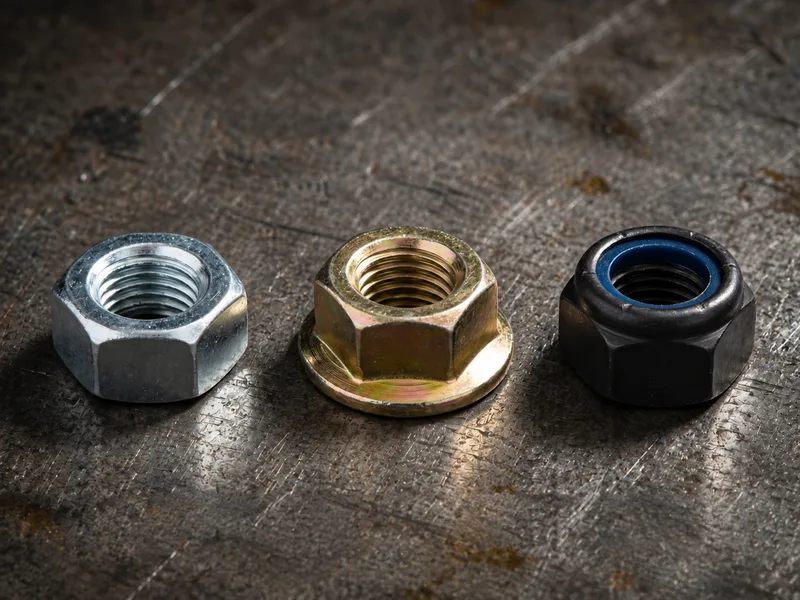
Specifications
The DIN 934 hex nut is the baseline nut of the metric system: full height (style 1), hexagon driven by a standard width-across-flats wrench, and mated to the equally familiar hex-head bolts on the same nominal thread. Its dimensions are carried by EN ISO 4032 — DIN 934's current norm is DIN EN 24032, with ISO 4032 the equivalent designation — and the collected table runs the preferred thread series from M1.6 up to M64, with a non-preferred series (M3.5, M14, M18, M22, M27, M33, M39, M45, M52, M60) tabulated alongside. Strength selection follows the nut property-class system rather than the bolt's two-number code: steel nuts come in classes 6, 8, 10 and 12 (plus thin 04/05 patterns), where a class-8 nut is the match for an 8.8 bolt and a class-10 nut for a 10.9 bolt, with proof-load stresses from 800 to 1200 MPa across the regular classes. Thread tolerance is 6H; stainless carries the A2/A4 grades. See the jam-nut page for the thin pattern and the lock-nut pages where back-off, not raw clamp load, is the problem.
| Standard | DIN 934 — hexagon nut, style 1; current norm DIN EN 24032, equivalent ISO 4032 |
|---|---|
| Size range | Preferred threads M1.6 – M64; non-preferred series tabulated (M3.5, M14 – M60) |
| Dimensions at M10 | Width across flats s = 16 mm; height m max 8.4 mm; e min 17.77 mm |
| Series highlights (s × m max, mm) | M6 10 × 5.2 · M8 13 × 6.8 · M12 18 × 10.8 · M16 24 × 14.8 · M20 30 × 18 · M24 36 × 21.5 |
| Property classes | Steel 6 / 8 / 10 / 12; class 8 ≈ 800–920 MPa and class 10 ≈ 1040–1060 MPa proof-load stress (coarse thread, ISO 898-2-derived) |
| Grade pairing | Class 8 with 8.8 bolts, class 10 with 10.9, class 12 with 12.9; a higher nut class may substitute a lower one |
| Thread | 6H |
| Materials | Steel; stainless A2 / A4; brass, copper, aluminium; thermoplastic (Pa) where metal is excluded |
| Typical applications | General-purpose clamping on hex-head metric bolts across machinery, construction and assembly work |
Materials
- Steel
- Stainless steel A2
- Stainless steel A4
- Brass
DIN 934 is the general-purpose hex nut, and its three material families answer different buyer questions: carbon steel (Grade 2 being the reference pairing with any low-carbon, non-heat-treated bolt at 74,000 psi minimum tensile or less) where joint strength comes from the steel, stainless A2/A4 where corrosion resistance does the work, and brass where conductivity, non-magnetic or spark-resistant behaviour matters more than strength.
The stainless split is the chloride question: A2/18-8 is corrosion resistant under normal atmospheric conditions but vulnerable to chlorides and chemicals, while A4/316 adds 2-3% molybdenum specifically for chloride resistance in marine and chemical service. Brass brings inherent corrosion resistance and electrical conductivity for electronic and decorative use, but cannot match the tensile strength of steel — treat it as a functional, not structural, choice.
Ordering & documentation
Documents
Shipments of DIN 934 Hex Nuts (ISO 4032) are backed by Mill Test Certificate (MTC), Dimensional Report, Salt Spray Test Report on request, with full batch traceability from raw material to finished product. Quality management for DIN 934 Hex Nuts (ISO 4032) orders follows the owner-confirmed compliance list: ISO 9001:2015, RoHS, REACH. Exact document sets are confirmed on the order.
Quotation
- The product family (DIN 934 Hex Nuts (ISO 4032)), product standard/designation and drawing or part number.
- The dimensions that apply to this part — such as size, pitch, length, thickness, fit, grip or groove geometry.
- Material/grade, heat-treatment condition and surface finish, together with the service environment.
- Quantity per size, delivery destination and required test or traceability documents.
Sample & supply
Supply source for DIN 934 Hex Nuts (ISO 4032): own manufacturing plus qualified outsourcing (per the owner-confirmed scope of supply (own production plus outsourcing)).
Minimum order quantity for din 934 hex nuts (iso 4032) is 10,000 pieces (applies to the standard sizes and finishes for din 934 hex nuts (iso 4032); mixed, special or custom variants are quoted — final commercial terms per quotation) Stock items for din 934 hex nuts (iso 4032) run 3–7 days. Quantities or variants of din 934 hex nuts (iso 4032) outside the standard range are confirmed at quotation.
Storage & shipping
DIN 934 Hex Nuts (ISO 4032) are packed for export and shipped factory-direct to buyers in Europe, Asia, the Americas and the Middle East. Store din 934 hex nuts (iso 4032) dry and protected until installation, and keep coated parts in their packaging until use; specific packing and preservation requirements can be stated on the order and confirmed at quotation.
Frequently asked questions
What does the "8" on a metric hex nut mean — is it the same as an 8.8 bolt marking?
Not quite — nut and bolt class numbers are different systems. A bolt marked 8.8 states tensile strength and yield ratio; a nut marked 8 states a proof-load category read from ISO 898-2 (about 800–920 MPa proof-load stress across the size bands for coarse thread). The pairing rule is simple: a class-8 nut is the rated partner for an 8.8 bolt, class 10 for 10.9, class 12 for 12.9, and a higher-class nut may always substitute a lower one — the joint is then sized to fail by bolt fracture rather than thread stripping. Never read a nut's "10" as a "10.9 nut"; the numbers coincide, the definitions do not.
Are DIN 934 and ISO 4032 the same nut?
For ordering purposes, yes. DIN 934's current norm designation is DIN EN 24032 and ISO 4032 is its equivalent international designation — the collected standard table is headed "Table according to EN ISO 4032". Order whichever designation the drawing carries; the dimension series (width across flats, height, e min) is the common table. One practical note: some very large sizes and the non-preferred thread steps are tabulated separately, so confirm the exact size against the table when a drawing steps off the preferred M1.6–M64 series.
What is the MOQ and lead time for this nut type?
The minimum order quantity is 10,000 pieces. Stock items ship in 3–7 days; non-stock items are confirmed at quotation. Common diameters in this nut type are widely stocked; confirm the exact schedule against quantity and size mix at quotation.
What should an RFQ for this nut type state?
State the standard designation (for example DIN 985 or DIN 6923), nominal thread size and pitch (metric coarse unless fine pitch is required), material and strength pairing with the mating bolt, finish (plain, zinc, or hot-dip galvanized where compatible), required certificates such as a mill test report per EN 10204 3.1, and quantity per size — plus destination country.
Request a Quote
Get factory-direct pricing from the manufacturer.
What to include in your DIN 934 Hex Nuts (ISO 4032) inquiry
- ✓ Name the nut standard, style and nominal thread size/pitch, including metric or inch thread series.
- ✓ State the nut property class or material and the bolt class/material it must be paired with.
- ✓ Specify locking or prevailing-torque feature, coating and corrosion environment.
- ✓ Give quantity per size, destination and any lot or mechanical-test documentation.
- ✓ Factory-direct pricing for your DIN 934 Hex Nuts (ISO 4032)
- ✓ Standard and custom specifications
- ✓ Factory-direct export to buyers in Europe, Asia, the Americas and the Middle East
- ✓ Full fastener family support