
DIN 6927 Hex Nuts with Flange (Prevailing Torque, All-Metal)
DIN 6927 hexagon nuts with flange, prevailing torque type all-metal, M5–M20 — the integrated washer face plus an all-metal locking element in one nut, with the collected per-size tables: coarse/fine pitches, c, d a, flange d c, d w, e, h, m, m w, s and r.
Last updated: 2026-11
Specifications
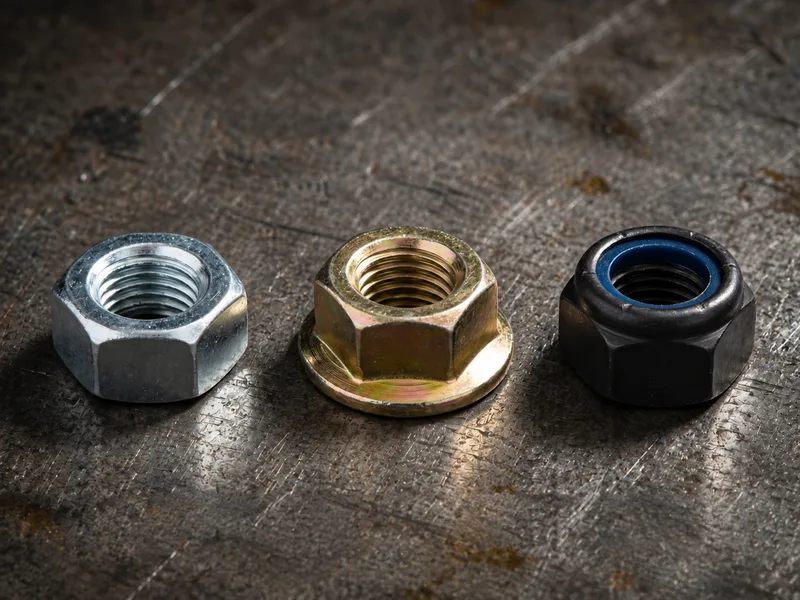
DIN 6927 folds two functions into one nut: the flange of the DIN 6923 family — a built-in washer face that spreads the clamp over the bearing surface and grips the joint against rotation — and an all-metal prevailing-torque locking element, so the nut resists loosening under vibration without any nylon insert to soften with heat. That makes it the hot-joint member of the flange-nut family: engine and exhaust hardware, brake assemblies, turbo and manifold flanges — anywhere a DIN 6926's non-metallic insert would creep above its temperature window or where reusable locking after service matters (all-metal elements keep a useful prevailing torque through repeated assemblies). The collected tables run M5 to M20 with coarse plus fine-pitch rows: flange edge c, countersink d a, flange diameter d c, bearing face d w, across-corners e, total height h with the locking element, metal-body height m, prevailing-torque check m w, across-flats s and the flange fillet r. Two reading notes are carried as table footnotes: the source merges "-" into some Fine thread-2 pitch cells, and the across-flats ladder is the narrow flange-nut series (15 at M10, 21 at M14) — not the DIN 934 ladder — so check wrench sizes against the printed s row. Property classes and finishes stay per RFQ.
| Standard | DIN 6927 — hexagon nuts with flange, prevailing torque type, all-metal (flange nut + all-metal locking element in one part) |
|---|---|
| Series | M5 – M20 (two source column groups: M5/M6/M8/M10 and M12/(M14)/M16/M20; parenthesized non-preferred size; coarse plus fine thread-1/2 pitch rows) |
| Tabulated geometry | Per size: pitch P (coarse/fine-1/fine-2, "/" and merged "-" values as printed), c (min), d a (min/max), flange d c (max, 11.8–42.8), d w (min), e (min), h (max, 6.2–22.4), m (min, 4.7–18.9), m w (min, 2.2–11.1), s (max=nominal, min), r fillet (max) |
| Flange-nut wrench series | Across-flats follow the narrow flange-nut ladder per the source (s = 15 at M10, 21 at (M14)) — see table footnote; not the DIN 934 17/22 ladder |
| Property classes / finishes | Not tabulated by the collected specification — per RFQ (state class and temperature exposure at quotation) |
| Attribute | M5 | M6 | M8 | M10 |
|---|---|---|---|---|
| P — Pitch — Coarse thread | 0.8 | 1 | 1.25 | 1.5 |
| Fine thread-1 | / | / | 1 | 1.25 |
| Fine thread-2 | / | / | / | -1 |
| c — min | 1 | 1.1 | 1.2 | 1.5 |
| d a — min | 5 | 6 | 8 | 10 |
| max | 5.75 | 6.75 | 8.75 | 10.8 |
| d c — max | 11.8 | 14.2 | 17.9 | 21.8 |
| d w — min | 9.8 | 12.2 | 15.8 | 19.6 |
| e — min | 8.79 | 11.05 | 14.38 | 16.64 |
| h — max | 6.2 | 7.3 | 9.4 | 11.4 |
| m — min | 4.7 | 5.7 | 7.6 | 9.6 |
| m w — min | 2.2 | 3.1 | 4.5 | 5.5 |
| s — max=nominal size | 8 | 10 | 13 | 15 |
| min | 7.78 | 9.78 | 12.73 | 14.73 |
| r — max | 0.3 | 0.36 | 0.48 | 0.6 |
- Row 3 (Fine thread-2): The source merges '-' into the Fine thread-2 pitch value where the fine-2 pitch exists ('-1' at M10, '-1.25' at M12) and prints '-' elsewhere; kept verbatim.
- Row 13 (s — max=nominal size): The source tabulates s = 15 across flats at M10 and s = 21 at (M14) — the narrow flange-nut across-flats series as printed (not the DIN 934 17/22 ladder).
| Attribute | M12 | (M14) | M16 | M20 |
|---|---|---|---|---|
| P — Pitch — Coarse thread | 1.75 | 2 | 2 | 2.5 |
| Fine thread-1 | 1.5 | -1.5 | 1.5 | 1.5 |
| Fine thread-2 | -1.25 | / | / | / |
| c — min | 1.8 | 2.1 | 2.4 | 3 |
| d a — min | 12 | 14 | 16 | 20 |
| max | 13 | 15.1 | 17.3 | 21.6 |
| d c — max | 26 | 29.9 | 34.5 | 42.8 |
| d w — min | 23.8 | 27.6 | 31.9 | 39.9 |
| e — min | 20.03 | 23.36 | 26.75 | 32.95 |
| h — max | 13.8 | 15.9 | 18.3 | 22.4 |
| m — min | 11.6 | 13.3 | 15.3 | 18.9 |
| m w — min | 6.7 | 7.8 | 9 | 11.1 |
| s — max=nominal size | 18 | 21 | 24 | 30 |
| min | 17.73 | 20.67 | 23.67 | 29.16 |
| r — max | 0.72 | 0.88 | 0.96 | 1.2 |
- Row 2 (Fine thread-1): The source merges '-' into the pitch value at (M14) (printed as '-1.5') where no fine thread-1 variant applies — kept verbatim.
- Row 3 (Fine thread-2): The source merges '-' into the pitch value at M12 (printed as '-1.25') and prints '/' at (M14)/M16/M20 where no fine thread-2 pitch applies — kept verbatim.
- Row 13 (s — max=nominal size): The (M14) across-flats prints s = 21 (min 20.67), a step below the surrounding sizes' 18/24/30 ladder — value kept verbatim as printed; quote s when ordering this size.
Materials
- Material, property class and finish specified per RFQ — the all-metal element is chosen for temperature and reuse; state the service temperature at quotation
Ordering & documentation
Documents
Shipments of DIN 6927 Hex Nuts with Flange (Prevailing Torque, All-Metal) are backed by Mill Test Certificate (MTC), Dimensional Report, Salt Spray Test Report on request, with full batch traceability from raw material to finished product. Quality management for DIN 6927 Hex Nuts with Flange (Prevailing Torque, All-Metal) orders follows the owner-confirmed compliance list: ISO 9001:2015, RoHS, REACH. Exact document sets are confirmed on the order.
Quotation
- The product family (DIN 6927 Hex Nuts with Flange (Prevailing Torque, All-Metal)), product standard/designation and drawing or part number.
- The dimensions that apply to this part — such as size, pitch, length, thickness, fit, grip or groove geometry.
- Material/grade, heat-treatment condition and surface finish, together with the service environment.
- Quantity per size, delivery destination and required test or traceability documents.
Sample & supply
Supply source for DIN 6927 Hex Nuts with Flange (Prevailing Torque, All-Metal): own manufacturing plus qualified outsourcing (per the owner-confirmed scope of supply (own production plus outsourcing)).
Minimum order quantity for din 6927 hex nuts with flange (prevailing torque, all-metal) is 10,000 pieces (applies to the standard sizes and finishes for din 6927 hex nuts with flange (prevailing torque, all-metal); mixed, special or custom variants are quoted — final commercial terms per quotation) Stock items for din 6927 hex nuts with flange (prevailing torque, all-metal) run 3–7 days. Quantities or variants of din 6927 hex nuts with flange (prevailing torque, all-metal) outside the standard range are confirmed at quotation.
Storage & shipping
DIN 6927 Hex Nuts with Flange (Prevailing Torque, All-Metal) are packed for export and shipped factory-direct to buyers in Europe, Asia, the Americas and the Middle East. Store din 6927 hex nuts with flange (prevailing torque, all-metal) dry and protected until installation, and keep coated parts in their packaging until use; specific packing and preservation requirements can be stated on the order and confirmed at quotation.
Frequently asked questions
DIN 6927 (all-metal) or DIN 6926 (nylon insert) flange lock nut?
Temperature and reuse decide. Both nuts give you the same flange benefits — integrated washer face, grip against backing-off, no separate washer to stock — and the same prevailing-torque function; they differ in the element that delivers it. DIN 6926's nylon insert gives high, consistent drag at room temperature but has a ceiling: the insert creeps and loses locking at sustained elevated temperature, and its prevailing torque drops noticeably with each reassembly. DIN 6927's all-metal element (the geometry of the collected tables carries it in the taller h and the m w check height) keeps working where nylon cannot — exhaust, engine, brake and turbo hardware — and survives service reassembly with more consistent drag. The counters: all-metal locking drags more on assembly (torque tables must account for the prevailing torque, not just clamp torque) and costs a little more. Check the wrench before ordering: the collected tables show the flange-nut across-flats ladder (15 at M10, not 17) — see the table footnote — and the pitch rows carry a fine-pitch option per the printed P rows, so order size and pitch together.
What is the MOQ and lead time for this nut type?
The minimum order quantity is 10,000 pieces. Stock items ship in 3–7 days; non-stock items are confirmed at quotation. Common sizes in this nut type are widely stocked; confirm the exact schedule against quantity and size mix at quotation.
What is the MOQ and lead time for DIN 6927 Hex Nuts with Flange (Prevailing Torque, All-Metal)?
Orders under this designation have a minimum order quantity of 10,000 pieces. Stock items ship in 3–7 days. Final commercial terms are confirmed per quotation.
What should an RFQ for DIN 6927 Hex Nuts with Flange (Prevailing Torque, All-Metal) state?
State the full designation (DIN 6927), thread size and pitch or diameter, length or head dimension, finish, quantity per size, plus the destination country and any required certificate such as a mill test report per EN 10204 3.1; dimensions and schedule for this designation are confirmed with the quotation.
Request a Quote
Get factory-direct pricing from the manufacturer.
What to include in your DIN 6927 Hex Nuts with Flange (Prevailing Torque, All-Metal) inquiry
- ✓ Name the nut standard, style and nominal thread size/pitch, including metric or inch thread series.
- ✓ State the nut property class or material and the bolt class/material it must be paired with.
- ✓ Specify locking or prevailing-torque feature, coating and corrosion environment.
- ✓ Give quantity per size, destination and any lot or mechanical-test documentation.
- ✓ Factory-direct pricing for your DIN 6927 Hex Nuts with Flange (Prevailing Torque, All-Metal)
- ✓ Standard and custom specifications
- ✓ Factory-direct export to buyers in Europe, Asia, the Americas and the Middle East
- ✓ Full fastener family support