
ISO 10663 Flange Nuts (Fine Pitch)
ISO 10663 hex flange nuts, fine pitch, sizes 8 to 20 — the fine-thread counterpart of the ISO 4161 coarse ladder, with the flange bearing face (dc/dw), height band (m) and wrench sizes (s) tabulated per size as printed by the source.
Last updated: 2026-11
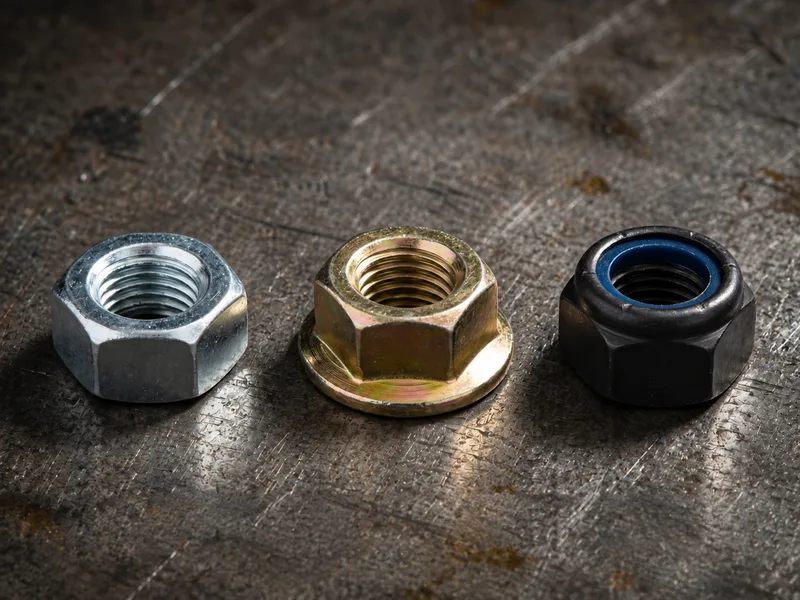
Specifications
ISO 10663 is the fine-pitch version of the plain flange nut: the same integrated-flange form as ISO 4161, cut for the fine thread series where a finer pitch buys clamp-load control and vibration resilience on thinner walls or harder materials. The fine pitch also means the same nominal size carries a larger pitch diameter and slightly different wrench geometry than the coarse ladder — which is why the two tables are kept apart rather than merged: M12 fine and M12 coarse share a name but not a column set. The printed grades matter at the top of the range: through size 16 the source prints product grade A, while size 20 is printed as grade B, reflecting the proof-strength split in the underlying standard. Where the coarse ladder (ISO 4161) skips M12 and M18 on its own print, the fine ladder here runs continuously 8-10-12-14-16-20 — so a fine-pitch requirement on those sizes has a table line here where the coarse page would have sent you to a quotation.
| Standard / scope | ISO 10663 — hex flange nuts, fine pitch series, sizes 8 to 20 tabulated (the Standard column prints "ISO 10663" on every source row) |
|---|---|
| Form | plain (non-locking) hex nut with integrated flange, fine pitch — the free-spinning counterpart of the coarse ISO 4161 ladder; no insert |
| Product grade | grade A at sizes 8-16, grade B at size 20 (per the source table's Product Grade column) |
| Thread series | fine pitch throughout: pitch 1 at size 8, 1.25 at 10 and 12, 1.5 at 14, 16 and 20 — printed per row; the coarse-pitch form is ISO 4161, a separate ladder and a separate page |
| Flange bearing face | dc max and dw min printed per size (e.g. dc 21.8 / dw 19.6 at size 10, dc 42.8 / dw 39.9 at size 20) — the washer-replacement bearing diameter check |
| Height band | m max/min printed per size (8.00/7.64 at size 8 rising to 20.0/18.7 at size 20); mw min (effective gripping length) also printed per row |
| Width across flats | s max/min printed per size: 13.00/12.73 at size 8, 15.00/14.73 at 10, 18.00/17.73 at 12, 21.00/20.67 at 14, 24.00/23.67 at 16, 30.00/29.16 at 20 |
| Provenance note | recovered from the source's per-size calculator by live-DOM capture (2026-11-05), passing capture-time repeat-signature and column-consistency checks; supersedes an earlier dump of the same page whose trailing Size column was corrupted and which was never minted |
| Not tabulated | sizes above 20, the coarse-pitch ladder (ISO 4161), proof load or hardness class, MOQ, lead time and price — the last three are confirmed at quotation |
| Thread size | Product grade | Standard | Pitch (mm) | c min | da max | da min | dc max | dw min | e min | m max | m min | mw min | s max | s min | r max |
|---|---|---|---|---|---|---|---|---|---|---|---|---|---|---|---|
| 8 | A | ISO 10663 | 1 | 1.2 | 8.75 | 8.00 | 17.9 | 15.8 | 14.38 | 8.00 | 7.64 | 4.6 | 13.00 | 12.73 | 0.5 |
| 10 | A | ISO 10663 | 1.25 | 1.5 | 10.8 | 10.0 | 21.8 | 19.6 | 16.64 | 10.00 | 9.64 | 5.6 | 15.00 | 14.73 | 0.6 |
| 12 | A | ISO 10663 | 1.25 | 1.8 | 13 | 12 | 26 | 23.8 | 20.03 | 12.00 | 11.57 | 6.8 | 18.00 | 17.73 | 0.7 |
| 14 | A | ISO 10663 | 1.5 | 2.1 | 15.1 | 14.0 | 29.9 | 27.6 | 23.36 | 14.0 | 13.3 | 7.7 | 21.00 | 20.67 | 0.9 |
| 16 | A | ISO 10663 | 1.5 | 2.4 | 17.3 | 16.0 | 34.5 | 31.9 | 26.75 | 16.0 | 15.3 | 8.9 | 24.00 | 23.67 | 1 |
| 20 | B | ISO 10663 | 1.5 | 3 | 21.6 | 20.0 | 42.8 | 39.9 | 32.95 | 20.0 | 18.7 | 10.7 | 30.00 | 29.16 | 1.2 |
Materials
- Fine-pitch flange nuts order in steel (typically zinc-plated for general service, with stainless for corrosive duty); the source page is a dimension reference and does not print material or finish stocks — state thread size, grade A or B preference, and any finish requirement on the RFQ. Commercial terms (MOQ, lead time, price) are confirmed at quotation.
Ordering & documentation
Documents
Shipments of ISO 10663 Flange Nuts (Fine Pitch) are backed by Mill Test Certificate (MTC), Dimensional Report, Salt Spray Test Report on request, with full batch traceability from raw material to finished product. Quality management for ISO 10663 Flange Nuts (Fine Pitch) orders follows the owner-confirmed compliance list: ISO 9001:2015, RoHS, REACH. Exact document sets are confirmed on the order.
Quotation
- The product family (ISO 10663 Flange Nuts (Fine Pitch)), product standard/designation and drawing or part number.
- The dimensions that apply to this part — such as size, pitch, length, thickness, fit, grip or groove geometry.
- Material/grade, heat-treatment condition and surface finish, together with the service environment.
- Quantity per size, delivery destination and required test or traceability documents.
Sample & supply
Supply source for ISO 10663 Flange Nuts (Fine Pitch): own manufacturing plus qualified outsourcing (per the owner-confirmed scope of supply (own production plus outsourcing)).
Minimum order quantity for iso 10663 flange nuts (fine pitch) is 10,000 pieces (applies to the standard sizes and finishes for iso 10663 flange nuts (fine pitch); mixed, special or custom variants are quoted — final commercial terms per quotation) Stock items for iso 10663 flange nuts (fine pitch) run 3–7 days. Quantities or variants of iso 10663 flange nuts (fine pitch) outside the standard range are confirmed at quotation.
Storage & shipping
ISO 10663 Flange Nuts (Fine Pitch) are packed for export and shipped factory-direct to buyers in Europe, Asia, the Americas and the Middle East. Store iso 10663 flange nuts (fine pitch) dry and protected until installation, and keep coated parts in their packaging until use; specific packing and preservation requirements can be stated on the order and confirmed at quotation.
Frequently asked questions
When does a fine-pitch flange nut beat the coarse ISO 4161 version?
Fine pitch buys clamp-load precision: for the same tightening torque a finer thread produces higher and more repeatable preload, which matters on dynamically loaded joints and where the clamped material is thin or hard. Fine pitch also engages more threads over the same height, useful on short engagements. The trade is assembly care — fine threads gall and cross-thread more easily, and dirty-field assembly favors coarse. Geometrically the two forms share the flange concept but not the numbers: the fine ladder here runs 8 to 20 continuously, while the coarse ISO 4161 print skips M12/M18, so the choice of pitch series can also decide whether a size has a table line at all. Both pages print grade A to size 16 and grade B at the top, and the wrench sizes match the plain hex nut series in both series.
What does the grade A / grade B split at size 20 mean for ordering?
The source table prints product grade A for sizes 8 through 16 and grade B for size 20 — the top of the range moves to the lower proof-strength grade on this print. Practically: if a joint calculation assumed the grade A proof strength, a size-20 requirement should be checked against the B-grade property before ordering, or the joint should be resized. The table itself carries the geometry either way; what the grade changes is the strength expectation, and that is a quotation conversation when the size-20 line comes up — state the load requirement on the RFQ rather than assuming the same rating as the smaller sizes.
Why is the earlier capture of this page flagged, and what changed?
An earlier automated capture of this same calculator produced a table whose trailing Size column contradicted the row's own geometry (values stepped out of line with the flange and height columns), so it was rejected fail-closed and never minted. The current table comes from a live-DOM recapture that drives the calculator through every size selection and checks, at capture time, that the size column steps monotonically and stays correlated with the geometry columns before anything is written. Every cell in the table below is traceable to a displayed value from that checked capture — which is why the gap between the two captures is disclosed here rather than silently patched over.
Request a Quote
Get factory-direct pricing from the manufacturer.
What to include in your ISO 10663 Flange Nuts (Fine Pitch) inquiry
- ✓ Name the nut standard, style and nominal thread size/pitch, including metric or inch thread series.
- ✓ State the nut property class or material and the bolt class/material it must be paired with.
- ✓ Specify locking or prevailing-torque feature, coating and corrosion environment.
- ✓ Give quantity per size, destination and any lot or mechanical-test documentation.
- ✓ Factory-direct pricing for your ISO 10663 Flange Nuts (Fine Pitch)
- ✓ Standard and custom specifications
- ✓ Factory-direct export to buyers in Europe, Asia, the Americas and the Middle East
- ✓ Full fastener family support