
Hex Jam Nuts (Inch Series)
Inch-series hex jam nuts from 1/4 to 1 1/2 in — reduced-thickness hex nuts sharing the hex nut width across flats, with the jam thickness band tabulated per size and the 5/16, 3/8 and 11/16 in gaps disclosed.
Last updated: 2026-11
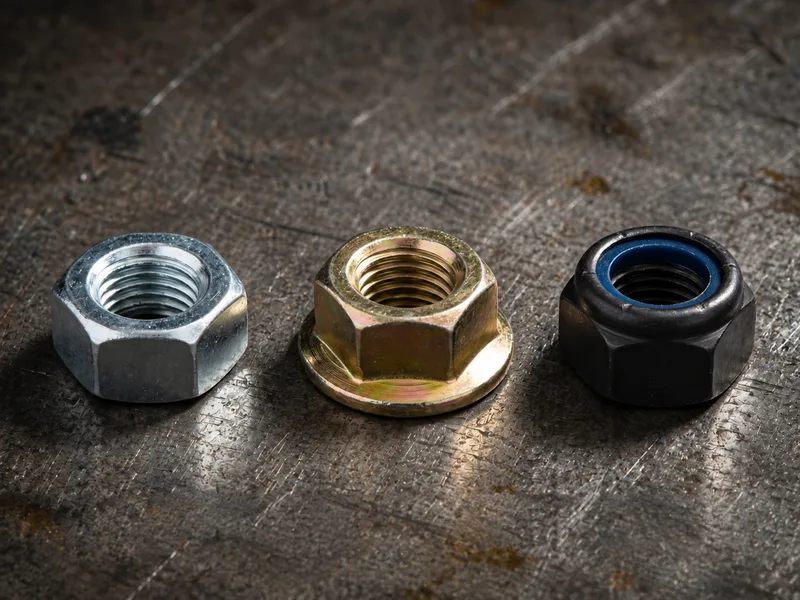
Specifications
A hex jam nut is the thin half of the classic jam-nut pair: same hex form and same width across flats as the standard hex nut of the nominal size, roughly half the thickness, used either where stack height is tight or locked against a full nut so the pair resists loosening without a deformable insert. The source ladder tabulates both nuts side by side per size — the shared width across flats and corners, the full hex nut thickness band, and the jam-specific thickness column — which makes it directly usable for planning a jam pair: the thread engagement lost on the thin nut is what the full nut behind it restores, and the two nuts wrench against each other across the same flats. One reading note: the printed ladder is not complete across the inch series — 5/16, 3/8 and 11/16 in are skipped by the source, and those sizes are a quotation question here, not a table lookup. The source prints no standard number on the page; the table carries the product identity and dimensions as printed, and a standard-controlled requirement should state the controlling standard explicitly on the RFQ.
| Type / scope | inch-series hex jam nuts, nominal sizes 1/4 through 1 1/2 in on the source ladder; sizes 5/16, 3/8 and 11/16 in are not tabulated by the source (gaps carried, not interpolated) |
|---|---|
| Form | hex nut body at reduced ("jam") thickness — width across flats and across corners identical to the same-size hex nut on the source print; no chamfer or insert detail is tabulated on the source |
| Width across flats | 7/16 in at 1/4 rising to 2 1/4 in at 1 1/2 (F max/min printed per size, e.g. 0.750/0.736 at 1/2 in and 1.500/1.450 at 1 in) |
| Jam thickness | the jam-specific column: 5/32 in basic at 1/4 (max 0.163 / min 0.150) rising to 27/32 in basic at 1 1/2 (max 0.880 / min 0.808) — roughly half the hex nut thickness printed alongside it |
| Hex nut thickness (reference) | the full-height band is printed on the same rows (7/32 basic at 1/4 to 1 9/32 at 1 1/2) — usable for planning a jam-plus-full-nut pair |
| Standard status | the source page prints the product identity and dimensions but no standard number; this page is registered as a type-descriptor, and a standard-controlled requirement should name the controlling standard on the RFQ |
| Anomaly note | the source calculator dump repeated the 1/4 in row verbatim; the duplicate was collapsed (values identical) and the 5/16, 3/8 and 11/16 in gaps are carried as printed |
| Not tabulated | thread pitch/series per size, proof load or hardness class, MOQ, lead time and price — the last three are confirmed at quotation |
| Nominal size | Width across flats basic | F max | F min | Width across corners max | G min | Hex nut thickness basic | H max | H min | Jam nut thickness basic | H1 max | H1 min |
|---|---|---|---|---|---|---|---|---|---|---|---|
| 1/4 | 7/16 | 0.438 | 0.428 | Gmax / 0.505 | 0.488 | 7/32 | 0.226 | 0.212 | 5/32 | 0.163 | 0.150 |
| 7/16 | 11/16 | 0.688 | 0.675 | Gmax / 0.794 | 0.768 | 3/8 | 0.385 | 0.365 | 1/4 | 0.260 | 0.240 |
| 1/2 | 3/4 | 0.750 | 0.736 | Gmax / 0.866 | 0.840 | 7/16 | 0.448 | 0.427 | 5/16 | 0.323 | 0.302 |
| 9/16 | 7/8 | 0.875 | 0.861 | Gmax / 1.010 | 0.982 | 31/64 | 0.496 | 0.473 | 5/16 | 0.324 | 0.301 |
| 5/8 | 15/16 | 0.938 | 0.922 | Gmax / 1.083 | 1.051 | 35/64 | 0.559 | 0.535 | 3/8 | 0.387 | 0.363 |
| 3/4 | 1 1/8 | 1.125 | 1.088 | Gmax / 1.299 | 1.240 | 41/64 | 0.665 | 0.617 | 27/64 | 0.446 | 0.398 |
| 7/8 | 1 5/16 | 1.312 | 1.269 | Gmax / 1.516 | 1.447 | 3/4 | 0.776 | 0.724 | 31/64 | 0.510 | 0.458 |
| 1 | 1 1/2 | 1.500 | 1.450 | Gmax / 1.732 | 1.653 | 55/64 | 0.887 | 0.831 | 35/64 | 0.575 | 0.519 |
| 1 1/8 | 1 11/16 | 1.688 | 1.631 | Gmax / 1.949 | 1.859 | 31/32 | 0.999 | 0.939 | 39/64 | 0.639 | 0.579 |
| 1 1/4 | 1 7/8 | 1.875 | 1.812 | Gmax / 2.165 | 2.066 | 1 1/16 | 1.094 | 1.030 | 23/32 | 0.751 | 0.687 |
| 1 3/8 | 2 1/16 | 2.062 | 1.994 | Gmax / 2.382 | 2.273 | 1 11/64 | 1.206 | 1.138 | 25/32 | 0.815 | 0.747 |
| 1 1/2 | 2 1/4 | 2.250 | 2.175 | Gmax / 2.598 | 2.480 | 1 9/32 | 1.317 | 1.245 | 27/32 | 0.880 | 0.808 |
Materials
- Hex jam nuts order in steel (typically zinc-plated for general service, with stainless for corrosive duty); the source page is a dimension reference and does not print material or finish stocks — state nominal size, material, and any pairing (jam alone versus jam-plus-full-nut) on the RFQ. Commercial terms (MOQ, lead time, price) are confirmed at quotation.
Ordering & documentation
Documents
Shipments of Hex Jam Nuts (Inch Series) are backed by Mill Test Certificate (MTC), Dimensional Report, Salt Spray Test Report on request, with full batch traceability from raw material to finished product. Quality management for Hex Jam Nuts (Inch Series) orders follows the owner-confirmed compliance list: ISO 9001:2015, RoHS, REACH. Exact document sets are confirmed on the order.
Quotation
- The product family (Hex Jam Nuts (Inch Series)), product standard/designation and drawing or part number.
- The dimensions that apply to this part — such as size, pitch, length, thickness, fit, grip or groove geometry.
- Material/grade, heat-treatment condition and surface finish, together with the service environment.
- Quantity per size, delivery destination and required test or traceability documents.
Sample & supply
Supply source for Hex Jam Nuts (Inch Series): own manufacturing plus qualified outsourcing (per the owner-confirmed scope of supply (own production plus outsourcing)).
Minimum order quantity for hex jam nuts (inch series) is 10,000 pieces (applies to the standard sizes and finishes for hex jam nuts (inch series); mixed, special or custom variants are quoted — final commercial terms per quotation) Stock items for hex jam nuts (inch series) run 3–7 days. Quantities or variants of hex jam nuts (inch series) outside the standard range are confirmed at quotation.
Storage & shipping
Hex Jam Nuts (Inch Series) are packed for export and shipped factory-direct to buyers in Europe, Asia, the Americas and the Middle East. Store hex jam nuts (inch series) dry and protected until installation, and keep coated parts in their packaging until use; specific packing and preservation requirements can be stated on the order and confirmed at quotation.
Frequently asked questions
How does an inch hex jam nut differ from a full-height hex nut, and when is the thin nut the right choice?
The hex form is the same — the source ladder shows identical width across flats and corners for the two nuts on each row — so wrench access and bearing area do not change. What changes is thickness: at 1/2 in the jam nut runs 5/16 in basic against the full nut's 7/16 in, and at 1 1/2 in it is 27/32 against 1 9/32. That makes the jam nut the choice where a standard nut would run past the end of the bolt or foul an adjacent part, and the classic choice in a jam pair, where the thin nut sits behind a full nut and the two are wrenched against each other so the joint cannot back the pair off. The thin nut alone has fewer engaged threads, so on long or high-vibration joints the pair (or a nylon-insert nut instead) is the conservative pick. The table on this page prints both thickness bands per size so the stack can be planned against the actual bolt length.
Why are 5/16, 3/8 and 11/16 in missing from the dimension table?
The source page serves dimensions through a per-size calculator, and the recovered ladder simply does not include those sizes — the gaps are disclosed here rather than filled from another source, because values quoted from a different reference would not be traceable to the same print. If a requirement falls on 5/16, 3/8 or 11/16 in, treat the dimension check as a quotation question: state the size and the application on the RFQ and the confirming dimensions come back with the offer rather than being assumed from this table.
Can a jam nut be reused, and does it need anything behind it?
A plain jam nut locks by preload and wrench friction between the two nuts of a pair (or between the nut and the joint), so it has no insert to degrade and tolerates reassembly better than a nylon-insert nut — the practical limit is thread and bearing-face wear, not a locking element that fatigues. It does need something to react against: alone, a thin nut offers less thread engagement and less prevailing resistance, so the standard arrangements are the jam-plus-full-nut pair (thin nut against the joint, full nut backed against it, or the reverse where the thin nut carries the load) or a jam nut over a harder stop. The temperature and chemical limits that matter for nylon-insert nuts do not apply here, which is why jam pairs remain the usual answer near heat. The thickness bands in the table give the stack arithmetic for either arrangement.
Request a Quote
Get factory-direct pricing from the manufacturer.
What to include in your Hex Jam Nuts (Inch Series) inquiry
- ✓ Name the nut standard, style and nominal thread size/pitch, including metric or inch thread series.
- ✓ State the nut property class or material and the bolt class/material it must be paired with.
- ✓ Specify locking or prevailing-torque feature, coating and corrosion environment.
- ✓ Give quantity per size, destination and any lot or mechanical-test documentation.
- ✓ Factory-direct pricing for your Hex Jam Nuts (Inch Series)
- ✓ Standard and custom specifications
- ✓ Factory-direct export to buyers in Europe, Asia, the Americas and the Middle East
- ✓ Full fastener family support