DIN 7973 Slotted Raised Countersunk Head Tapping Screws (ST2,2 – ST6,3)
DIN 7973 slotted raised countersunk head tapping screws — sheet-metal tapping screws with a slotted raised head (countersunk flush plus a load-bearing dome), attributes P/a/dk/f/k/n/r/rf/t/y and the full length-mass ladder l 6,5 to 38 dimensioned ST2,2 to ST6,3, for driving with a plain screwdriver where the head must sit near-flush but take torque.
Last updated: 2026-11
Specifications
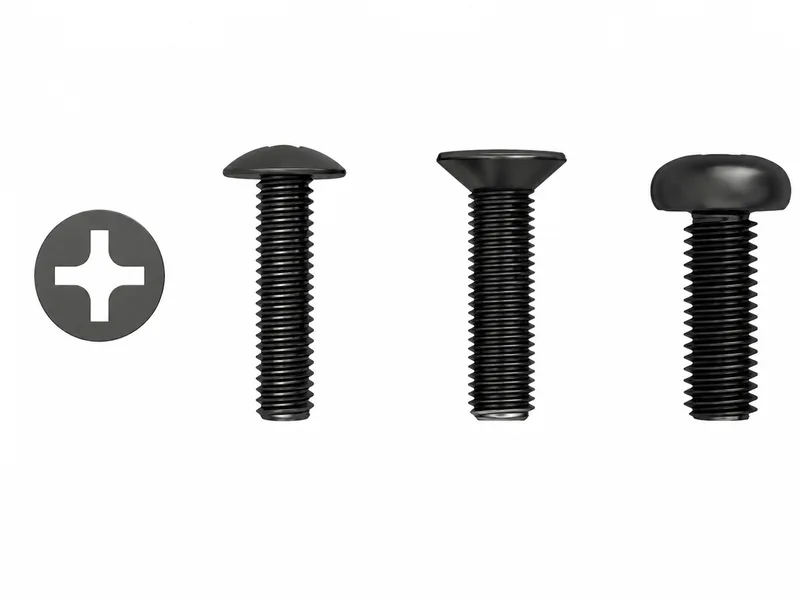
DIN 7973 is the slotted member of the sheet-metal tapping family, and its head answers a conflict the plain countersunk tapping screw cannot: a flush head has almost no head height to carry the driving torque of driving a screw into steel sheet, while a pan head stands proud of the surface. The raised countersunk head splits the difference — the countersunk flange seats into the pre-drilled or punched hole near-flush, and the shallow dome above it gives the head enough metal to resist the slot's driving loads. The slot (not a cross recess) is the drive: better for hand-driving into thin sheet with a plain screwdriver, worse under power drivers that cam out, which is exactly why the tapping ladder splits this way — the cross-recess cousins (DIN 7981/7982/7983, registered on this site) own the power-driven applications and this part owns the hand-driven and service-plate ones. The collected reference runs the full captured grid: the attribute table per thread ST2,2 to ST6,3 — pitch P, point a, head diameter dk in nominal/min., nib height f, head height k, slot n in nominal/min./max., radius r, head radius rf, slot depth t in min./max., and the Type C/F point runout y — plus the length ladder l 6,5 to 38 with per-type min./max. bands and the source's own mass-per-1000 column (7,85 kg/dm³, blank where not tabulated). Reading notes before engineering use: the source frames the table "according to ISO 1483" (the printed equivalent of this DIN — the ISO framing is the source's own and is carried, not resolved); the n nominal row prints a literal "12" at ST4,8 where its neighbours read 1,2 and 1,6 — carried verbatim and flagged, use the min./max. band for that size rather than the nominal print; and the (ST3,9) column is parenthesized as the source's non-preferred-size marker.
| Standard / scope | DIN 7973 slotted raised countersunk head tapping screws (source title as printed); table intro prints "Table according to ISO 1483" — equivalents printed: ISO 1483; CSN 021238; PN 83104; UNI 6953 |
|---|---|
| Threads | eight tabulated tapping sizes: ST2,2, ST2,9, ST3,5, (ST3,9), ST4,2, ST4,8, ST5,5, ST6,3 — (ST3,9) parenthesized as the source's own non-preferred-size marker, carried verbatim |
| Head geometry | head diameter dk nominal=max. 4,3 to 12,4 (min. 4 to 11,97); head height k approx. 1,3 to 3,8; nib height f approx. 0,7 to 2; head radius rf approx. 3,8 to 11,1; radius r max. 0,8 to 2,4 |
| Slot (n / t) | slot width n nominal 0,6 to 1,6 (min./max. bands tabulated; the ST4,8 nominal cell prints a literal "12" — flagged, see FAQ); slot depth t min. 0,95 to 2,85 / max. 1,15 to 3,45 |
| Point / thread | pitch P 0,8 to 1,8 (thread ISO 1478 as printed); point a max. 0,8 to 1,8; Type C/F point runout y max. per type (Type C 2 to 6; Type F 1,6 to 3,6) |
| Length ladder (l) | 6,5 to 38 nominal with per-type min./max. bands (Type C and Type F) and the source's mass column (kg per 1000 units, 7,85 kg/dm3; blank cells = not tabulated) |
| Materials / thread (as printed) | Steel: steel - ISO 2702; Stainless: A2; Thread: thread ISO 1478; Plastic: -; Non Ferrous: - (source makings block verbatim) |
| Attribute | ST2,2 | ST2,9 | ST3,5 | (ST3,9) | ST4,2 | ST4,8 | ST5,5 | ST6,3 |
|---|---|---|---|---|---|---|---|---|
| P | 0,8 | 1,1 | 1,3 | 1,3 | 1,4 | 1,6 | 1,8 | 1,8 |
| a max. | 0,8 | 1,1 | 1,3 | 1,3 | 1,4 | 1,6 | 1,8 | 1,8 |
| dk nominal=max. | 4,3 | 5,5 | 6,8 | 7,5 | 8,1 | 9,5 | 10,8 | 12,4 |
| dk min. | 4 | 5,2 | 6,44 | 7,14 | 7,74 | 9,14 | 10,37 | 11,97 |
| f approx. | 0,7 | 0,9 | 1,2 | 1,3 | 1,4 | 1,5 | 1,7 | 2 |
| k approx. | 1,3 | 1,7 | 2,1 | 2,3 | 2,5 | 3 | 3,4 | 3,8 |
| n nominal | 0,6 | 0,8 | 1 | 1 | 1,2 | 12 | 1,6 | 1,6 |
| n min. | 0,66 | 0,86 | 1,06 | 1,06 | 1,26 | 1,26 | 1,66 | 1,66 |
| n max. | 0,8 | 1 | 1,2 | 1,2 | 1,51 | 1,51 | 1,91 | 1,91 |
| r max. | 0,8 | 1,1 | 1,4 | 1,5 | 1,6 | 1,9 | 2,1 | 2,4 |
| rf approx. | 3,8 | 4,6 | 5,4 | 6 | 6,6 | 8,2 | 9,4 | 11,1 |
| t min. | 0,95 | 1,25 | 1,55 | 1,7 | 1,85 | 2,15 | 2,42 | 2,85 |
| t max. | 1,15 | 1,5 | 1,9 | 2,05 | 2,25 | 2,6 | 2,95 | 3,45 |
| y max. Type C | 2 | 2,6 | 3,2 | 3,5 | 3,7 | 4,3 | 5 | 6 |
| y max. Type F | 1,6 | 2,1 | 2,5 | 2,7 | 2,8 | 3,2 | 3,6 | 3,6 |
- the n 'nominal' row prints a literal '12' at ST4,8 between neighbours 1,2 and 1,6 — carried verbatim and flagged, never normalized; the min./max. rows (1,26/1,51) bound the slot width independently for that size.
- the n min. row prints 0,66 above its nominal 0,6 at ST2,2 (and 0,86 above 0,8) — band ordering as captured, kept verbatim.
- the '(ST3,9)' column keeps the source's parentheses — the non-preferred-size marker is the source's own convention.
- the attribute rows sit directly under the thread header without a separate band row — sub-labels ('max.', 'approx.', 'nominal', 'Type C/F') folded into row labels by captured DOM occupancy.
| l nominal | Type C min. | Type C max. | Type F min. | Type F max. | mass ST2,2 | mass ST2,9 | mass ST3,5 | mass (ST3,9) | mass ST4,2 | mass ST4,8 | mass ST5,5 | mass ST6,3 |
|---|---|---|---|---|---|---|---|---|---|---|---|---|
| 6,5 | 5,7 | 7,3 | 5,7 | 6,5 | 0,18 | 0,332 | ||||||
| 9,5 | 8,7 | 10,3 | 8,7 | 9,5 | 0,24 | 0,44 | 0,721 | 0,888 | 1,07 | 1,53 | ||
| 13 | 12,2 | 13,8 | 12,2 | 13 | 0,31 | 0,566 | 0,898 | 1,11 | 1,32 | 1,88 | 2,74 | 3,46 |
| 16 | 15,2 | 16,8 | 15,2 | 16 | 0,37 | 0,674 | 1,05 | 1,3 | 1,53 | 2,18 | 3,12 | 4 |
| 19 | 18,2 | 19,8 | 18,2 | 19 | 0,782 | 1,2 | 1,49 | 1,74 | 2,48 | 3,51 | 4,54 | |
| 22 | 21,2 | 22,8 | 20,7 | 22 | 1,35 | 1,68 | 1,95 | 2,78 | 3,89 | 5,08 | ||
| 25 | 24,2 | 25,8 | 23,7 | 25 | 1,51 | 1,87 | 2,16 | 3,08 | 4,28 | 5,62 | ||
| 32 | 30,7 | 33,3 | 30,7 | 32 | 2,65 | 3,78 | 5,19 | 6,88 | ||||
| 38 | 36,7 | 39,3 | 36,7 | 38 | 4,38 | 5,97 | 7,96 |
- the mass ladder grows with thread size: short lengths are mass-tabulated only for the small threads (l 6,5 exists for ST2,2/ST2,9 only; l 38 starts at ST4,8) — blanks are the source's own not-tabulated cells, not zeros.
- the Type C/F min./max. bands differ per type (l 22: Type C 21,2-22,8 vs Type F 20,7-22) — the point style belongs on the RFQ line, as the band and the y runout row are per type.
Materials
- The source makings block prints two material families with their standards attached — Steel: steel - ISO 2702 (the tapping-screw steel grades standard) and Stainless: A2 — plus Thread: thread ISO 1478. This page claims exactly that and no more: the steel grade within ISO 2702 (case-hardened vs surface-hardened tapping grades), any coating, and the drive-environment match are order-line decisions. Practical RFQ notes: state thread (ST size), length from the ladder (checked against the Type C/F min./max. band for your point style), material family, finish (none printed), and quantity per size — and if a powered driver is in the picture, reconsider the slot drive itself: this part is the slotted member of the family, and the cross-recess DIN 7981 counterpart may be the better fit for production-line driving. A2 stainless tapping screws into steel sheet are a quoting item (galling and tapping performance differ from the ISO 2702 steel grades).
Ordering & documentation
Documents
Shipments of DIN 7973 Slotted Raised Countersunk Head Tapping Screws (ST2,2 – ST6,3) are backed by Mill Test Certificate (MTC), Dimensional Report, Salt Spray Test Report on request, with full batch traceability from raw material to finished product. Quality management for DIN 7973 Slotted Raised Countersunk Head Tapping Screws (ST2,2 – ST6,3) orders follows the owner-confirmed compliance list: ISO 9001:2015, RoHS, REACH. Exact document sets are confirmed on the order.
Quotation
- The product family (DIN 7973 Slotted Raised Countersunk Head Tapping Screws (ST2,2 – ST6,3)), product standard/designation and drawing or part number.
- The dimensions that apply to this part — such as size, pitch, length, thickness, fit, grip or groove geometry.
- Material/grade, heat-treatment condition and surface finish, together with the service environment.
- Quantity per size, delivery destination and required test or traceability documents.
Sample & supply
Minimum order quantity for din 7973 slotted raised countersunk head tapping screws (st2,2 – st6,3) is 10,000 pieces (applies to the standard sizes and finishes for din 7973 slotted raised countersunk head tapping screws (st2,2 – st6,3); mixed, special or custom variants are quoted — final commercial terms per quotation) Stock items for din 7973 slotted raised countersunk head tapping screws (st2,2 – st6,3) run 3–7 days. Quantities or variants of din 7973 slotted raised countersunk head tapping screws (st2,2 – st6,3) outside the standard range are confirmed at quotation.
Storage & shipping
DIN 7973 Slotted Raised Countersunk Head Tapping Screws (ST2,2 – ST6,3) are packed for export and shipped factory-direct to buyers in Europe, Asia, the Americas and the Middle East. Store din 7973 slotted raised countersunk head tapping screws (st2,2 – st6,3) dry and protected until installation, and keep coated parts in their packaging until use; specific packing and preservation requirements can be stated on the order and confirmed at quotation.
Frequently asked questions
The ST4,8 "n nominal" cell prints "12" between neighbours that read 1,2 and 1,6 — which is right?
The source prints "12" and this page carries it verbatim rather than silently correcting it to "1,2" — the neighbours (0,6, 0,8, 1, 1, 1,2, 12, 1,6, 1,6) make the likely misprint obvious, but a likely misprint is still not a verified value. The engineering-safe path is on the page already: the min./max. rows around it (1,26/1,51 at ST4,8) bound the slot width independently of the suspect nominal, so use the band for that size. For a drawing-critical use, resolve the nominal against ISO 1483 or the standard document; if you quote from this page, state that the nominal print at ST4,8 is carried as-published.
Why a slotted tapping screw at all — my assembly line uses drivers?
Because the slot is not a compromise everywhere: it is the right drive where the screws go in by hand, one at a time, with a plain screwdriver — service plates, switchgear and enclosure building, repair work, and any environment where the driver fleet is just a set of flat blades. A slot also survives dirt and paint in ways a cross recess does not. Where screws are power-driven in volume, the slot's cam-out becomes the deciding fault, and that is precisely why the family splits: DIN 7981/7982/7983 (cross recess, registered on this site) for the production line, DIN 7973 (this page) for the hand-driven and maintenance lanes. The raised head matters for both: tapping torque into steel sheet is high, and a fully flush head has too little metal under the slot to take it.
The table is framed "according to ISO 1483" but the page is DIN 7973 — which standard am I buying?
The source prints DIN 7973 as the page subject and lists ISO 1483 first among the equivalents (with CSN 021238, PN 83104 and UNI 6953), then frames its own table "according to ISO 1483" — this page carries all of that as printed without adjudicating which text is authoritative. Practically the two designations describe the same raised-countersunk slotted tapping screw and the dimension grid is self-consistent, so the RFQ question is which designation your drawing and your supplier's catalogue speak: state the designation your drawing uses (and its tolerance standard for the thread — ISO 1478 is printed for the thread form itself). If a contract requires one specific standard document, that document is quoted from, not this page.
What should an RFQ for DIN 7973 screws state?
Thread size (ST2,2-ST6,3 from the ladder) and length as a pair checked against the ladder (6,5-38; lengths past the printed ladder or blanks in the mass column are quotation items), the point style — Type C or Type F — since the ladder prints separate min./max. bands and a separate runout y per type, material family (ISO 2702 steel grade or A2 stainless), finish if not plain, quantity per size — plus the drive reality check (slot vs the cross-recess cousins) and the note that the ST4,8 slot nominal is quoted verbatim from the reference. Anything outside the printed grid is confirmed at quotation.
Related knowledge
- Thread-Forming vs Thread-Cutting vs Thread-Rolling Self-Tapping Screws: What the Evidence Settles on Base Material
- Screw Family Selection by Base Material: Wood, Machine and Self-Tapping Threads, Engagement and Coating
- Hex Bolts vs Socket Head Cap Screws: What the Evidence Settles on Strength, Clearance and Cost
Request a Quote
Get factory-direct pricing from the manufacturer.
What to include in your DIN 7973 Slotted Raised Countersunk Head Tapping Screws (ST2,2 – ST6,3) inquiry
- ✓ Identify the screw type and standard, including head style and drive recess.
- ✓ Give nominal diameter, thread pitch, length and engagement or hole details where relevant.
- ✓ State the material/property class, substrate material and thickness, and required coating or finish.
- ✓ Describe installation, locking or removal requirements, quantity and destination.
- ✓ Factory-direct pricing for your DIN 7973 Slotted Raised Countersunk Head Tapping Screws (ST2,2 – ST6,3)
- ✓ Standard and custom specifications
- ✓ Factory-direct export to buyers in Europe, Asia, the Americas and the Middle East
- ✓ Full fastener family support