
ISO 2010 Slotted Raised Countersunk Head Screws
ISO 2010 slotted raised countersunk (oval) head machine screws — M1 to M10, the crowned flush head for thin or finished panels, with the collected geometry rows and the full weight ladder M1–M10 × l 2–60.
Last updated: 2026-11
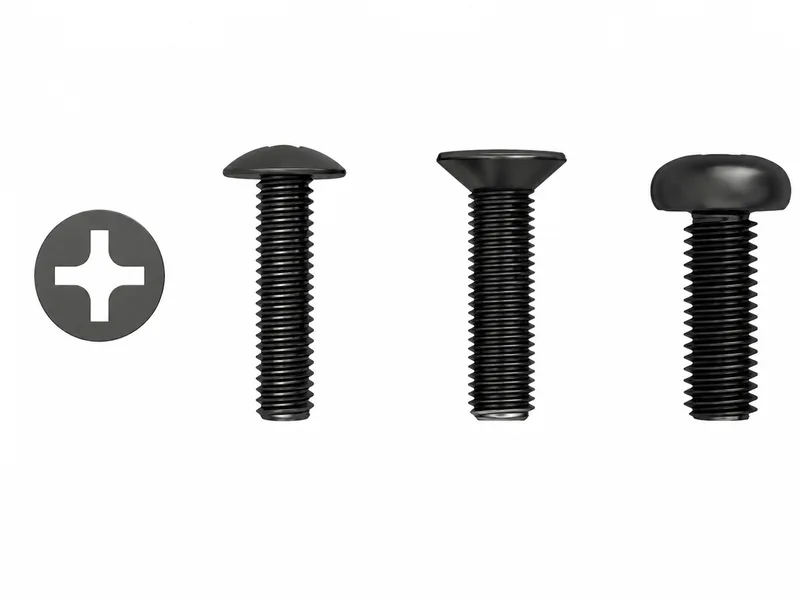
Specifications
ISO 2010 is the oval-head member of the slotted countersunk pair: like ISO 2009 it seats in a 90° countersink, but its raised face adds a shallow crown above flush — no sharp edge to catch, a slightly deeper head for the slot, and a deliberately "finished" look on instrument panels and switchgear. The collected data covers M1 through M10 with the full geometry ladder (including the crown parameters f approx. and rf approx. that the flat ISO 2009 page does not carry) and a complete kg/1000 weight matrix for lengths 2 to 60. Choose it over the flat version when the panel is thin enough that a flush head would sit proud anyway, or when the edge profile matters; choose ISO 2009 when true flush is required. One genuine anomaly is flagged rather than smoothed: at M5–M10 the source prints crown heights f larger than the total head heights k, which breaks the small-size progression — if the crown profile is dimension-critical, confirm per RFQ. Property class and finish are not tabulated by the collected specification — per RFQ.
| Standard | ISO 2010 — slotted raised countersunk (oval) head screws |
|---|---|
| Size range | Threads M1 – M10, (M3,5) non-preferred per the source notation |
| Head diameter | dk: nominal = max. / min. per thread (e.g. M4: 7,5 / 7,14 mm) |
| Head height | k max: 0,6 (M1) → 2,5 (M10) mm, incl. the raised face |
| Crown | f approx. 0,25 → 5 mm, rf approx. 2 → 20 mm per thread (M5–M10 f/k print flagged verbatim) |
| Slot | n Nominal 0,25 (M1) → 2,5 (M10) mm with min./max. windows; t min. 0,4 → 4 mm |
| Weight | kg/1000 pcs ladder, l 2 – 60 × M1 – M10, carried verbatim (0,016 → 35,8) |
| Property class / finish | Not tabulated by the collected specification — per RFQ |
| Thread d | P | a max. | b min. | dk nominal = max. | dk min. | f approx. | k max. | n Nominal | n min. | n max. | r max. | rf approx. | t min. | t max. | x max. |
|---|---|---|---|---|---|---|---|---|---|---|---|---|---|---|---|
| M1 | 0,25 | 0,5 | full thread | 1,9 | 1,76 | 0,25 | 0,6 | 0,25 | 0,31 | 0,45 | 0,1 | 2 | 0,4 | 0,5 | - |
| M1,2 | 0,25 | 0,5 | full thread | 2,3 | 2,06 | 0,3 | 0,72 | 0,3 | 0,36 | 0,5 | 0,12 | 2,5 | 0,5 | 0,6 | - |
| M1,4 | 0,3 | 0,6 | full thread | 2,6 | 2,46 | 0,35 | 0,84 | 0,3 | 0,36 | 0,5 | 0,14 | 3 | 0,52 | 0,65 | - |
| M1,6 | 0,35 | 0,7 | 15 | 3 | 2,86 | 0,4 | 0,96 | 0,4 | 0,46 | 0,6 | 0,16 | 3 | 0,65 | 0,8 | 0,9 |
| M2 | 0,4 | 0,8 | 16 | 3,8 | 3,5 | 0,5 | 1,2 | 0,5 | 0,56 | 0,7 | 0,2 | 4 | 0,8 | 1 | 1 |
| M2,5 | 0,45 | 0,9 | 18 | 4,7 | 4,4 | 0,6 | 1,5 | 0,6 | 0,66 | 0,8 | 0,25 | 5 | 1 | 1,2 | 1,1 |
| M3 | 0,5 | 1 | 19 | 5,6 | 5,3 | 0,75 | 1,65 | 0,8 | 0,86 | 1 | 0,3 | 6 | 1,2 | 1,45 | 1,25 |
| (M3,5) | 0,6 | 1,2 | 20 | 6,5 | 6,14 | 0,9 | 1,93 | 0,8 | 0,86 | 1 | 0,35 | 7 | 1,4 | 1,7 | 1,5 |
| M4 | 0,7 | 1,4 | 22 | 7,5 | 7,14 | 1 | 2,2 | 1 | 1,06 | 1,2 | 0,4 | 8 | 1,6 | 1,9 | 1,75 |
| M5 | 0,8 | 1,6 | 25 | 9,2 | 8,84 | 2,5 | 1,25 | 1,2 | 1,26 | 1,51 | 0,5 | 10 | 2 | 2,3 | 2 |
| M6 | 1 | 2 | 28 | 11 | 10,57 | 3 | 1,5 | 1,6 | 1,66 | 1,91 | 0,6 | 12 | 2,4 | 2,8 | 2,5 |
| M8 | 1,25 | 2,5 | 34 | 14,5 | 14,07 | 4 | 2 | 2 | 2,06 | 2,31 | 0,8 | 16 | 3,2 | 3,7 | 3,2 |
| M10 | 1,5 | 3 | 40 | 18 | 17,5 | 5 | 2,5 | 2,5 | 2,56 | 2,81 | 1 | 20 | 4 | 4,6 | 3,8 |
- Row 10 (M5): M5 - M10: the source prints f approx. (2,5 / 3 / 4 / 5) larger than k max. (1,25 / 1,5 / 2 / 2,5), breaking the f < k progression of M1 - M4. Carried verbatim, not normalized — confirm the raised-face detail per RFQ.
| l nominal | l min. | l max. | M1 | M1,2 | M1,4 | M1,6 | M2 | M2,5 | M3 | (M3,5) | M4 | M5 | M6 | M8 | M10 |
|---|---|---|---|---|---|---|---|---|---|---|---|---|---|---|---|
| 2 | 1,8 | 2,2 | 0,016 | 0,027 | 0,039 | 0,055 | |||||||||
| 3 | 2,8 | 3,2 | 0,021 | 0,034 | 0,049 | 0,067 | 0,119 | 0,211 | |||||||
| 4 | 3,75 | 4,25 | 0,025 | 0,041 | 0,057 | 0,078 | 0,138 | 0,242 | 0,35 | 0,536 | |||||
| 5 | 4,75 | 5,25 | 0,029 | 0,047 | 0,066 | 0,09 | 0,156 | 0,272 | 0,395 | 0,596 | 0,824 | ||||
| 6 | 5,75 | 6,25 | 0,054 | 0,076 | 0,102 | 0,175 | 0,302 | 0,439 | 0,656 | 0,902 | 1,49 | ||||
| 8 | 7,7 | 8,3 | 0,093 | 0,125 | 0,212 | 0,362 | 0,527 | 0,775 | 1,06 | 1,73 | 2,66 | ||||
| 10 | 9,7 | 10,3 | 0,111 | 0,145 | 0,249 | 0,422 | 0,615 | 0,894 | 1,21 | 1,98 | 3,01 | 6,14 | |||
| 12 | 11,65 | 12,35 | 0,287 | 0,482 | 0,703 | 1,01 | 1,37 | 2,23 | 3,36 | 6,78 | 11,7 | ||||
| (14) | 13,65 | 14,35 | 0,325 | 0,543 | 0,791 | 1,13 | 1,52 | 2,47 | 3,72 | 7,41 | 12,7 | ||||
| 16 | 15,65 | 16,35 | 0,362 | 0,603 | 0,879 | 1,25 | 1,68 | 2,72 | 4,07 | 8,05 | 13,7 | ||||
| (18) | 17,65 | 18,35 | 0,397 | 0,663 | 0,968 | 1,37 | 1,83 | ,2,97 | 4,42 | 8,68 | 14,7 | ||||
| 20 | 19,6 | 20,4 | 0,723 | 1,06 | 1,49 | 1,99 | 3,22 | 4,78 | 9,32 | 15,7 | |||||
| (22) | 21,6 | 22,4 | 0,783 | 1,14 | 1,61 | 2,14 | 3,46 | 5,13 | 9,95 | 16,7 | |||||
| 25 | 24,6 | 25,4 | 0,874 | 1,28 | 1,79 | 2,37 | 3,83 | 5,66 | 10,9 | 18,2 | |||||
| (28) | 27,6 | 28,4 | 1,41 | 1,97 | 2,61 | 4,11 | 6,19 | 11,8 | 19,7 | ||||||
| 30 | 29,6 | 30,4 | 1,5 | 2,09 | 2,76 | 4,44 | 6,55 | 12,5 | 20,7 | ||||||
| 35 | 34,5 | 35,5 | 2,39 | 3,15 | 4,93 | 7,43 | 14,1 | 23,7 | |||||||
| 40 | 39,5 | 40,5 | 3,53 | 5,68 | 8,31 | 15,7 | 25,7 | ||||||||
| 45 | 44,5 | 45,5 | 6,43 | 9,2 | 17,3 | 28,2 | |||||||||
| 50 | 49,5 | 50,5 | 7,18 | 10,1 | 18,9 | 30,7 | |||||||||
| 55 | 54 | 56 | 20,5 | 33,2 | |||||||||||
| 60 | 59 | 61 | 35,8 |
- Row 11 ((18)): l = (18), M5 cell prints ",2,97" with a stray leading comma in the source. Carried verbatim, not normalized.
- Row 15 ((28)): l = (28): the source prints an extra stray-comma cell ahead of the M3 column (row shifted here by one during transcription; the value sequence 1,41 / 1,97 / 2,61 / 4,11 / 6,19 / 11,8 / 19,7 aligns M3 - M10). Carried verbatim, not normalized.
Materials
- Property class and finish specified per RFQ — oval heads are common on visible panels: 4.8 steel with bright or coated finish, brass, stainless; state the panel and look at quotation
Ordering & documentation
Documents
Shipments of ISO 2010 Slotted Raised Countersunk Head Screws are backed by Mill Test Certificate (MTC), Dimensional Report, Salt Spray Test Report on request, with full batch traceability from raw material to finished product. Quality management for ISO 2010 Slotted Raised Countersunk Head Screws orders follows the owner-confirmed compliance list: ISO 9001:2015, RoHS, REACH. Exact document sets are confirmed on the order.
Quotation
- The product family (ISO 2010 Slotted Raised Countersunk Head Screws), product standard/designation and drawing or part number.
- The dimensions that apply to this part — such as size, pitch, length, thickness, fit, grip or groove geometry.
- Material/grade, heat-treatment condition and surface finish, together with the service environment.
- Quantity per size, delivery destination and required test or traceability documents.
Sample & supply
Minimum order quantity for iso 2010 slotted raised countersunk head screws is 10,000 pieces (applies to the standard sizes and finishes for iso 2010 slotted raised countersunk head screws; mixed, special or custom variants are quoted — final commercial terms per quotation) Stock items for iso 2010 slotted raised countersunk head screws run 3–7 days. Quantities or variants of iso 2010 slotted raised countersunk head screws outside the standard range are confirmed at quotation.
Storage & shipping
ISO 2010 Slotted Raised Countersunk Head Screws are packed for export and shipped factory-direct to buyers in Europe, Asia, the Americas and the Middle East. Store iso 2010 slotted raised countersunk head screws dry and protected until installation, and keep coated parts in their packaging until use; specific packing and preservation requirements can be stated on the order and confirmed at quotation.
Frequently asked questions
Raised (ISO 2010) or flat (ISO 2009) countersunk head — what actually differs in the joint?
Flush versus crowned seating on the same 90° cone. Both pages share head diameters (7,5 mm at M4) and slot gauges, so they are near-drop-in alternatives at the countersink; the difference sits above flush. The flat ISO 2009 head finishes level with the panel — required when something slides over the face. The raised head adds the f/rf crown: the collected table shows f approx. 1 mm at M4 rising to 5 mm at M10, which leaves the slot deeper in proportion (better driver engagement on a soft material) and the visible profile rounded instead of edged — the classic choice on instrument fascias, switch plates and furniture hardware. It also tolerates a panel too thin to swallow a full flat head. One caution comes straight off the source, flagged on the table: at M5–M10 the crown rows print larger than the total-height rows, so a dimension-critical crown goes per RFQ, not off the cell. Class and finish stay per RFQ on both pages.
What is the MOQ and lead time for ISO 2010 Slotted Raised Countersunk Head Screws?
Orders under this designation have a minimum order quantity of 10,000 pieces. Stock items ship in 3–7 days. Final commercial terms are confirmed per quotation.
What should an RFQ for ISO 2010 Slotted Raised Countersunk Head Screws state?
State the full designation (ISO 2010), thread size and pitch or diameter, length or head dimension, finish, quantity per size, plus the destination country and any required certificate such as a mill test report per EN 10204 3.1; dimensions and schedule for this designation are confirmed with the quotation.
Related knowledge
- Thread-Forming vs Thread-Cutting vs Thread-Rolling Self-Tapping Screws: What the Evidence Settles on Base Material
- Screw Family Selection by Base Material: Wood, Machine and Self-Tapping Threads, Engagement and Coating
- Hex Bolts vs Socket Head Cap Screws: What the Evidence Settles on Strength, Clearance and Cost
Request a Quote
Get factory-direct pricing from the manufacturer.
What to include in your ISO 2010 Slotted Raised Countersunk Head Screws inquiry
- ✓ Identify the screw type and standard, including head style and drive recess.
- ✓ Give nominal diameter, thread pitch, length and engagement or hole details where relevant.
- ✓ State the material/property class, substrate material and thickness, and required coating or finish.
- ✓ Describe installation, locking or removal requirements, quantity and destination.
- ✓ Factory-direct pricing for your ISO 2010 Slotted Raised Countersunk Head Screws
- ✓ Standard and custom specifications
- ✓ Factory-direct export to buyers in Europe, Asia, the Americas and the Middle East
- ✓ Full fastener family support